Due to the lack of infrastructure construction and income generation in Rara and Chefoksundo National Parks, there is a shortage of residents in the central area, and the attraction of tourists is low.
We use Google Cloud Translation Services. Google requires we provide the following disclaimer relating to use of this service:
This service may contain translations powered by Google. Google disclaims all warranties related to the translations, expressed or implied, including any warranties of accuracy, reliability, and any implied warranties of merchantability, fitness for a particular purpose, and noninfringement.
Last year in July, 13 sheep in the cage of Shankar Rawal of Chayanatharara Municipality-8 were killed by a bear of Rara National Park. He applied to the park asking for relief. But when and how much relief will come has not yet been decided.
Due to wild animals, Pahlahadur Rawat of Chayanatharara-8 has not been able to bring in the grain crops planted on his 9-planted land for 5 years . "When it is ripe, wild animals always come and destroy the crops, because of the park, it was difficult to get us to eat," he said, "there is no compensation, nor is there any way to prevent wild animals." He says that they are deprived of basic development because the park does not allow them to construct roads, electricity, community buildings, bridges, irrigation schemes and other structures.
Due to the lack of physical infrastructure in Rara, there has not been a significant increase in the arrival of tourists and the income source is low . Karn Rawal, a local leader, said that due to the neglect of the government, the residents of the central region have been forced to live in poverty for a long time.
During the establishment of the park in the year 2032, the government acquired the lands of Serilamalek, Karkibada, Srinagar, Mathitum and others in Chayanatharara municipality. But so far, about 300 households there have not been able to get relief and resettlement facilities.
The federal government allocates 3 to 40 million budget annually for the park . Mahesh Neupane, the senior conservation officer of the park, said that about 60 percent of the amount will be spent on the salaries of the employees. According to him, the internal income is about 1 crore rupees.
For tourists coming to Rara, an entry fee of Rs 100 will be charged from domestic tourists, Rs 1,500 from tourists from SAARC countries and Rs 3,000 from tourists from other countries. He said that although there is a provision to spend 30 to 50 percent of the penalty along with the entry fee from the tourists for the benefit of the intermediate area, there is a problem in the development of the intermediate area due to low revenue.
According to the statistics of the park, about 23 million rupees that came for the development of Rara in the past 3 years have been returned because of the lack of work. Ranger Dharamjit Saud said that the budget is frozen due to random allocation of funds without a master plan, adequate budget allocation for work, and late approval at the end of the financial year. According to him, even though the contractor and consumer committee are not working in some plans, the budget is being frozen.
Local Raj Bahadur Rokaya said that there is a problem in earning a living because of the lack of attraction of non-governmental organizations like other parks. "There is no development and no way to earn income for us," he said, "The budget for the development of Raratal and the park has also been mixed up, the park is causing us more losses than benefits."
Local Nanda Bahadur Rokaya said that only a limited number of families have the opportunity to ride horses, drive boats and earn money through hotels. "It is difficult to protect crops and fruits as wild animals such as leopards, bears, and wild animals come out of the park from time to time," he said, "There is no budget for the central region, with the small budget given by the park, no development-construction and income-generating works have been done in the village, nor is it easy to collect firewood." is .
Meen Rawal, the leader of the intermediate zone development committee, says, "There was a lot of hope from the park," he said, "but now we have to live in disappointment."
87 settlements in Jumla and Mugu are under the intermediate zone. 10 units and 83 groups have been formed in the intermediate area for income generation and infrastructure development. But he says that all these groups and units have become useless due to lack of budget.
Village chairman Aj Bahadur Shahi said that the road connecting Khatyad rural municipality has been blocked for a long time due to the park. Chhayanatharara municipality has already dug the road from Gamgarhi to Lamachaur, while Khatyad rural municipality has already constructed a 21 km road from Gamtha to Nigalbot's Samane . Only about 9 kilometers of roads are left to be connected. 'Nikunj has cut the shortest way to connect the villages, it is difficult to move around Gamgarhi because of the lack of road facilities,' President Shahi said, 'Without the road, I was forced to move to the headquarter as a cowherd of Jumla.'
Mahesh Neupane, senior conservation officer of the park, said that there is more problem of pollution in Rara. According to him, around Rara Lake, around 1,000 families are grazing their livestock daily. "Raratal area is becoming polluted due to rampant overgrazing, endangered plants are disappearing, which has had a great impact on the environment," he said.
Rara National Park, spread over 160 square kilometers, covers the territory of Chhayanatharara Municipality of Mugu, Soru, Khatyad Rural Municipality and Kankasundari Village Palik of Jumla.
The same is true in Chefoksundo
In the biggest park of Nepal, Chefoksundo National Park, infrastructure construction works have been stalled for a long time due to lack of budget . Ranger Ishwar Mahat said that endangered wild animals such as naur, ghoral, jharal, musk, black bear can be found in the park. From 2019 to 2021, 90 endangered snow leopards were found in the count through camera taping.
There are about 7,000 households in the central area of Chefoksundo. The senior conservation officer of the park, Nurendra Aryal, said that although the federal government sends an annual budget of about 50 million rupees, about 3.5 million rupees are spent on salaries and allowances.
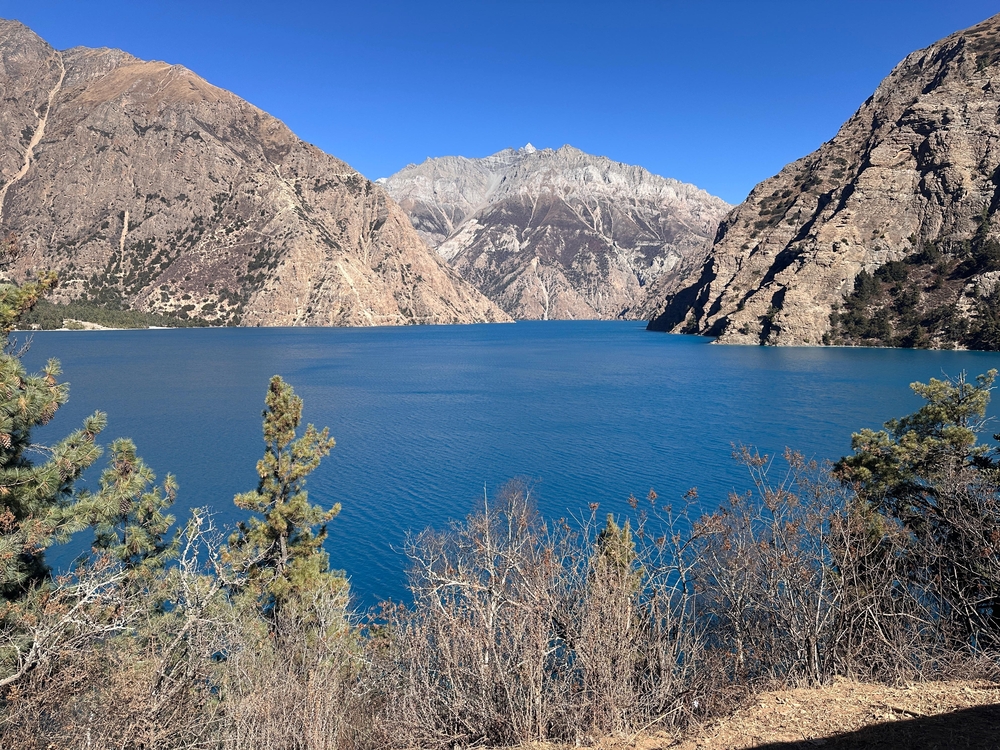 'Where will the remaining one and a half million rupees be delivered?', he said, 'Since there is no road, the transportation fee is expensive, so at least 10 lakhs should be spent to build the plan to build the headquarters in Dunai for one lakh, and the budget is also low.' He said that in the name of infrastructural development, the annual budget is spent on improving habitats, bridges, resting places, post construction and road construction.
Due to the lack of infrastructure, tourists are also forced to suffer when Phoksundo Lake, the main tourist destination of Karnali, is inside the park. Phoksundo Lake is 2 days walking distance from the capital city Dunai . Pushparaj Shahi of Birendranagar-6, who returned from Phoksundo 2 weeks ago, said that there is a problem due to lack of tourist hotels in Suligad, Chhepka, Kagri, Saldang, Sangra and other places while going to Phoksundo. "In the hotel you meet on the way, you don't get good food or fast accommodation," he said.
According to the park, about 1 crore rupees are collected from tourists in a year. Ranger Mahat informed that about 8 thousand tourists come to visit Phoksundo every year. According to him, 4,000 tourists have come to visit the park so far in the current financial year. Phoksundo Park is charging Rs 100 from Nepali tourists, Rs 1,500 from tourists from SAARC countries and Rs 2,000 from foreigners. "Even if there is no master plan, there is a problem in infrastructure development," said senior conservation officer Aryal, "The government never sends enough budget, and local resources are not reliable."

