We use Google Cloud Translation Services. Google requires we provide the following disclaimer relating to use of this service:
This service may contain translations powered by Google. Google disclaims all warranties related to the translations, expressed or implied, including any warranties of accuracy, reliability, and any implied warranties of merchantability, fitness for a particular purpose, and noninfringement.
2nd of January 1990. Journalist Bhairav Risal was playing with soil in the bari when the earthquake struck at 2:24:22. Born in 1984, Risal was only 6 years old when the earthquake struck. It felt like playing ping pong when the earthquake shook the ground he was playing on.
I was at home in Bhaktapur. I was playing by making clay bricks in the farm. All at once everything shook . The ground is completely shaking . I was wondering what could have happened,' Risal remembers that moment. This is all he remembers about the 1990 earthquake. "I don't really remember knowing anything else myself." I didn't even know it was an earthquake. I found out later,' he added .
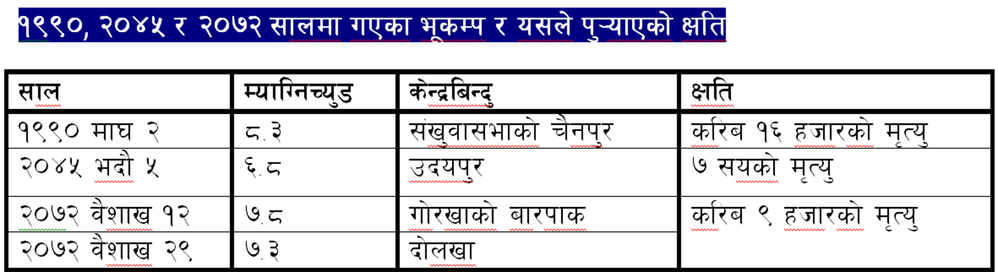
People like Risal, who belongs to the generation that experienced the earthquake of 1990, are rarely found now. However, the incident that happened 92 years ago comes back as a memory every year when the page of Magh 2 turns over in the calendar. The government of Nepal also celebrates the 'National Earthquake Safety Day' in memory of that day. Earthquake Safety Day falls on Wednesday this year. While celebrating Earthquake Day, Nepal is also being shaken by the 6.8 magnitude earthquake that hit Tibet in China last week. Reminding of major earthquakes. What were the four major earthquakes in Nepal in about a century? Why are there frequent earthquakes in Nepal? The facts of history are as follows:
Earthquake of 1990: 8.3 magnitude
In the book 'Nepal's Great Earthquake (1990)' written by Major General Brahmashamsher Jung Bahadur Rana (1966-2044), the Great Earthquake of 1990 has been described. ;. 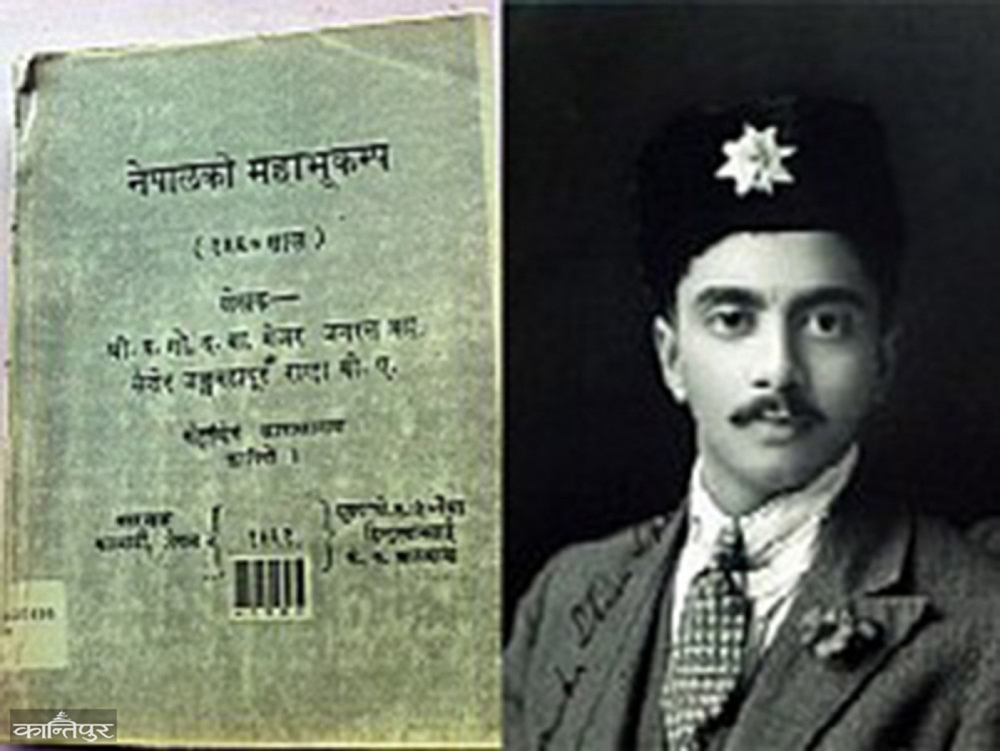
In a book published in March 1991, Major General Brahmshamsher wrote, 'At exactly 2 o'clock 24 minutes 22 seconds, suddenly there was a rumbling sound from the ground and at the same time an earthquake started - the Great Earthquake of 2nd January 1990 was created.'
This book of his has become a historical document that tells about 90 years of earthquakes in the history of Nepal.
'How strongly the ground shakes, the trees and plants flex as if caught in a wind . With the tips of the small plants, the land became like a shack," wrote Brahmashamsher in the book, "The water of the pond began to break out like a big wave. The house started to open and close like a door in the wind. The house began to fall rapidly while going down and up the ground . Even tall parts of potatoes fell down. The terrible sound of the house collapsing started coming like a cannon boom. It was dark because of the dust.'
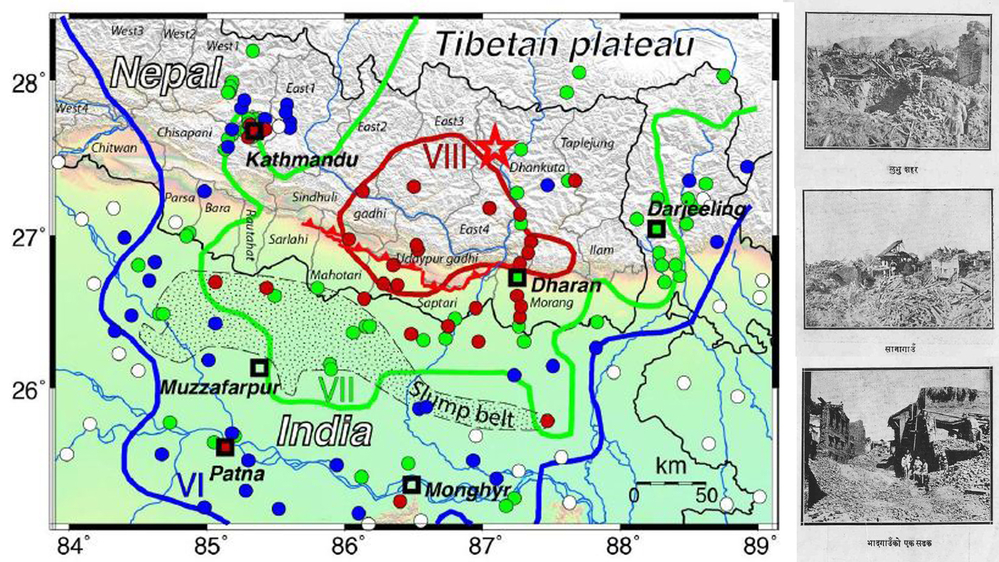
This earthquake of 1990 was centered in Chainpur of Sankhuwasabha in eastern Nepal. About 8,500 people died in this earthquake of magnitude 8.3 in Nepal. 7,000 people are mentioned in the research paper prepared by Lokvijay Adhikari, a seismologist who passed away in Bihar, India, for his studies at a French university. He is currently working as a seismologist at the National Earthquake Measurement and Research Center. According to the official, the 1990 earthquake is also known as the 'Bihar-Nepal' earthquake.
Explaining the reason for this, he said, "There was no such access in Nepal in 1990". About 4,000 people who died in Nepal died in Kathmandu. After so many people died in Bihar at that time, it was supposed that this earthquake occurred in Bihar. That's how the Bihar-Nepal earthquake happened.'
Earthquakes with a magnitude greater than eight are known as mega-earthquakes. Therefore, the earthquake of 1990 was a great earthquake. After that, the seismologist informed that earthquakes of 7-8 magnitude are called strong and others are called medium and small earthquakes after that.
'At that time, there was an earthquake measuring machine in India's Calcutta . It was the same machine that measured earthquakes near the epicenter. Because it was a big earthquake, this earthquake was measured even in Europe," says the seismologist official, "while measuring and studying it everywhere, it was found out that it went to Chainpur in Sankhuwasabha . This earthquake started in Chainpur and then the crack spread 200 kilometers to the east. The 1990 earthquake reached Chure. This is what was discovered by studying . As the crack reached the hills, the damage was more in Terai. According to seismologists, studies and research about earthquakes in Nepal have not been enough. The book written by Brahmashamsher is one of the strongest sources to know about the 1990 earthquake.
Major Brahmashamsher worked in reconstruction after the 1990 earthquake. He has covered the situation and damage in his book. As the
officer also mentioned in his research paper, the population of Nepal at that time was 59 lakh. About 4 thousand 296 people died in the Kathmandu valley in the earthquake that passed through the epicenter in the east. Similarly, 3 thousand 974 people died in the eastern hilly district. 65 people died in West Hills and 184 people died in Eastern Terai. 7 thousand 188 people died in Bihar, India.
Earthquake of 2045: 6.8 magnitude
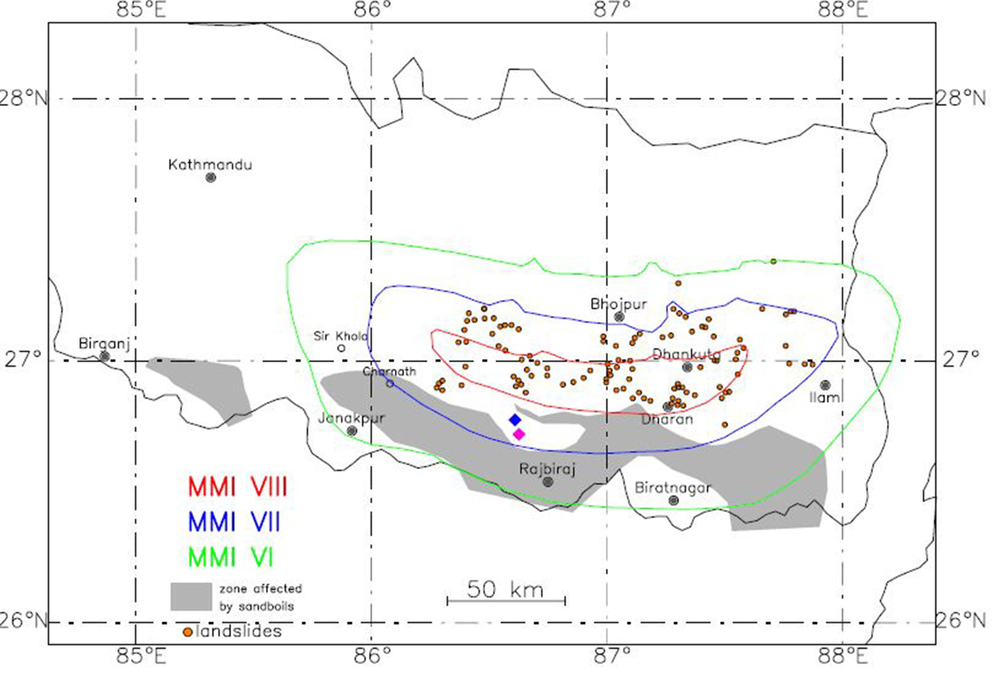
2045 An earthquake occurred at 5:55 in the morning on August 5, 2045. This is a moderate earthquake. It was 6.8 magnitude . This is a different kind of earthquake from the big earthquakes that hit Nepal," the official said while giving information about the Udaipur earthquake, "This is an earthquake that goes inside the Indian Plate . Its depth is also 57 km below . In other mountains and hills, the epicenter of the earthquake is less than 10 km.
More than 700 people died in the Udaipur earthquake. He says that this earthquake was felt in the north of India, Bangladesh and the eastern part of Myanmar. He says, 'It caused damage to Gaighat, the southern part of Udaipur and Dharan.' A team of scientists was able to map the impact caused by this earthquake. This happened to be the earthquake of Nepal's Geological Survey. The team led by Dixit observed the earthquake in an area of 5,500 km and identified more than 100 landslides in the northern Himalayan region.
Earthquake of 2072: 7.8 and 7.3 magnitude
This was a powerful earthquake that passed through the epicenter of Barpak in Gorkha at 11:56 on Saturday, 12th Baisakh, 2072 after the 1990 earthquake. An earthquake of 7.8 magnitude is among the earthquakes felt even by the last generation .
Reminiscing about the 2072 earthquake, Dilipshekhar Shrestha, former joint secretary of the Ministry of Urban Development, says, 'I was working on the Chandragiri Hills project at that time. A meeting was going on with the locals at Bottom Station in Thankot. We were on the fourth floor . Looking through the window, everyone was shaking . I was the last to leave the hall . At that time there was also an earthquake. It seemed like the house was going to collapse, but it didn't. The neighboring buildings were collapsing. It was seen that the entire dust was coming out in Kathmandu.'
In the year 2072, another earthquake of 7.3 magnitude occurred on the 29th after Baisakh 15. This earthquake which made the center of the gold mine of Dolakha was also felt in China, India and Bangladesh. Shrestha, who is also an engineer, says that the houses and buildings that were not damaged by the earthquake on 12th Baisakh helped to demolish the houses and buildings on 29th.
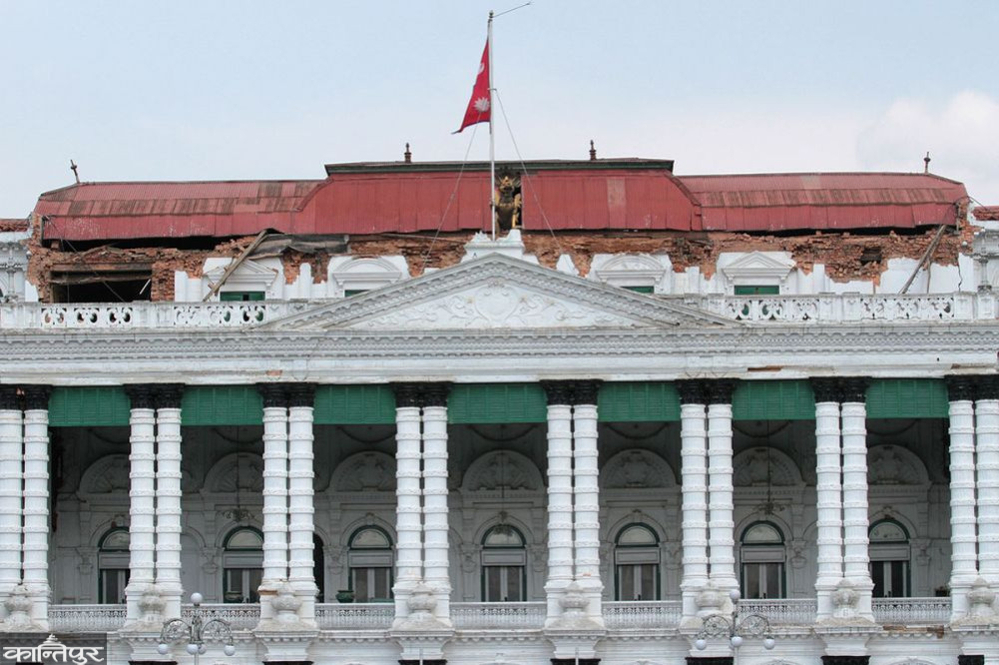
072 Earthquake Damaged Sinha Darbar
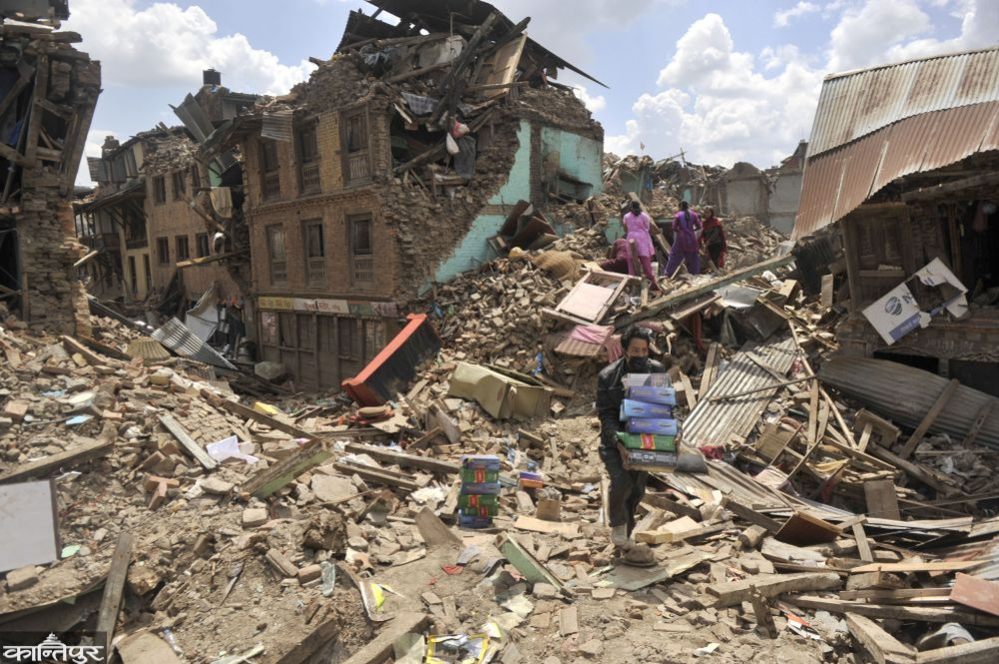
2072 Earthquake came from Barpak center of Gorkha. According to the National Disaster Risk Reduction and Management Authority, 8 thousand 962 people died and 773 thousand 95 houses, buildings and structures were damaged in the earthquake of 2072. 22 thousand 3 hundred 2 people were injured .
Seismologist Lokvijay Adhikari has prepared a research paper "Seismicity Associated with the April 25, 2015 Gorkha Earthquake in Nepal: Probing the Himalayan Seismic Cycle" about the 2072 earthquake.
According to him, this is the first earthquake that has been studied in detail after the beginning of earthquake measurement in Nepal. He also said that Kathmandu suffered more damage due to the Gorkha earthquake's crack moving from west to east. "The most measured aftershocks of earthquakes, with all kinds of data, is the earthquake of 2072," he said.
According to him, the earthquake of 2072 is an earthquake that happened in the place where the GPS record was recorded. It gives data on which earthquake cracks have moved to which direction . Earthquake measurement is measured in three ways. GPS measures earthquake movement . GPS measures where it has moved by looking at a point. Another seismometer measures the speed of an earthquake . Accelerometer measures distance traveled over time . It measures how much shock has gone to which place .
The earthquake of 2072 happened in the same place, which also happened in 1890 . The earthquake of 1890 happened at night. Because it is 11:55, it is mentioned that the earthquake occurred in the middle of the night. But there is no definite information about the earthquake. In the earthquake of 1890, there was a "force shock" ie a foreshock. This is the aftershock that precedes a major earthquake. A small earthquake occurred 25 minutes before the big earthquake of 1890. The man came out of the house . After that, the official says that there was an earthquake as big as the year 2072.
"Its center was in Mustang and its crack went from Mustang to the west," he said, "its crack reached Chure ." This is all the information about this. It is mentioned as a historical earthquake, but it is not mentioned anywhere how much damage it caused. GPS was placed in Kathmandu, Kakani and Chilime before the 2072 earthquake.
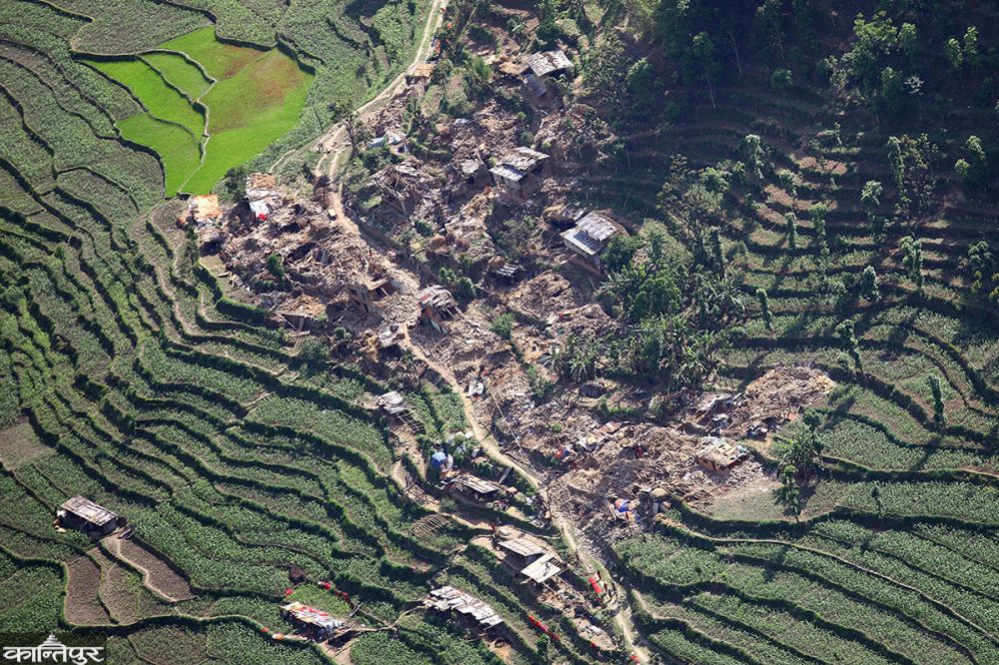
A settlement in Sindhupalchaek was damaged by the 2072 earthquake
'When the first earthquake occurred in 2072, it was found that the Kathmandu valley moved one meter down and rose up and moved 45 centimeters to the south,' he said while informing about the 2072 earthquake. He said, 'First it went 80 cm to the east and then it shook and got stuck 45 cm from the previous place. Cockney rose one meter 80 cm and Chilime fell 70 meters. One side rose and sat up . Looking towards Rasuwa from Dhunche, it was pressed towards the north and from there the part towards the south rose . Such measurements were done in the earthquake of 2072. He said that after the earthquake of 2072, more than 45,000 aftershocks have been measured.
Seismologists say that earthquakes occur in Nepal at different times. Seismologist Shiv Subedi said that the geographical location of Nepal is one of the reasons for earthquakes in Nepal.
'Earthquakes have occurred in Nepal in different periods since 1255 . King Abhay Malla also died in the earthquake," said seismologist Subedi, "If we look at the history of earthquakes, the 1505 earthquake is known as the biggest earthquake in Nepal.
Earthquake of 1505 years which is more than 8.5 magnitude, according to seismologists . In this earthquake, even the king of Tibet is found in the past history . But Seismologist Subedi said that there is not enough study material and clear information about the earthquake of 1505.
Why do earthquakes keep happening in Nepal ?
To find the answer to this question, it is necessary to understand the history of Mount Everest rising from the ocean. Five million years ago, the place where Nepal and Nepal's mountains were located was the Tethys Sea. According to seismologist Shiv Subedi, the Indian plate, which started 70-80 million years ago, collided with the Eurasian plate about 50 million years ago. The Indian plate and the Eurasian plate collided under what is now Nepal. When these two collided, the upper parts combined to form the Ice Range, which includes various high mountains, including Mount Everest.
'These two plates joined together . The lower part of the Indian plate tends to subduct under the Eurasian plate . It penetrates 2 to 4 cm every year,' he further explained, 'as long as this frictional force is equal to the accumulated power, it will not slip. There comes a point where the energy stored by the movement of the plate must be released . At that time, the power coming out will cause movement, which we call earthquake. He said that the movement caused by the friction between the two plates will become an earthquake outside the surface.
072 earthquake damaged Sankhu
of Kathmandu Similarly, the seismologist officer also says that it is necessary to understand the tectonic plates of the earth to know the reason for earthquakes in Nepal. "Earth's outer covering that contains both land and water". Outer mantle A sheet 80 km thick has been torn apart . Which is called tectonic plate . The more the earth goes in, the more the heat increases," the official explains the physics of earthquakes, "those plates move due to the heat inside the earth. As the plates move, some plates join together, some move away from each other . Some plates move right-left of each other . In which the two plates approaching are the Indian plate and the Eurasian plate . These two plates come close to each other . Thus, wherever there is a boundary of the plates, earthquakes occur at that boundary.'
Similarly, the Himalayas of Nepal are a place where two land plates are meeting. At that time there was friction between the oceanic plate and the Eurasian plate. But in five million years, the land of the Indian plate collided with the Eurasian plate and then the two land-land plates joined. 2500 km long ice chain from Afghanistan to Myanmar, in which 800 km area is the ice chain of Nepal .

