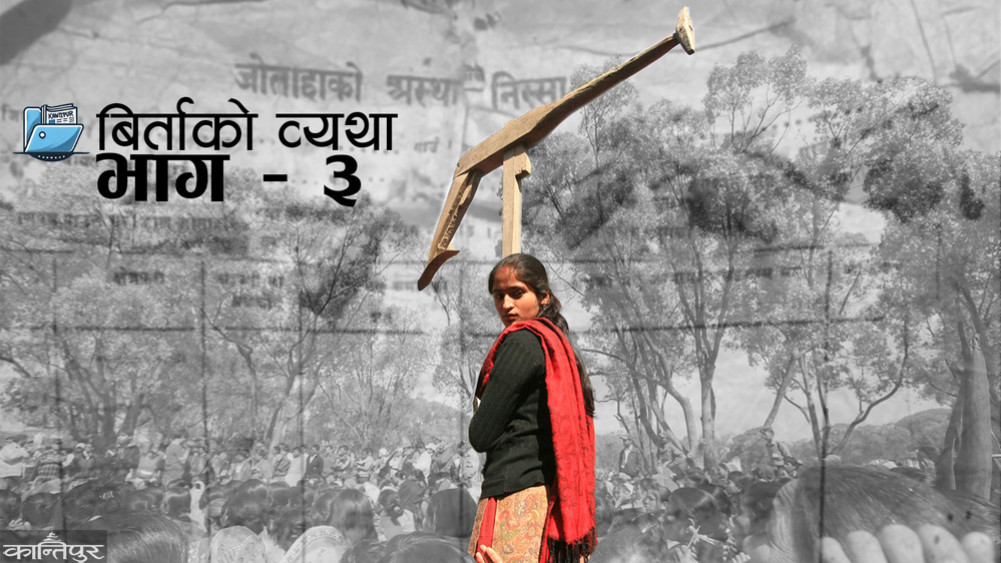
The farmers of Rasuwa are bound in the ancient chains of Birta
We use Google Cloud Translation Services. Google requires we provide the following disclaimer relating to use of this service:
This service may contain translations powered by Google. Google disclaims all warranties related to the translations, expressed or implied, including any warranties of accuracy, reliability, and any implied warranties of merchantability, fitness for a particular purpose, and noninfringement.
The 250-year-long rule of Prithvi Narayan Shah's descendants - Darsantan - has ended, but the cultural remains of the exploits left by him remain in the republic. That is the residue - Birta.
The land on which the farmers had sweated was in the possession of Birtawal until 2016, even after the abolition of Birta, it remained under their control and the farmers have been working hard for years. According to the law, many farmers who farmed on Birta land, which was abolished in 2016, still have not been able to register the Birta land in their name . In 2034, the land was surveyed, the state registered the land in the name of Birtawal and the name of the plowing farmer was registered in Mohi . Even the post-abolition law could not bring justice to the lives of dependent farmers.
The sighs and sorrows of the farmers of Rasuwa, bound by the ancient chains of Birta, have not been able to be washed away by the Betrabati and Trishuli that flow through the same land . Birta's legal chain and entanglement could never be his own Pakho's Lalpurja. Wrapped in chains, Shantakumari of Manigaon, Uttargaya Rural Municipality-4, went to the court several times to register the plowed land in her own name, but she is still puzzled by not understanding the legal entanglements.
As Glan found out, 3 generations of his family tilled the land. In the year 2020, a big landslide happened in the village. His family built a farm after removing all the landslides. Glan's question is, "Does our owner know that farm of his with Lalpurja?" Bhoomi Rights Forum - Treasurer of Rasuwa It has been 16 years since he joined the land movement.
'The law was trusted . He thought that the law was on the side of the poor like us. But now it seems that the law also serves the rich,' Glan says, 'I haven't even read it.' Even though I didn't study, after joining the movement, I was able to speak my words in a place where there were 4/5 people. All our land was within Birta, after many years of protesting, we took the remaining part of the registration exemption, that too only of three parts . Many lands are vacant. My demand is that I should get Lalpurja and my son generation should not have to fight for land.'
"During the conflict, the Maoists used to come from house to house, they said that when our Sarkhar comes, we will bring the parts of Birta home". But, everyone is just saying,' Glan concluded.
The story of Harimaya Thing of Uttargaya Rural Municipality-4 Manigaon is also the same. Aggrieved, she says, 'We farmers want red parts of our land not from Birtawal, but through the government, and we are protesting for that.'
000
It is known from the Birta example of Rasuwa that even though there has been some reduction in the ruling and exploitative activities of the landlords in Nepal, the side effects of feudal land relations remain. Even after 65 years since the abolition of Birta, Birtawals who do not cultivate themselves are pressuring the farmers to leave the land they are cultivating by registering the land illegally. Thus, there is a history of farmers suffering a lot of hardship and hardship due to the birta system, which was distributed according to the decision of the rulers.
The Birta Abolition Act introduced in 2016 by the BP Koirala-led government as a key to ending zamindari haikom and exploitation is considered an important effort among some of Nepal's land reform efforts. Analyzing the Birta Abolition Act, there are basically three purposes of implementing it:
First: A lot of the state's land was lost, so to restore the state's lost rights on that land . It would be easy to regulate the said land by converting it into rakers.
Second: Basically the state did not get anything from the Birta land . Therefore, the purpose of abolishing and taking tax from the land .
Third: At that time, the main part of the tax was the land tax, so ending the middleman role between the state and the farming farmers .
However, the law could not be effectively implemented everywhere. Since the government does not have a reliable record of Birta land, Birtawal and the actual cultivator, Birtawal registered the land by pretending to have cultivated it himself. Due to the lack of records, the restrictions could not be tightened .
'The law was trusted . He thought that the law was on the side of the poor like us. But, now it seems that the law also serves the rich.' -Shantakumari Glan
Jhalak Subedi, the author/analyst of the book 'Bhoomi, Kisan ar Rajya' says, 'The land that Birtawalla had, remained with her like a slave. Why the land in addition to Birtawal could not be in the name of farmers was a question related to land reform. Abolition only required another law to give land in the name of the farmers who were cultivating the land. That Act came in 2021, but the implementation of that Act was obstructed by Bhoomipati connected with the Palace and the Palace also did not want to irritate the Bhoomipati.'
It is written in the preamble of the Birta Abolition Act, 'An Act to end the feudal custom of enjoying land without paying state taxes for the sacred purpose of maintaining good relations by creating a sense and status of equality among the people of different classes and maintaining and strengthening the convenience and economic interests of the people. has been formulated .'
Back then those who earned land did not pay taxes to the state, instead they collected taxes/crops from the farmers and ate them. In the Act, it is said that "Birta land" means all kinds of land that has been acquired or is entitled to by paying less than the land that is owned by the government property or by paying less than the property of the same type of land in that place. Birta is divided into 'A' category and 'B' category . "A" category land means "the land that has been acquired or taken in such a way that it can be used up to the agreed amount, regardless of whether it has been obtained, or the amount that has been collected and eaten according to the amount of the amount, the government has to pay or do not have to pay anything and also the unclaimed land and the forest land"  ; And all other birta land except 'A' category land is mentioned as 'B' category . It is written in section-3 of the 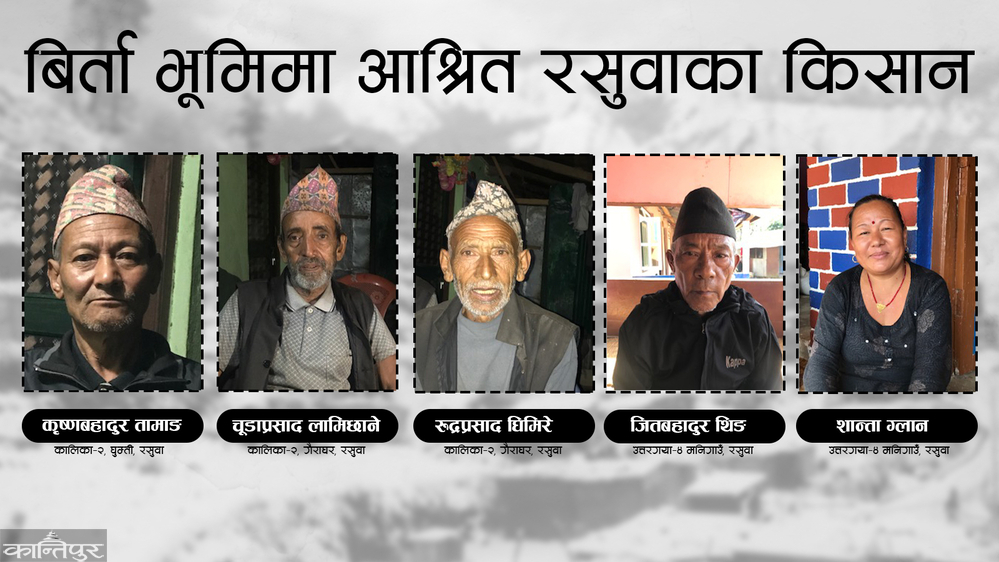
act, "Birta practice has been abolished from the date of commencement of the act". All the birta lands abolished in this way will be converted into rakers and the land ownership will be transferred to the government and the rights and rights related to the land ownership of the birtawals in such birta lands before the commencement of the Act shall be deemed to be automatically terminated.'
Analyzing the provisions mentioned in the law, the main purpose of the Birta Abolition Act is that if the Birta land is being cultivated, it will be converted into a raker in the name of the farmer, if it is not being cultivated, it will be fully owned by the government, and the Birtawal is cultivating it himself and if there is no mohi, then the Birtawal There is a provision to register up to the specified extent.
'We farmers want our land not from Birtawal, but through the government, we are protesting for that.' -Birtawala who does not even know the limit has registered . The land registered in this way is still being earned by the descendants of Mohi. Farmers are still suffering due to such dual ownership. The owner of the real land, the farmer is without rights.
Amendment of Birta Abolition Act of 2016- Section 7 of 2049 added the provision that 'land earners are allowed to register Birta land', according to which a person who earns Birta of 'B' category must submit proof that he has or is aware of within the period specified by the Government of Nepal after the commencement of this section. And the lot number of that land, the name of the owner of the four forts, the surname, the country, the land, and the tiro also open such land in his name. It was said that an application should be made at the goods or goods office of the relevant district for registration.
'However, taking advantage of this added system, on the contrary, it seems that the landowners are planning to keep the land under their control . The farmers, who have no knowledge of the law, and are always stuck in their fields and struggling to earn a living for themselves and their families, did not know about these legal arrangements,' says agronomist Jagat Deuja. Instead of getting the land surveyed in the name of the farmer, he pressured them to get the land surveyed in the name of the farmer. After that, it seems that more and more farmers are being deprived of ownership.
Birta Elimination Regulations, 2017 has been made to register the Birta land in the name of the farmer. According to Section-3 'A' of the regulation, there is a provision regarding the registration of 'B' category land in the name of the person who earns the land. 3 According to (1) of 'A', when the person who earns the land of 'B' category, applies to register such land in his own name, according to section 7 'A' of the Act, it must be disclosed that it is a land, land, acknowledgment, zonal book or land. As long as there is any other kind of record to come, such record should be attached . And, (3) If it is found that the land applied for registration according to sub-rule (2) is unclaimed, even if no evidence was submitted while making the application according to sub-rule (1), such land shall be registered in the name of the applicant.
Under the special provisions for registering land under section 12 of the Birta Abolition Act, 2016, 'B' category land that has not been registered in the name of anyone by the end of June 2049, is registered only in the name of the person who earns the land, under the Birta Abolition Act, 2016 It will be registered according to Section 7 'A' and after that period, the 'B' category land will not be registered in the name of any person and even if it has been registered, it will be recognized. It is clearly mentioned that it does not happen. However, the farmers complain that they are not able to register the land . The farmers of Rasuwa have only one complaint, 'Malpot did not help us when we tried to register the land, the submitted application has been put on hold without taking any action.' In order for the person to register his name in accordance with sub-section (1) of section 7 of the Birta Elimination Act, 2016 at the relevant customs office within the middle of Chait 2066 According to the restrictive phrase of section 12 of the Abolition of Taxation Act, 2016, the concerned land office has been given a deadline till the end of March 2067 to finalize the action of the petitions that have to be submitted and converted into land registers in accordance with the restrictive phrase of section 12 of the Abolition Act, 2016.
For that, a notice was also published in "Gorkhapatra" on 30th January 2066. The farmers had completed the necessary procedures within the prescribed period and applied for the transfer of the acquired land to their names.
However, the land campaigner Sushma Neupane says that Malpot has put the farmer's request in Tameli saying that 'the buyer has already made the parts and took them away'. She says, "After repeated delegations and memorandums of the farmers, the eighth amendment of Birta Eradication Schedule, 2017 was made in 2066". With this amendment, some farmers were able to register their land.
In Article 51 of the Constitution of Nepal 2072, in (e) of the state policies, in (1) of the policy on agriculture and land reform, it is said to end the dual ownership of land and take into account the interests of farmers and scientific land reform. In (2) it is mentioned to increase production and productivity by discouraging absentee land ownership. However, even after so much time has passed since the constitution was made, there is still dual ownership in Birta, Mohi, Guthi and other lands.
Land Administration Guideline- 2045 in Section 3 of Chapter 3, there is a provision regarding the procedure to be followed when converting Birta land into raker, according to which (a) in the case written in Chapter 2 (b), the Mohi must take from the Birtawal with proof of 'B' category land before making a claim. If you come to make a claim, if you have a grandson, you will also have to pay the fees, as per the circular dated 2026/7/11 from the Department of Anti-Vidai Birta Abolition Act, Rules and Regulations from 2016. Registration should be done as a landlord in the name of Birtawal in order to take it. (b) In relation to the 'B' category Birta land, since the Birtawal has not given details so far, if the Mohi who earns the said land applies for the Birta Abolition Act, 'Convert the land into a raker and get it registered according to the provisions of the rules', if the birtawal has also understood that the land has not been converted into a raker and registered (Birta If it is approved as land) if the son-in-law is absent, if he comes to fight and the claim is not filed, as the owner of the land in the name of Mohi, 2016 Registration should be done by taking the tiro from the year. Kush-BREAK (c) is a safacts tax law on the use of goods department (data field) in a group of land has been spoken by a group of land. & NBSP;. & nbsp;
scientific land reform (Besendra Bannet), 2067), 2067). In the report, the issue of departing land registrations have been present in the report of the report registration, "the issue of the Commission of the Commission has been stated in 'B' of the Commission of Country, so far the registration of the registration of the Commission. Guti etc.) etc.) On the basis of the connection, arrangements arrangements to register the term and NBSP;. However, the Berndra Bastern leadership has not been implemented so far and NBSP;. & Nbsp; 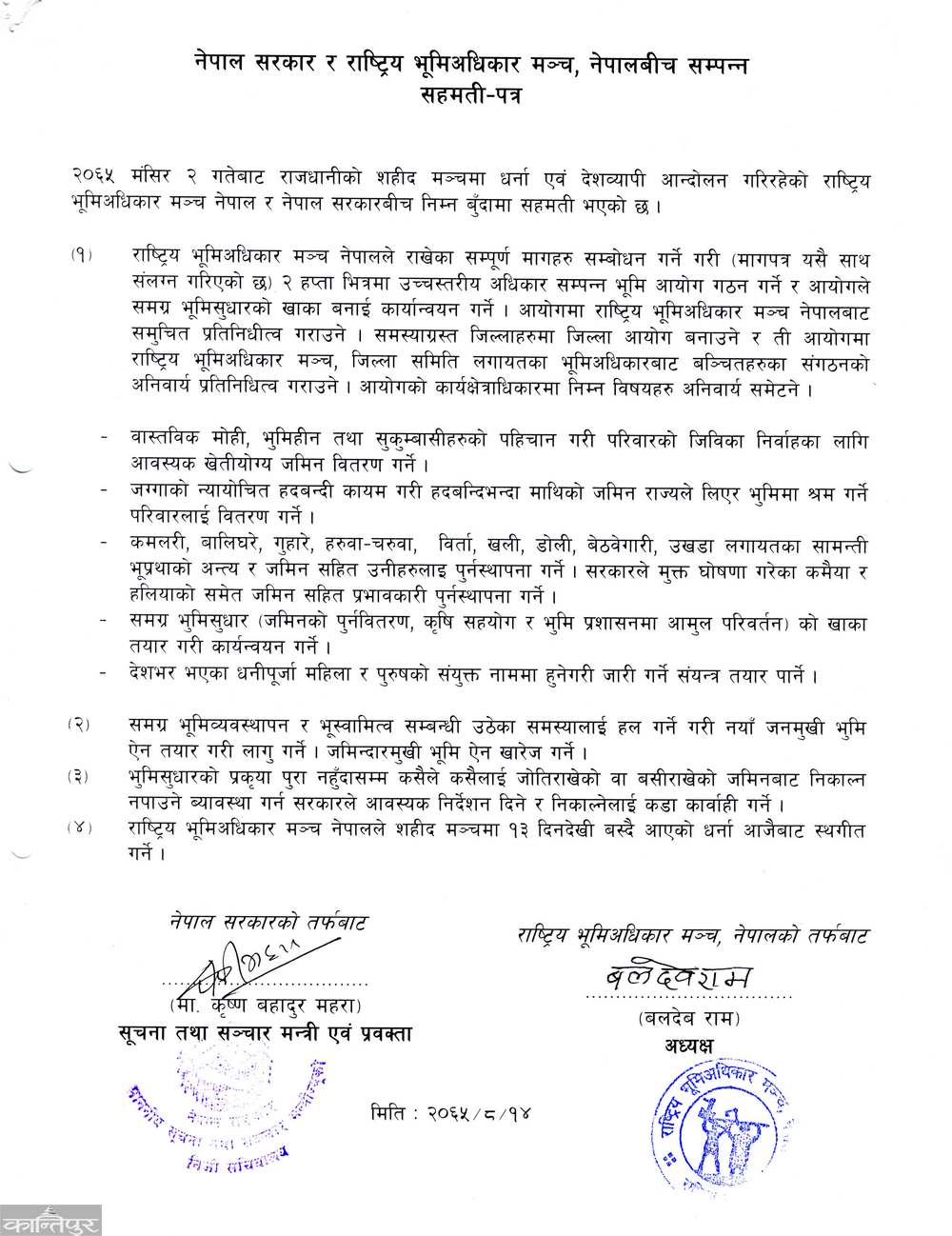
000
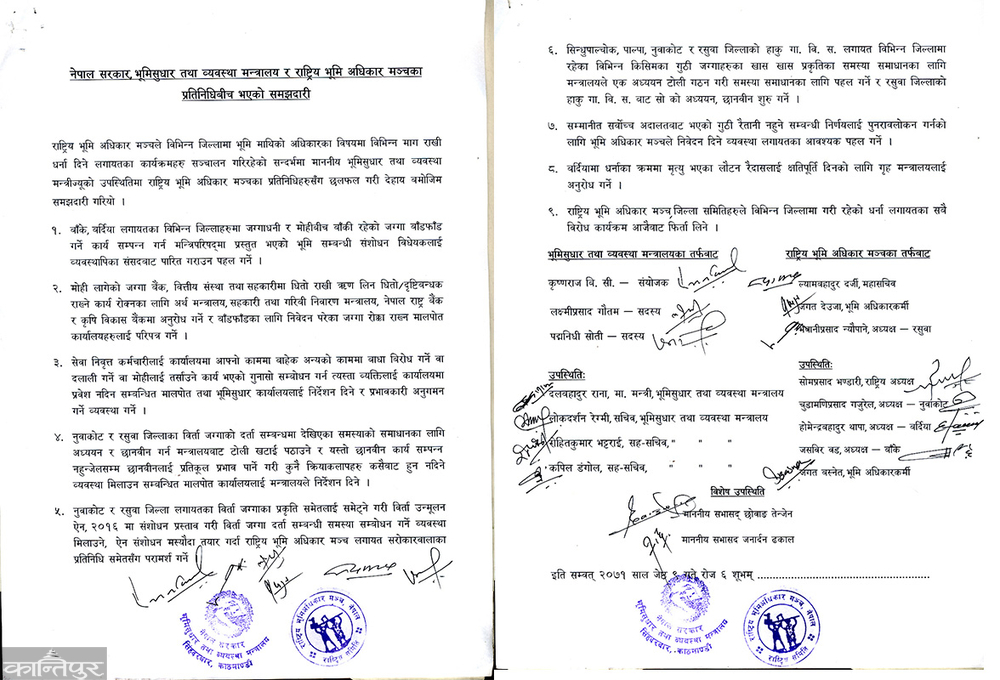
2071 Parlo, Nasukot and Rasukar, Sarcute, During 3 to 26, dug out and Nbsp;. After one week of a week, after a weeking force, there was 9-point agreement between the Ministry of Overlay and Land Rights Forum Forum for Nbsp. The point of agreement. In 4 and 5, the issue of solution was included in solutions and nbsp;. . According to the Ministry of Nuwakot and Rasuwa district, the ministry states that the ministry is allowed to provide information from the Ministry of Nuwakot and Rasuwa district. And, the point no. Milan, said that the amendment of Buti land registration facilities, including the nature of Nuwakot and Russia, 2016, and Nbsp ;. Counting the agreement made by the government at the time (NBSP;. & Nbsp;
is also mentioned that in December 14, including 2065 BS, 2 and National Land Rights Deputy Statement, and Nbsp;. The agreement could not be implemented if it was agreed to add the commission within a 2 week and NBSP; 5; सम्झौताको बुँदा १ को उपबुँदा ३ मा लेखियो– कमलरी, बालिघरे, गुहारे, हरुवा, चरुवा, बिर्ता, खली, डोली, बेठबेगारी, उखडालगायतका सामन्ती भूप्रथाको अन्त्य र जमिनसहित उनीहरूलाई पुनःस्थापना गर्ने । However, this agreement could not be implemented (NBSP;. 'This demand could not understand the multipletical change policy and government employee of Nepal,' National Land Rights Rights, which is not true and nbsp;. '& Nbsp;
WIDGGE विजा, aim to adopt the owners of farming on the bottle lands, a purpose in the bumming land. "Buerwal that does not cultivate the ground is illegal and NBSP;. The illegal registration should not be recognized that the action to help in the bibliors and the process should be taken and NBSP;. And, it should be registered on the basis of the recommendation of local levels in the name of the real farmer in the name of the Actual farmers and Nbsp ;.. No judge in any way to connect illegal registration with property, 'he says and nbsp;.
Advocate Officer says: However, since Rasua and Nuwakot saw the situation of Rasua and Nuwakot now, the dual owners of the land owned there and NBSP;. So as so, the current legal system seems to be half of the crocodile half and nbsp half of the bisner and nbsp;. & Nbsp;
Advocate Verifie Prophet Poudel says: 'The state should solve the rest by discussing with the fox and land, and NBSP;. The solution can be simple in the case that Buerwal registered the ground is simple and NBSP;. '& NBSP; In order to register the elimination of Burti Bhavadist Act, 2016, the government has been disressed in the name of Burti-Rasuwas, while the evidence is released in the name of the farmers, the government will be cultivated by the land that he has been cultivated by the land. If so, Kun should also solve a problem problem and solving a coming problem and nbsp;. & Nbsp;
farmers also say - Prithvinarayan Shah's labishness must not be in the republic and the cake of traditional laws and nbsp;.