Israel and the US appeared to assume that victory against Iran would be achieved in a short period of time through the use of overwhelming force, but the course of the war over the past two weeks suggests that their assessment was wrong.
We use Google Cloud Translation Services. Google requires we provide the following disclaimer relating to use of this service:
This service may contain translations powered by Google. Google disclaims all warranties related to the translations, expressed or implied, including any warranties of accuracy, reliability, and any implied warranties of merchantability, fitness for a particular purpose, and noninfringement.
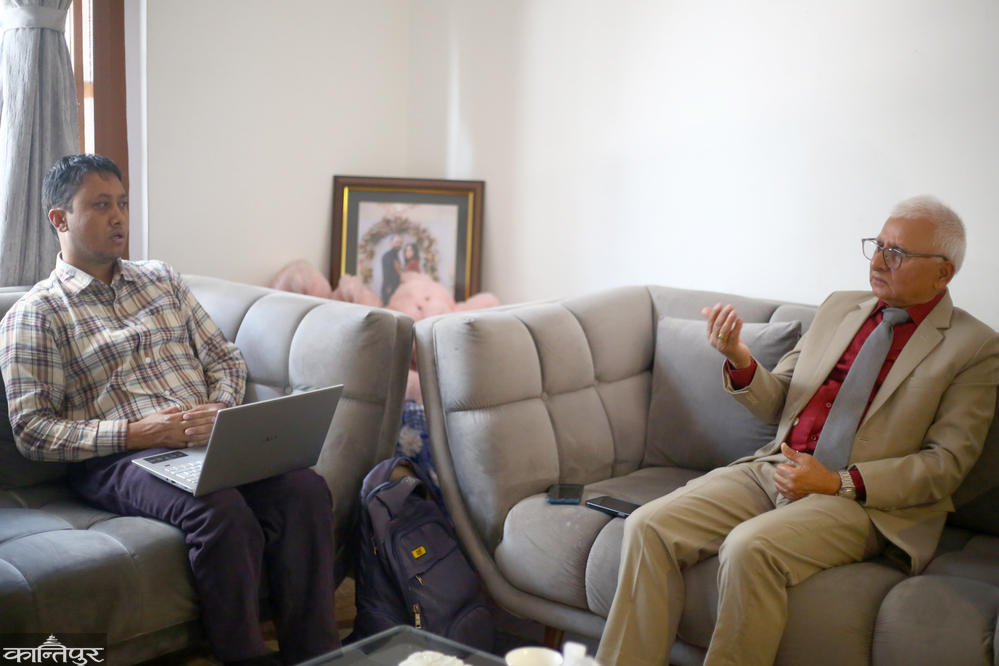
The US and Israel's attacks on Iran and the Iranian counterattacks on Gulf countries where US military bases are located have created tension in the Gulf countries for the past two weeks. One Nepali has already died and at least 15 people have been injured. With no way to predict when the attacks and counterattacks will end, more than 1.7 million Nepalis and their families in the Gulf countries, which are the main labor destinations of Nepalis, are currently in fear. How far will this situation spread, how will it affect Nepalis, and what should be the diplomatic and rescue preparations? Dr. Naradnath Bhardwaj, former ambassador to Qatar, spoke to Kantipur's Home Karki and Kishore Dahal about these issues: After the US and Israel's attacks on Iran, Iran has been targeting Gulf countries in retaliation. Having served as ambassador to Qatar, how much risk do you see of the crisis there turning into a regional war?
The Israeli and American attack on Iran has a deep meaning. It is not only a regional war, but if the current tension does not end quickly, it cannot be said that it will not lead to a world war with the involvement of other major powers. Because Israel and the United States have assumed that victory against Iran will be achieved by using excessive force in a short period of time.
But looking at the process of the war in the past two weeks, it seems that their assessment was wrong. Iran's internal military power had been in a state of preparation for a long time. Therefore, I see that the war has reached a more serious situation since Iran has succeeded in counterattacking many American military bases, important spy agencies and economic centers in West Asia.
There are millions of Nepali workers in the Gulf region. What risks do you see in their lives and other security in the current situation?
There are 1.7-1.8 million Nepalis. Of these, there are a large number of Nepalis in Saudi Arabia, the UAE and Qatar. The workers are mostly housed in simple temporary structures in those countries. There are no structures prepared for war anywhere in those countries. There are no bunkers. However, the attacks are focused on American bases. But when a missile explodes in the middle or its parts fall, it can have an impact.
Qatar, Kuwait, and Bahrain are the same city. There are some 'cluster city areas'. There is a high population density in those areas. That can definitely affect Nepalis. On the one hand, there is a possibility of direct impact of the war. On the other hand, there is an increased possibility of Nepali workers becoming unemployed as victims of the economic stagnation brought about by the war. On the other hand, all electricity in the Gulf is generated from gas. If a gas plant is attacked, there may be a situation where there is no electricity at all. At that time, it can be very difficult to live without AC in temperatures above 40 degrees. When we send workers to the Gulf, we also saw the need to provide them with orientation training on safety and self-defense.
As tensions increase, it seems that the labor market in the Gulf region is also being affected. How much risk could the employment of Nepalis, who are predominantly in sectors such as construction, services, and domestic labor, be at risk?
The limited number of domestic workers and people in the service sector may not be immediately evicted. But most of our Nepali workers work in the construction sector. They work in gas plants. If there is an attack there, the safety of the workers working there will be questioned. In this situation, the responsibility of rescuing them and taking them to a safe place lies with the concerned country. Our state should take responsibility for that. How prepared are we for that? This is an important issue.
I am not aware of any preparations for the situation of rescuing them. Nepali embassies are operated with limited resources. Most of the revenue equivalent to the operating expenses of embassies in the destination country of labor is raised there. The government does not have to bear the burden from here like in other countries.
Despite that, there are no necessary resources and structures to adopt the necessary safety measures, to provide shelter and security to the displaced and abused workers. There are no facilities and structures in the Nepalese embassy to provide shelter to more than five/seven people.
Therefore, such facilities should be prepared in our embassy. What should we do immediately if there is a situation where our workers who are at risk at work need to be transferred to a safe place? In such a situation, we have to rent some of the available structures there and be prepared. It doesn't seem like that's happening.
Our government is doing it. What is the status of the orientation training related to security provided by the destination country or the employer company?
When we sent workers to the Gulf, we saw the need to provide orientation training on their security and self-protection. It doesn't seem like the government has paid attention to it yet. The Ministry of Labor has come to a point where it has to take this very seriously.
Earlier, we considered Iraq a very risky country and became a bit stricter in our labor policy. Looking at the current situation, the same kind of risk is seen in the Gulf as much as there is risk in Iraq. Should the government only understand this as a special situation or should it think differently?
I see it a bit seriously. I don't see the possibility of reaching a solution soon. The overall geopolitical issue is determining the current situation, not the economic situation there. The current situation is not due to mutual disputes between the labor destination countries or their economic crisis. It is due to external interference. The current situation has arisen from the ambition of a power to keep the Gulf region within its sphere of influence and to monopolize its resources. Therefore, I think the current situation will last for a long time.
Iran is the biggest power in that region. It has a long history. It has existed as a powerful empire for almost five or six centuries.
I don't think that in a short period of time, a small power will take control of it and the situation will change, and our workers will come back to normal conditions and they will be able to experience their jobs and security as before. We need to make long-term plans with a little foresight.
Where do you see the security crisis in the Gulf region heading?
I feel that the war is deepening. It seems that the US has previously implemented a 'shock and a' policy on Iran, that is, a policy of using very large force to destroy it in a short time and force it to surrender. The US had already adopted such a strategy to achieve its objectives in Syria, Libya and Iraq. It adopted the same strategy in Iran as well.
When the attack was carried out last June, three major nuclear facilities in Iran were targeted. America's 'reading' is that Iran is trying to make a nuclear bomb, enriching uranium, modifying it, it has already been enriched to above 60 percent, after enriching it to 90 percent, it will be suitable for making an atomic bomb, if it is allowed to go further than this, Iran will become a nuclear-armed country, if that happens, the balance of power in the Middle East will be disturbed. On the one hand, Nepali workers are likely to be directly affected by the war, on the other hand, the possibility of becoming unemployed due to the economic stagnation brought about by the war has also increased.
America is supporting Israel as the main power in the Middle East. Israel has a Jewish population, and they are also exerting a great influence on the politics there in America. For Israel, it seems like America is fighting this war against Iran. This is also the analysis of the world's famous strategic scholars. I agree with such analysis. This war could be long and very destructive.
In such a situation, do you see that Nepal has come to a situation where it has to do its homework to immediately rescue its citizens? Or should we still remain in a state of 'wait and see'?
We are in a situation where we should not just remain in 'wait and see', but should start preparing. In the current situation, even if there is a single major attack, the situation there could take an unimaginable turn. We need to understand that possibility. I would like to give the example of Qatar. There is an American barracks in Al Udayt, Qatar.
It is also the largest airbase. There are 10,000 Americans there. There is a large air defense system and radar system there. This war could take a more complicated turn. It could spread. Iran is now attacking from time to time. If attacks on labor areas, industrial areas, and residential areas start to increase in intensity tomorrow, it could take a big form.
What is the role of the employer, destination country, and our country in ensuring the safety of Nepali workers currently in the Gulf region?
Our Ministry of Foreign Affairs needs to maintain high-level diplomatic dialogue with the governments of the Gulf countries. We need to strengthen our embassies.
In each embassy, we should be able to provide immediate shelter to at least 100 to 150 people. I see that we should start building a structure that can be expanded as needed. If the war becomes more complicated and a rescue situation arises, we should cooperate with India. If there is a situation where we need to relocate our workers who are at risk at work to a safe place, we should rent some of the available structures there and be ready.
In 1990-91, Iraq attacked Kuwait. At that time, India rescued more than 170,000 Indians. From this experience, it is clear that air rescue alone is not possible. Even now, air routes are blocked. There is a lot of risk in the 'war zone'. Now that Nepal Airlines is going, that is a big risk. Looking at the situation there, it is a very big risk. If we coordinate with the Indian government and make necessary preparations, we can manage even in the event of an emergency. We will not be unprepared.
Although the issue of rescuing millions of Nepalis and bringing them to Nepal is idealistic, it is practically difficult, and there is also an analysis that Nepal's capacity is not possible to do so. Objectively speaking, can we do that with our capacity?
We do not have the capacity to rescue everyone at once. However, what message will be conveyed to the families of Nepalis living there if we say that we are not capable of rescuing our citizens? Therefore, the government should assure that we can and will rescue to the maximum extent. How much we can, will be determined by the situation behind us. But our commitment should be that we will not hesitate to make any effort to rescue our Nepali brothers in times of distress. We should keep looking for alternatives for that. That should not happen by procrastination.
Some time ago, I heard the analysis given by the Ministry of Foreign Affairs that there is no need to rescue Nepalis yet. But the situation has become very serious. The US is saying that if Iran cannot be brought to its knees through air war, it is thinking of landing its army on the ground. At that time, 'artillery' will start being used. The situation could become more serious if that happens.
In the past Covid crisis, the rescue work was also very complicated. What should we have learned from that? Is that preparation visible now or not?
The management of short-term shelters is the most important. Resources should be managed to keep them. They should be rescued in their own country or in a safe nearby country. For that, we need to cooperate with other countries and engage in diplomatic preparations.
Are the rescue mechanisms we have created effective? Our commitment should be that we will not hesitate to make any effort to rescue our Nepali brothers in times of distress, we should keep looking for alternatives.
I have not seen them effective. Now I am saying the same thing, it has become a mechanism in name only. There is a need to create a legal structure in the Ministry of Foreign Affairs to resolve the emergency situation. The actions taken should be legitimate. There should be no legal challenge. Apart from that, people at the diplomatic level should be represented in those countries by giving short-term responsibilities.
A bridge of people who play the role of egoists should also be prepared for resource, diplomatic and geopolitical balance. I have not seen such preparations. And now the biggest issue is that when such an incident is happening, the Ministry of Foreign Affairs does not seem to have thought about calling experts in that field and at least getting suggestions and assistance, and using their knowledge and expertise.
How should Nepal now establish a balanced diplomacy with the Gulf governments or other powerful countries by keeping Nepalis at the center?
We should not show favoritism. As a diplomatic force of our country, we should be able to 'maintain' our neutral stance and stand strongly in favor of humanitarian obligations. If human rights are violated, we should take a clear stance. It is very important not to give our statements in a way that appears to favor any powerful country. As far as Iran is concerned, Iran is a country with a great history, civilization and heritage.
Many of the world's most important and valuable arts and cultures are still in Iran. Iran is not an entity that can be easily defeated or easily destroyed. Therefore, in our relations with Iran, we should conduct our foreign policy in a way that respects its right to protect its sovereignty without any kind of insistence or prejudice.
We should take our relations with the Arab countries, our main destination, on the basis of ‘give and take’. We should not be too grateful to them for giving us a market for labor. The blood of our Nepalis is at the foundation of their innovation, modernity, and prosperity. It is necessary to make them feel responsible for that. How can we create our ‘labor force’ in our relations with the Arab countries? Our foreign policy without ‘labor force’ has never been successful.
Labor force is our ‘labor force’. That ‘labor force’ is what we should use. The Philippines has used its labor force as ‘labor force’. It effectively retaliates if its workers are mistreated or exploited. It protects them. It rescues them in times of need. I find a kind of mentality among the workers that all countries should have a responsibility towards their workers like the Philippines.
We currently have a government whose main responsibility was to hold elections. Other weaknesses are not discussed much. Therefore, the new government coming in will have to play an effective role by taking the adequate or inadequate work done by this government into its institutional memory. What should be the role or priority of the new government regarding the security of Nepalis in the Gulf tensions?
We have a past experience of losing our institutional memory with the arrival of a new government. We need to break it and move forward with the new government. If we cannot do this, the multifaceted crisis created by the Gulf crisis could be a big test for them.
Our Nepali workers in the Gulf region will not only be displaced and unemployed, but their very lives and security may be at risk. Similarly, the oil supply chain is becoming disrupted. This will lead to the devastation of all industries, from food to transportation, tourism, and services. And, we need to prepare to deal with it. For that, the new government should start strengthening diplomatic outreach from the very beginning.
You said that we should have strong diplomatic relations with Arab countries. However, in the past decade, ambassadors have not been able to complete their full term in major destination countries. What is the impact of changing ambassadors in such a complex situation?
In such a crisis situation, most countries do not have ambassadors. The lack of ambassadors is affecting the representation there. On the other hand, it also creates obstacles in communicating accurate information to the higher levels by analyzing and evaluating the situation correctly. To overcome this, it is necessary to appoint ambassadors as soon as possible. If ambassadors are not appointed, if we can send responsible people to the crisis site temporarily, it will help us move forward according to the situation.
This is also the established trend of returning our ambassadors earlier than expected. What is the impact of changing ambassadors in the diplomatic sector?
The diplomacy of a country is to introduce its political power to another country. To expand its influence there. From that, it is to gather the support needed for its national interests. But changing ambassadors constantly reduces the ability to influence. The government there also starts a tradition of distrusting our diplomatic capabilities. This is why our diplomats are unable to effectively work with the life, society, and political system there, openly and confidently.
When I went to submit my ‘credentials’ as an ambassador, the Foreign Minister of Qatar asked, ‘How long have you been here as an ambassador?’ I replied with a laugh, ‘As long as the government sees my need, I will keep you here.’ He also laughed. This indicates that we are not pursuing a stable diplomacy. We are not creating a good image. Stability is very important not only in politics, but also in diplomacy.

