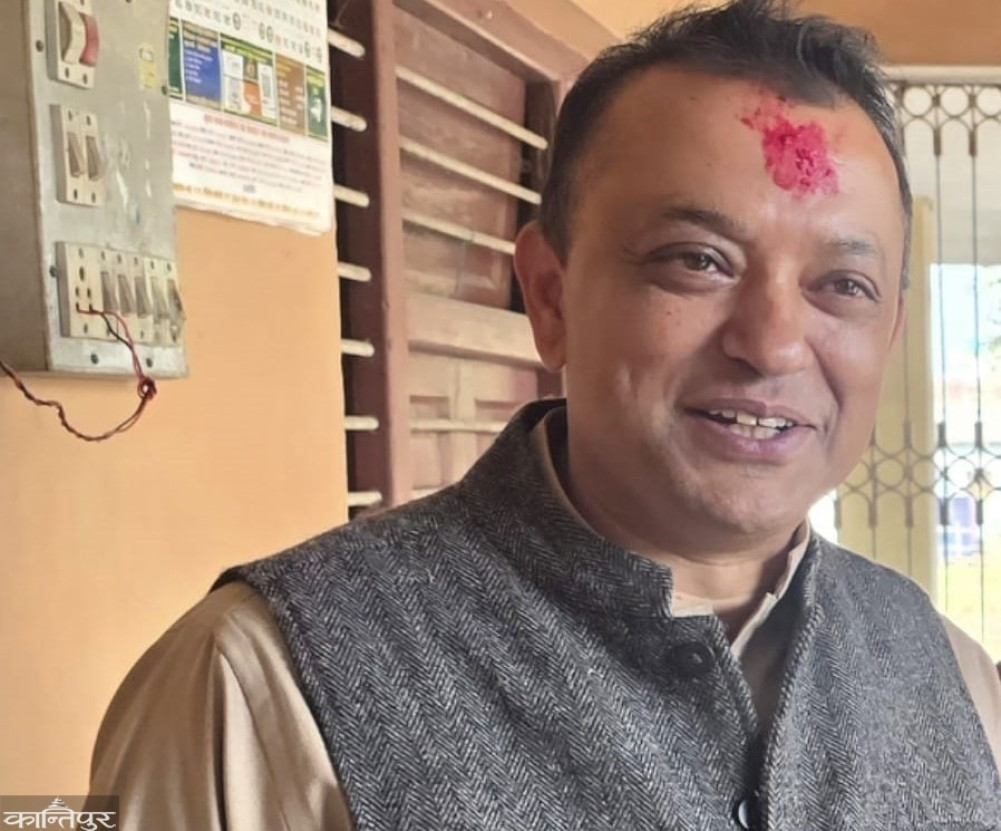
”The main theme of the recently concluded special general convention is that Congress voters in 165 constituencies will only vote for trees. There is no ups and downs in this.”
We use Google Cloud Translation Services. Google requires we provide the following disclaimer relating to use of this service:
This service may contain translations powered by Google. Google disclaims all warranties related to the translations, expressed or implied, including any warranties of accuracy, reliability, and any implied warranties of merchantability, fitness for a particular purpose, and noninfringement.
Gagan Kumar Thapa, who was recently elected as the president of the Nepali Congress at a special general convention, has left his traditional constituency Kathmandu-4 and gone to Madhesh to contest the election. This time, he is a candidate for the House of Representatives from Sarlahi-4. His decision to contest the election from Sarlahi, where he was directly elected three times, leaving the valley, is being commented on in various ways.
Former Congressman Amresh Kumar Singh is contesting against Thapa from the Rashtriya Swayamsevak Sangh (RSS) in Sarlahi-4. Some are calling Thapa's decision risky. Some are also interpreting it as a step to restore the credibility of the Congress in Madhesh. Gagan Thapa, who has been busy meeting voters in Sarlahi-4 for the past few days, was interviewed by Kantipur journalist Shiva Puri: What is the reason for choosing Sarlahi-4 instead of Kathmandu-4, where he had won the election three times? Isn't it a fear that a new party might lose? I was elected as a candidate three times in Kathmandu-4. Only the first election was easy for me. The second and third contests were unfavorable for me. However, I understood that it would be easier to win the election this time if I contested from Kathmandu. The situation in Kathmandu where all the parties, old and new, had to search for candidates until the last moment, confirmed that Kathmandu was favorable for me. For this, I am grateful to my party friends and especially the voters. This was not a matter of easy or difficult.
While fulfilling the responsibility of the President of the Nepali Congress, I have to keep a national perspective. But, so far, I only had a perspective of the hills. A person from a hill family. Since I was born there, the capital became my city. My workplace also became that. But, I had always been thinking about making a difference. This time, I felt that I could not carry the feelings of the entire country at once without immersing myself in Madhesh, without being from Madhesh for once and without feeling Madhesh. That is why I went to Madhesh without calculating the easy and difficult.
I decided that I would go to Madhesh and represent Madhesh. I came to Madhesh with a clear conscience, thinking that I would put my hand in the fire. I know that this decision can be risky. I came to Sarlahi knowing that it is not easy. I came because I have to work even if it is difficult.
Why did you choose Sarlahi? What is the strong basis behind it?
I had been thinking about going to Madhesh outside Kathmandu since the last election. Even then, I stopped at the last minute. During a general conversation, my friends asked me to come to Sarlahi-4. The party should have been ready first to take such a decision. The party leadership of Sarlahi also told me that I should come here. At that time, I could not dare.
At that time, I did not have the courage to go to a new place all at once.
This time I felt that I could not carry the feelings of the entire country at once without immersing myself in Madhesh, without being from Madhesh for once and without feeling Madhesh. That is why I went to Madhesh without calculating the easy and difficult. 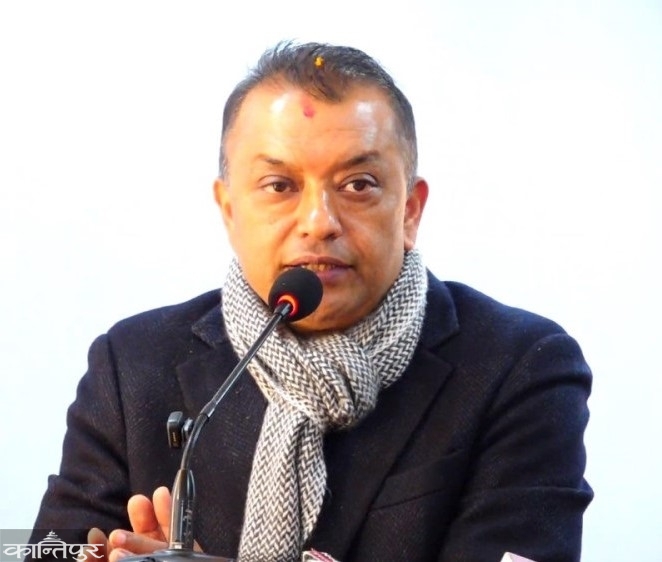
The matter of the official side of the Congress is pending in the court. How do you see it? It is not appropriate to comment too much on the case pending in the court. The court's decision should be respected. Based on the issues raised by the esteemed court in its decision yesterday, and after the court delivered its decision at one level, the friends who raised questions about the party's special general convention have now become candidates and entered the election. If we look at these two issues together, I think this issue has been resolved. However, it is the court's job to resolve it. On the other hand, yesterday we were in favor and against the special general convention. Some went to court, some stayed out. Now I think all these issues should be resolved. I am trying for that. Rather than going to court, I am trying to bring all friends, including the outgoing president, together. That will also be meaningful. If I had had time for a long discussion, I would have had time to think about other areas. Sarlahi-4 also called me when I had to go to Madhesh. That is exactly what happened. That is why I came here.
There are allegations that outgoing president Sher Bahadur Deuba did not give tickets to his supporters. You used to say that one should not seek revenge, one should move forward according to democratic values. And why revenge in ticket distribution?
This allegation is not true . There has been no retaliation at all . Since the discussion of the election started this time, I have been taking a stand that candidates who have been fighting in the same constituency for a long time should either leave the constituency or move to a new one . Former General Secretary Bishwa Prakash Sharma had to take a 'cooling off period' . I contested elections three times and lost twice, won once, and now he left saying that another friend should get a chance .
I will fight for the same friend, the same constituency forever . And if another friend gets a chance in the meantime, it is injustice, if it is retaliation, then no outside friend gets a chance . This time, we have given a chance to new ones where alternative candidates have been prepared so that we do not repeat as many candidates as possible . Where alternative candidates are not ready, old leaders continued as candidates .
For example, in Morang-6, Dr. Shekhar Koirala, Gyanendra Karki in Sunsari-4, Bimalendra Nidhi in Dhanusha-3. In that case, revenge should be taken against them, but their candidacy there was natural. There were no alternative candidates. No one had a serious claim. We have seen it this time.
Your citizenship was also heard in the cadre meeting. Are you called an outsider here? Why are you seeking citizenship?
My party friends have not told me anything. No one has told me anything about my party friends having to respond or speaking in my defense when the competing candidate is making accusations. I have told my friends about this issue if the party friends bring this issue up or in the context of Nepal as a whole.
How uncomfortable have you felt in Sarlahi-4?
I have never considered elections easy . So far, I have participated in the elections within the party, outside the party, and in the student organization . I lost the election once while running for the post of general secretary of the party in the thirteenth general convention . Apart from that, I got the opportunity to win all the elections . However, I did not consider any election easy .
When competing in elections, many friends would win, and I would congratulate them in advance that we had won . There is also my theoretical idea behind that . Going by the fact that we won in elections means disrespecting the voters . Voters have power . Therefore, voters can destroy even the areas that are considered solid or fortified . Therefore, in Kathmandu too, I worked hard in every election thinking that I am in trouble, at risk, and weak . Moreover, Sarlahi is a new place .
However, although Sarlahi is a new place for me, the geography is not new . Some things here are completely new to me. There are also many challenges. I will work harder than before, the main thing is to win the trust of the people before winning the ‘election’.
Madhesh is also a stronghold of the Congress. After the Madhesh movement, the stronghold has become like a religious one. How do you see it here?
You can’t blame anyone for it. We are the ones to blame for it. The Madhesh movement was a kind of dissatisfaction with the Congress. The Congress should have taken up the issue of Madhesh, but it didn’t. As a result, new parties were created. New movements were formed. We did not correct ourselves immediately. Since we are the ones who should solve the issue raised by Madhesh, we got to the point where we had to ‘claim’ it and say that we are from Madhesh. We considered ourselves weak. We would have formed an alliance with anyone by keeping that ‘complex’.
In some cases, we had to form an alliance centered on Madhesh. We had to coordinate.
Although Sarlahi is a new place for me, the geography is not new. Some things here are completely new to me. There are many challenges in this. I will work harder than before, the main thing is to win the trust of the people before winning the ‘election’.
If he is a member of the government, he will recommend a person from Madhesh as an ambassador! It is his turn, he is a fool. We were kind of making mistakes ourselves. To correct this, my candidacy from Madhesh is now. While a person who is the party president is saying that he will leave Kathmandu, today I have opportunities! My friends from Rolpa invited me to contest the election. Friends from Tehrithum, Solkhumbu, Kapilvastu invited me. But, I have come to Madhesh Raje.
Our leader Pradeep Giri used to say, ‘In terms of teaching specifically in Madhesh, introducing Madhesh, the Nepali Congress leadership has forgotten the fragrance of Madhesh soil. This city has become Kathmandu only. It cannot be returned only in slogans and speeches. If Madhesh cannot be returned to the spirit of the Nepali Congress, it will not last, my father would have to fry it.’ Now I am trying to return that trust. 
I understand 80/90 percent of the Madhesh language. I travel a lot during the day and keep in constant contact with my Madhesh friends in my team, so I try to learn the language and communicate with them. Speaking in a very loud voice is like cursing! People speak quickly in anger and excitement, but at that time I miss it. Otherwise, I understand the Madhesh language. I have to learn to speak. And I will learn. It will take a little time. Today I had an experience. Except for a few things, I understand the rest. But if I could also speak the language, I would have enjoyed having a two-way conversation. How much more fun I could have had. Now that I am contesting elections in Madhesh, how much of a language problem do you have here?
A few days ago, during a conversation with Kantipur workers in Jhapa, UML Chairman KP Sharma Oli had said that there was still a possibility of coordination with the main parties other than the new ones. When Deuba was the president, there was even homework to coordinate. Will your party, the Nepali Congress, coordinate with any party or not?
In a democracy, it does not mean that coordination between political parties cannot occur before elections. In many places, elections have been contested by coordinating. However, in the context of Nepal, the politics of coordination has failed. Because we have not been able to create a 'political culture'. There is no coordination before the elections to see who wins and who loses. For example, in India, we saw the NDA and India alliance.
In countries like Germany, the main opposition parties coordinate before the elections. Before coordinating, they discuss the issue for months, years. After coordinating, no matter how much conflict there is between the parties, they do not move for 5 years. Because, the voters voted for the coordination in the elections. On the other hand, we did not stay in coordination after the elections. Everyone cheated.
Now, no political party in Nepal can be said to coordinate. Because, we have made a mistake. But in recent times, when parties come together overnight during this election, that is also a kind of coordination. I have no comment on the parties. But what is ideology? Why are we together? Why did we get along? If we ask for deep or serious questions, discussions, and debates, no one will accept that debate. It is not just about whether we should get along or not. We did the same yesterday.
Why did UML and Maoists form a new party yesterday? The Congress-Maoists contested the elections together, but when we formed the government, the Congress-UML formed a new party together. What we, the so-called old party, did yesterday, the new party is doing today. We have not been able to build an advanced political culture for the politics of coordination. That is why we are not walking the path of coordination now.
If UML Chairman Oli and NCP Coordinator Pushpa Kamal Dahal and others propose that Gaganji now coordinate, what will you do?
अरु पार्टीका नेताहरूको कुरा सम्मानपूर्वक सुन्ने कुरा त भइ नै हाल्यो । नेपाली कांग्रेसको महासमिति बैठकले निर्णय गरेको कुरा पनि छ । भर्खरै सम्पन्न विशेष महाधिवेशनबाट सभापति निर्वाचित भएर आएको छु, त्यसको मुख्य विषय भनेकै १ सय ६५ निर्वाचन क्षेत्रमा कांग्रेसका मतदाताले रुखमा मात्र मत हाल्ने भन्ने छ । यसमा तलमाथि हुँदैन । त्यही विषयबाट सभापति निर्वाचित भएर आएको छु, त्यसैले उहाँहरूले पनि यो तालमेलको कुरा भन्नु हुन्छ जस्तो मलाई लाग्दैन । मेरो पोजिसन उहाँहरूले बुझ्नु भएको छ ।
निर्वाचन पछाडि ‘पोस्ट इलेक्सन’ एलायन्स भन्ने कुरा मुद्दाका आधारमा जोसित पनि गर्न सकिन्छ । सकेसम्म हामीले एकल बहुमत ल्याउने प्रयास गर्ने हो । अहिलेको निर्वाचन प्रणालीमा बहुमत आउने सम्भावना कम रहन्छ । त्यस बेलामा छलफल गर्ने, कुराकानी गर्ने, त्यसबेला हामी पुराना पार्टी हो, हामी यस्तो हो, हाम्रो फलानो पार्टीसित सम्बन्ध राम्रो छ, फलानोसित दुस्मनी छ, पार्टीहरूले यसरी भने सोच्नु हुँदैन । हाम्रो कसैसित प्रतिशोध छैन । मुधाका आधारमा भोलि सबैसित सहकार्य गर्ने कुरमा हामी सधैं खुला छौं ।
एउटा फरक प्रसंग, यहाँ पार्टी सभापति हुनु भएपछि शेरबहादुर देउवा, पुष्पकमल दाहाल, रास्वपाका सभापतिहरूले बधाई दिए कि दिएनन् ?
मेरो संवाद भएको चाहिँ पुष्पकमल दाहालसित हो । उहाँले फोन गरेर बधाई दिनुभएको हो । माधवकुमार नेपालले फोन गरेर बधाई दिनुभएको थियो । नेकपा एमालेका अध्यक्षज्यूले पनि फोन गर्नुभएको थियो । तर राम्रोसँग संवाद हुन सकेन । त्यसबाहेक अरूसँग संवाद भएको छैन ।