It was very good to see the creativity of Nepalis who expressed their society and culture in different ways. In all respects this experience has been unique.
We use Google Cloud Translation Services. Google requires we provide the following disclaimer relating to use of this service:
This service may contain translations powered by Google. Google disclaims all warranties related to the translations, expressed or implied, including any warranties of accuracy, reliability, and any implied warranties of merchantability, fitness for a particular purpose, and noninfringement.
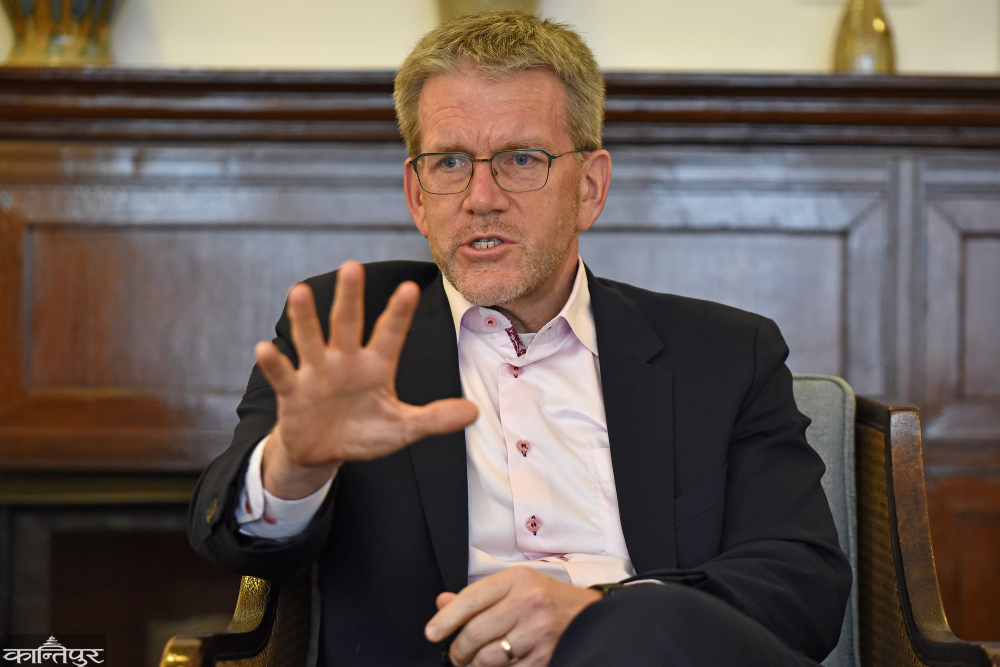
It has been 77 years since the establishment of diplomatic relations between Nepal and America. Meanwhile, US Ambassador to Nepal Dean Richard Thompson has just completed two years of his tenure. He came to Nepal before the 2022 general election and has closely observed Nepali politics and society.
Thompson with Umesh Chauhan and Biswas Baral Dialogue with Thompson
and
 Biswas Baral
:
You as the American Ambassador to Nepal It has been two years. Meanwhile, what developments have you seen in Nepali politics? What subject do you think is special in Nepal?
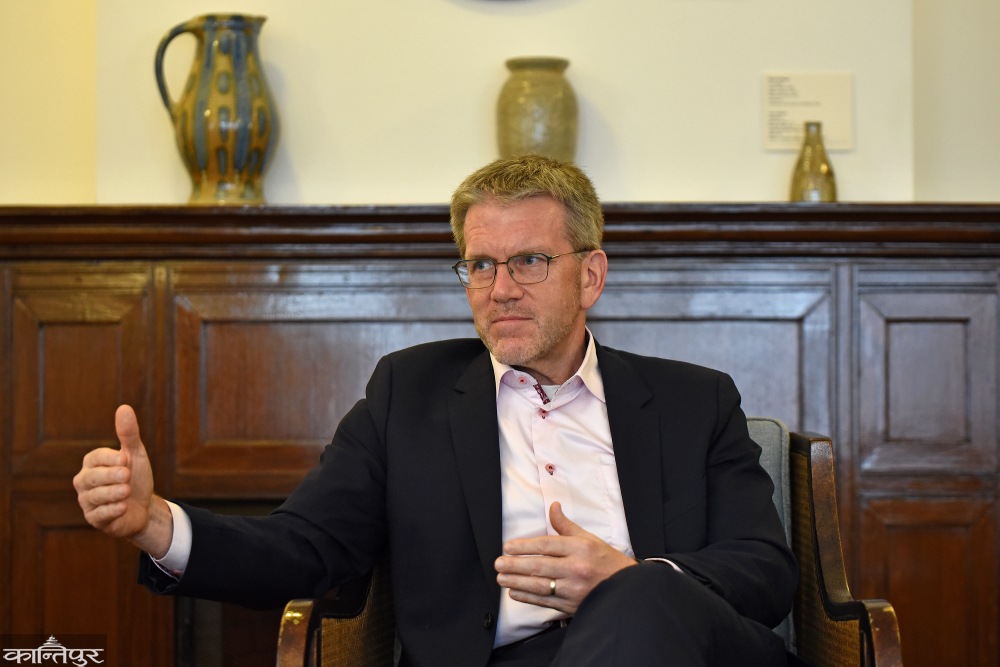 There have been many changes in Nepali politics. I came here shortly before the general elections held in November 2022. Watching the democratic process here, observing the participation of a large number of Nepalis to cast their votes was truly a pleasant experience. Democracy is a very vibrant and colorful practice in any country. In this regard, Nepal did not disappoint. It has been interesting to watch closely as it evolves and the formation process of various governments.
The best thing is that various governments have shown commitment to advance bilateral partnerships and work on projects. I am also very impressed with the innovative work done in various sectors of the economy here. I have seen the exciting work done in the IT sector. Such as: from traditional back-office operations to cutting-edge AI research, development of educational 'apps' for school students and participation in the 'Content Creators' fair we have organized in the last two years. It was great to see the creativity of Nepalese people who express their society and culture in different ways. The experience has been unique in every way.
It has been 77 years since the relationship between Nepal and America was established, how does America evaluate the relationship with Nepal in this diplomatic history? What do you think are the main characteristics of this relationship?
We have always tried to communicate and listen to Nepali society. Based on this, we have refined the range of products we serve. Peace Corps, USAID, Millennium Challenge Corporation, Development Finance Corporation or our various instruments of aid and development commitment. Nepal has also increased its capacity to use it. America has been able to add tools and resources to Nepal that can be used to develop its economy. I am very proud of the fact that we have done this primarily through grant-based assistance. So its negative aspects are very less. Meanwhile, we have focused on different sectors of the economy or society. For example, through the Development Finance Corporation we can now work together with the financial sector. This can create more opportunities for small and medium enterprises, especially women-run enterprises. We can use traditional aid mechanisms through USAID.
The Millennium Challenge Corporation (MCC) itself makes a lot of sense. It targets major infrastructure projects that will transform Nepal's economy. It has helped develop road and infrastructure networks and introduced new technologies. This can help expand the network, making roads safer, more reliable and easier to maintain. It has helped build electricity infrastructure. Which will help Nepal not only to use green hydropower internally, but also to earn more by exporting it regionally. We are very excited to see the events that have happened in the last 77 years and also the current situation.
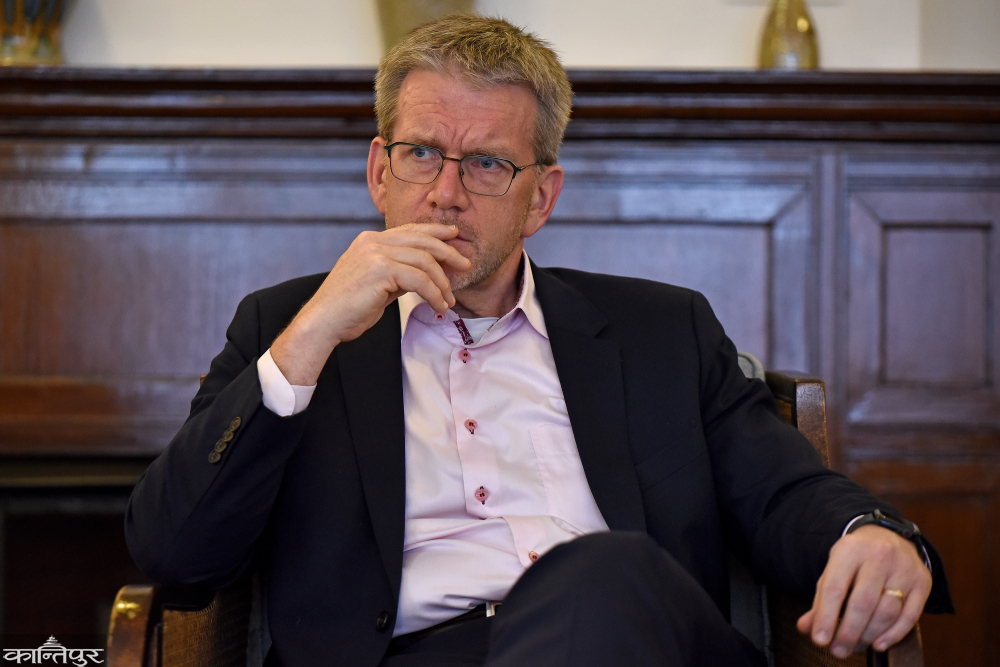 What is the status of project implementation under the Millennium Challenge Account, Nepal?
Energy is clearly a top priority at MCC. Transportation is also a priority. We have awarded the contract for the sub-station. We have already signed an agreement for 18 km cross-border transmission line. We have re-tendered for the 297 km long comprehensive transmission line package. which had to be revised due to changes in cost. But we are determined to get the work back on track by the end of this year and complete the project within the five-year timeframe. We are positive about this.
but some obstacles are also seen. Because transmission lines pass through many localities, communities have their own concerns. There are also procurement process and administrative questions. Do you expect the transmission line and road project to be completed in five years?
I think there will be more obstacles in the meantime. The biggest challenge came when bids were received for the 297 km long transmission line. Delays were caused by covid, global inflation, supply chain changes etc. Humans did not foresee it at all. I was not surprised. MCC has now accumulated a lot of experience in such projects around the world. Therefore, it is natural to challenge and reconsider.
But the real achievement is the assurance of moving forward, which helps the project to be completed on time and focused on moving in the right direction. In the case of Nepal, we are lucky, because we have such a partner, who has invested a lot of his own resources in the project. We have 500 million in grants and Nepal itself has invested around 200 million. It has been made as a project of national pride. Other problems will inevitably arise.
But we believe we have a good team to deal with it and will continue to push the project forward. It can serve as a positive model for how development cooperation and large infrastructure projects can be implemented in partnership. which is primarily the result of an internal process.
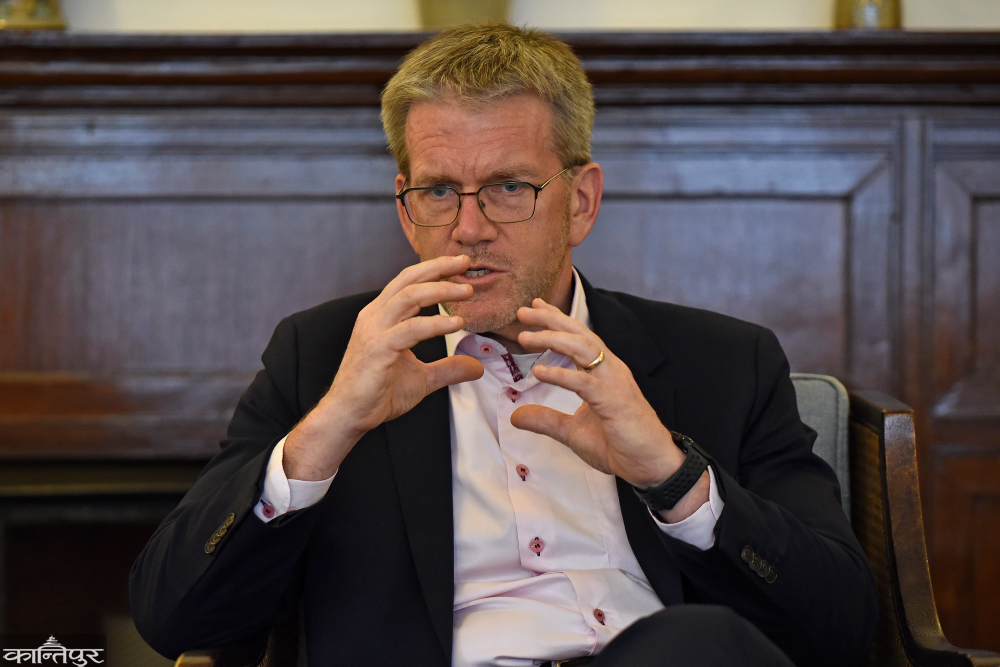 Let's not forget Nepal's request for the MCC project. The Government of Nepal conceptualized this project through a consultation process, designed the project and is now its main implementer. We are a financial partner, but this is overwhelmingly a Nepal-led effort.
MCC project is still in doubt on time, what if the project is not completed within the five-year deadline? The
project is to be completed within five years. But I can't say anything about whether the project will be delayed by 6 or 7 months due to some particular challenge or something like that. In our plans and projections, we hope to be able to move forward with this as soon as possible. If it needs to be taken beyond five years, we will work with partners and come up with a solution.
I am confident that the 500 million dollars provided by the US will be spent within five years and this will form a solid foundation for the full implementation of the project. But going back to your 'hypothesis', there really are different communities. Many people are affected by it. On the one hand, this is why we emphasize the consultation process and make everything as transparent as possible so that people can know, what is going on? Where is the money being spent? How many trees will be cut or where will the road be built? The most important thing for us is that there are no surprises for the community.
Even if there are challenges in other areas, we have a process to move the project forward. I am still very confident that we are on the right 'track' and have the right systems in place to address the challenges. It's an ambitious endeavor, no doubt. MCA Nepal is also committed to make it successful within five years. They are working together to ensure that this is done correctly and transparently. I am confident, we will be able to accomplish what is required. Also, there is a firm commitment from the government that if there is any small portion left, it will be ensured to go ahead.
I'm not worried about the final completion of the project. Instead, I'm more focused on how we can move it forward as quickly as possible. Because only the implementation of the project can give employment to about 10 thousand Nepalis. I really want communities to start benefiting from this project as soon as possible. Because this is its transformative aspect. Part of it is building, another part is executing, and yet another part is learning from the process. But when this infrastructure arrangement is completed, it will bring a change in Nepal's economic prosperity.
Some people are concerned that if the project is not completed on time, there may be a rift in bilateral relations!
 I don't think they should be afraid. We are partners in this. If any problem or challenge comes up, we will solve it together. In fact, there are some challenges. For example: Transmission line problems have already occurred. When the challenge comes, we work together. So, people need not worry. Instead the focus should be on implementing the project as quickly and completely as possible.
Now let's talk about geopolitics. Regionally, we see competition between India and China. Their attitude seems to be one of two. How do you see this geopolitical situation of Nepal?
This is a good question regarding the current situation and where the future is going. We have been watching India-China relations and their development with some interest over the past few years. Obviously, there was a conflict between them a few years ago. I think they are trying to manage it. No doubt, other countries in the region are also feeling it keenly.
From our point of view, we want countries in the region—especially Nepal, because I am assigned here and I have some knowledge here—that Nepal can exercise its sovereignty and have the space to decide the future in a positive way on behalf of its people.
We don't think countries should pick sides. We hope that Nepal will maintain harmonious relations with India and China. They are two neighbors. They are the largest countries in the region. It is very important for Nepal to work with and benefit from both these countries. At the same time, we see no reason why this should affect our relationship. There is no reason why Nepal should not be able to take full advantage of the benefits provided by the US. We encourage Nepal to work together as a partner and exercise its capacity to make decisions beneficial to the Nepalese people.
US-China relations are also very uncertain in the present situation. It is also interesting how the US views China's role around the world, especially in Nepal, isn't it?
 Recently our National Security Adviser made a high-level visit to China. Foreign Minister, Commerce Minister and Finance Minister also visited recently. I believe there is a real effort to manage the current competition in a positive way, which can lead to more cooperation. This channel should be continued by the US and China, but it is not a reflection of our relationship with Nepal or our relationship with India.
It is based on what we can do together with Nepal. I don't want to comment on what other countries are saying about us or how they are trying to influence us. What I want to emphasize is that we will be as transparent as possible, so that Nepalis can make their own decisions about what is happening in our relationship.
Recently, the US was blamed for Sheikh Hasina's departure from Bangladesh. The US is often accused of meddling in the domestic affairs of other South Asian nations and other parts of the world. What is your response to this?
Anyone who has been forced to flee their country should take anything they say with caution. The United States does not interfere in the internal politics of other countries. We work hard to be as transparent as possible about our relationships, what we're doing and what our goals are. This does not mean that if we disagree with a country on a policy or issue, we will not raise it.
But it is not in our diplomacy that the US government takes advantage of changing the government of a country. Instead, we strive to build the strongest relationships with our partner countries. We prefer to build stronger relationships through people-to-people relations and provide as many development opportunities as possible to our partner countries. So I don't give any importance to such rumours.
Now there is also a perception that the US and India are working together on strategic issues. How is the partnerships of these two countries in particular in South Asia?
is definitely increased in strategic partnerships between the United States and India. I think we would like to move on to it positively. However, at the same time, we have disagreement between the United States and India in various cases, just as we disagree with many of our other partners.
we try to address those issues active, professional and productive way. But yet we look at every country with a bilateral point of view. So, if the United States and India may be useful, and if another country has agreed in such cooperation, it is fine. But, when Nepal comes to Nepal, we will put our relationship and our efforts to base bilateral discussions and bilateral relations.
 now we are interviewing, US and the Nepal Army are training in Nepal. How do you portray the relationship between two armies?
is, 'Pasic Angel' practice is ongoing, which focuses on the dismiss-relief and humanitarian assistance. The relationship between the two armies is strong, it will remain strong. Because we also pay attention to the area where Nepal wants to reversion and building the excellent Nepali Army, is working as human networks of global networks for establishing peace of the United Nations peace. In which Nepal is the biggest contributor. We want to see Nepal commercially and develop the capacity in those areas. So, our attention is there, and we will continue in the same area. In
Nepal also had a lot of argument about the Indo-Pacific Strategy and the IPS) and its IPS) and its now in Nepal, especially in Nepal, especially in Nepal. But, what is its current situation?
Indo-Pacific strategy is a broad strategy of the United States, who addresses on how to view it. It includes how we can make open, free, free Indo-Pacific area for everyone. What we need to do is to use this strategy to strengthen our relationship with each country in this area. • How can we support democratic development? How can we help economic development? We must not forget that about 60 percent of the world's business is being in one way or another through the Indo-Pacific region. It is good for everyone to keep it open and free. It is important that countries in this area can work freely in their own interests.
IPS believes China are believed to challenge each other from the United States and Belt ENNDI (BRI) and Nepal struggle to maintain a balance between these two. What is your opinion about this?
, MCC, Development Finance Corporation - The only purpose of all our development partners to develop their economy together, making them more enable them to meet the needs of their people. We are focused on. These programs are prepared for the same purpose. We will look at her. BRI is the initiative of China. China is moving it forward. Each country is free to decide how to cooperate with others.
is going to believe that USAD or MCC is becoming beneficial processes as USAD or MCC is focused on programs, grant-based development. We will still have to move him forward because the statistics and historical experiences we have supported him. It is our responsibility to help our partners in uniform in every area we work. This is a very important thing to whom we must accept. And, we should ensure that they are also able to accept it.
is a matter of building this belief. It is point to show that our purpose is right. It is important that we are working in the interests of partners. And, it is a matter of showing that we are applying equal and transparent criteria in all. For example, in MCC, we have published all things on the Internet. Josuku in Nepal also wants to question any aspect of the project, you can read the project, 'blueprint' and can get information about what the project covers.
Similarly we build a relationship. If I come to Nepal, I want to make a project because I will not be better welcomed here. We do not see the world in that way. This is not a healthy way of a long time. But if bilateral attention is to find the people stronger, I believe that there is a better chance to move forward.
Nepal's parliament has finally revised the impressional law. This is also a matter of international concern. How does the US view it? How do you look at the transitional justice process?
is this an important step. We are watching on its current direction, and we are trying to see how we can help. You may have noticed that after the passage of Parliament Bill, we issue a statement of support with many other partners countries. We all know that it is always challenging to take the conflict at such a stage. The transition period has been passed with the judiciary, which was challenged. However, implementation will also be difficult.
 is eager to find out how we can be helpful and other partners can be helpful. It may also be from some bilateral things, also from some polygamical means. But, I am especially excited, we always said that it should be a process of running by Nepali. And, it has been led by Nepali. It should be a presocratic cyclonia. I think that's the same. Therefore, it is necessary to ensure that you need to keep your consultation process alive, so that the victim group, child soldier groups and other groups can take sound. How to deal with the solution, compensate, to compensate how to move forward with the reach of the incident.
every day are leaving the country in search of thousands of Nepali youth good employment. Industry in the country has not developed a country why this situation is. In this regard, do you see the possibility of coming foreign directors from the United States and can create fair employment in Nepal?

