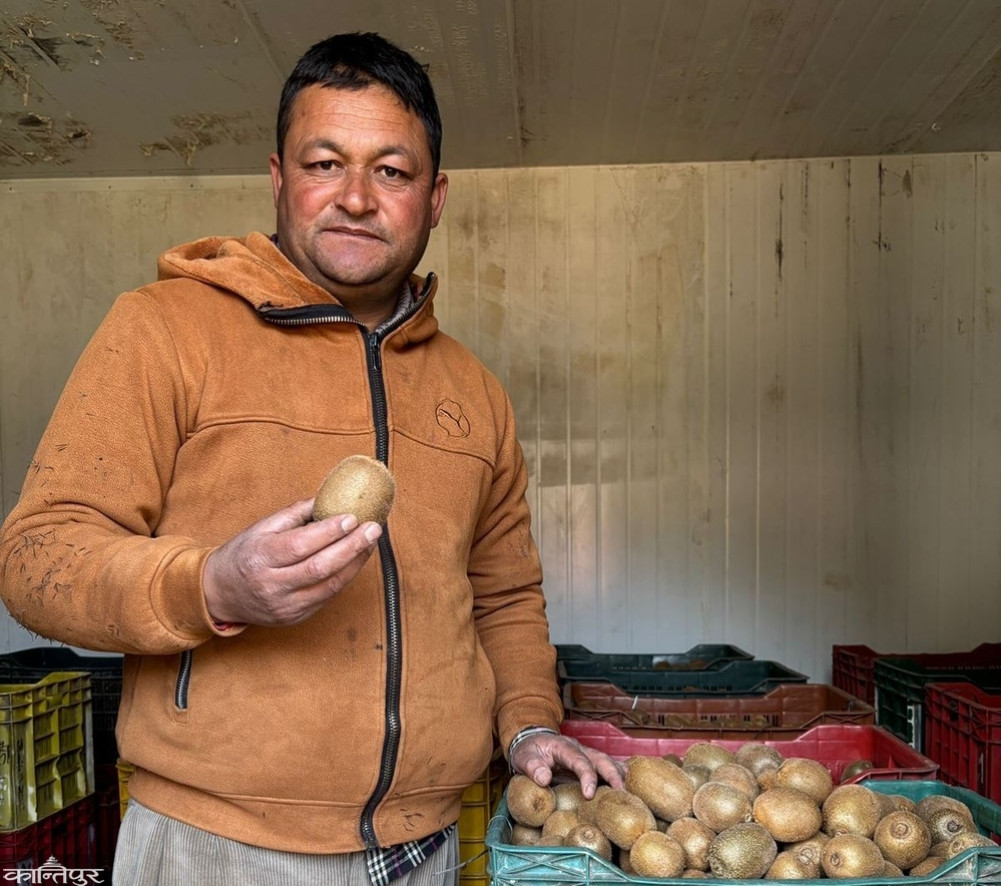
Kiwi farming has given me the confidence that my children will no longer have to go abroad. This is the greatest joy for me.
We use Google Cloud Translation Services. Google requires we provide the following disclaimer relating to use of this service:
This service may contain translations powered by Google. Google disclaims all warranties related to the translations, expressed or implied, including any warranties of accuracy, reliability, and any implied warranties of merchantability, fitness for a particular purpose, and noninfringement.
I grew up with the cold, the wind, and the sorrow. So the village environment is not new to me. For a few years, people started migrating from the village. And the land started becoming barren. Seeing that, my heart would flutter.
Even now, young people are migrating from the village to Kathmandu and abroad in search of employment. The people living in the village are also disappointed. Seeing this situation, I thought of doing something in the village. It is not possible to build a factory here with a huge investment. So I started kiwi farming in my own field. I registered Ananta Agrovet Bio Farm and started kiwi farming. About one crore rupees have been invested in it so far. Now, a lot of investment has been made. It was not easy at first. I had to level the barren land. I had to arrange irrigation. I had to buy seedlings at an expensive rate. I paid 350 rupees for a seedling and planted it. I bought seedlings and cultivated half of them. Later, I produced seedlings myself and planted them on the remaining land. When I added the cost of fertilizers, pipes, tanks, and workers, it was a lot of investment. I was confident that hard work would definitely bear fruit one day. It happened as expected. Then I expanded kiwi farming. Now I have kiwi orchards in three places. The orchard is at an altitude of about 2,000 meters. It is between two rivers. There is no shortage of water.
I have built a tank with the help of the District Agriculture Office by investing 3 lakhs. I have set up an irrigation system with 75 mm pipes. I use 50 carts of cow dung manure annually by buying it from the villagers. This has also generated income for local farmers.
This year, about 10,000 kg of kiwi was produced. Some was taken to Kathmandu and sold. Some was sold in the village itself. Even now, 4,000 kg of kiwi is in my humidity center. Since it is off-season, it is being sold from home for 300 rupees per kg. It reaches 350 rupees in Kathmandu. Initially, I sold it for Rs 150 per kg. Now, people come to buy it themselves. Friends and customers are calling and asking for kiwi. I am unable to meet the demand.
Initially, there were many challenges. Lack of technical knowledge, insufficient training, lack of information about kiwi. I was disappointed after the first year, when it yielded little. Since the orchard was on sloping land, the kiwi was sweet and juicy. This quality increased the demand in the market. This year, up to 80 kg was produced from one plant. Kiwis weighing 50 to 120 grams have been produced.
Since it is a mountainous region, pests and diseases are rare. After removing the Uttis trees near the orchard and preventing water from stagnating, the problem decreased. This has made farming easier. My goal is not just to earn personal income. There is a plan to make the barren land of Umakunda green and create jobs.
My household expenses are covered by the income from this kiwi. Its impact is visible in the daily life of the family, the wages of the workers, and the hustle and bustle of the village. I say that with the right plan, patience, and hard work, there is potential in the village. Kiwi farming has given me hope to make not only my life but also the future of Umakunda green. When I started kiwi farming, many people asked, "Will it bear fruit in my hand?" Today, I have started dreaming of earning crores from this same piece of land. This belief has changed my thinking.
My children have also started saying, "We will do our father's business, we will live in this village." One son is studying engineering. One daughter has completed her bachelor's degree. Kiwi farming has given them the confidence that they will no longer have to go abroad. This is the greatest happiness for me. Kiwi farming has not only provided good income, but also provided the basis for a secure future. The specialty of this fruit is that it does not spoil for two to two and a half months after picking. It can be kept in a humidified center and taken to the market at the right time. That is why the price is also good.
Presentation: Navraj Shrestha