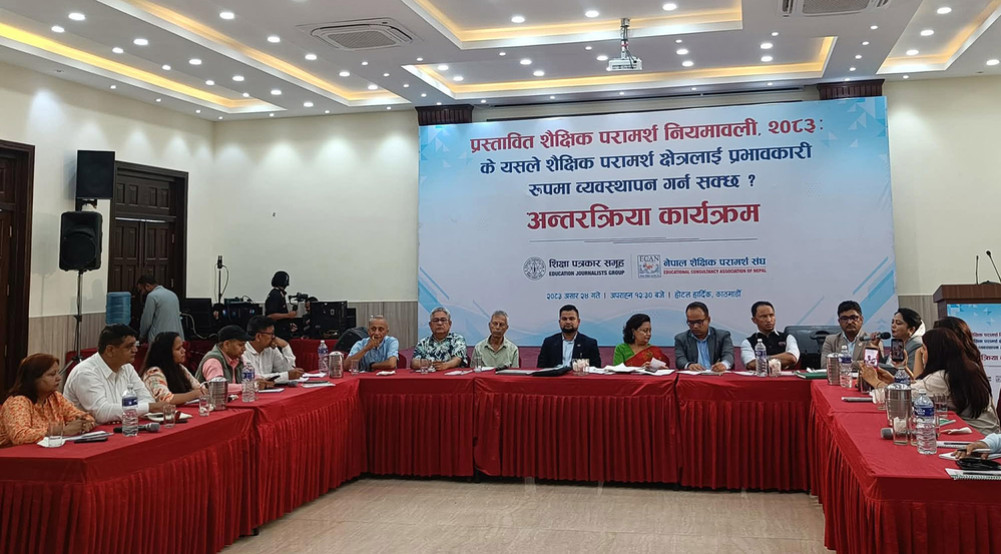
Educational consultancies had been operating based on the guidelines since 2011, while foreign colleges had also been established and operated under the guidelines since 2002.
We use Google Cloud Translation Services. Google requires we provide the following disclaimer relating to use of this service:
This service may contain translations powered by Google. Google disclaims all warranties related to the translations, expressed or implied, including any warranties of accuracy, reliability, and any implied warranties of merchantability, fitness for a particular purpose, and noninfringement.
The Cabinet meeting has passed regulations regarding colleges operating in Nepal under affiliation with foreign universities and educational consultancies. Educational consultancies had been operating based on directives since 2068 BS, while foreign colleges had also been established and operated under directives since 2059 BS.
Minister for Education and government spokesperson Sasmita Pokharel announced the issuance of the Educational Consultancy, Language, and Preparatory Classes (Operation and Management) Regulations 2083 and the Educational Program (Operation and Regulation) Regulations 2083 for foreign university affiliations. According to the regulations, a deposit of 2.5 million rupees must be maintained to establish an educational consultancy or open a branch office. Similarly, they must be renewed annually at the Ministry of Education. Consultancies had also been registered at the provincial level. The provision allows those registered at the provincial level to register at the central level as well. According to the Ministry of Education, about 1,500 consultancies are registered and operating, but only 924 have been renewed at the Ministry of Education.
The regulations also require a deposit of 2.5 to 3.5 million rupees to establish a college in Nepal under affiliation with a foreign university. The approved regulations specify a deposit of 3.5 million rupees for the undergraduate level and 2.5 million rupees for the postgraduate level. The regulations also set standards for the physical infrastructure of colleges.
The regulations have been issued so that only programs from universities ranked within the top 1,000 globally can be operated in Nepal. Currently, 56 colleges affiliated with foreign universities are providing higher education to Nepali students in Nepal.
According to the Ministry, most of these colleges are operating in the Kathmandu Valley.
At the undergraduate and postgraduate levels, colleges with foreign affiliations have been running educational programs in faculties and subjects such as management, science and technology, computer science, information technology, humanities, cyber security, business administration, network engineering, mobile application development, data science, data analysis, software engineering, hospitality management, human resource management, fashion design, among others.
The 2059 BS directive stipulated that only universities ranked within the top 1,000 by Times Higher Education and Shanghai Jiao Tong could operate educational programs in Nepal. In 2056 BS, the Ministry of Education made the decision to regulate educational institutions opened under foreign affiliation for the first time. Colleges had already been established before that. Three years later, in 2059 BS, the directive was issued. For the first time, regulations regarding the operation of consultancies and foreign colleges have been issued to tighten regulation.