64 children and 4 young people trying to learn Kakhara
We use Google Cloud Translation Services. Google requires we provide the following disclaimer relating to use of this service:
This service may contain translations powered by Google. Google disclaims all warranties related to the translations, expressed or implied, including any warranties of accuracy, reliability, and any implied warranties of merchantability, fitness for a particular purpose, and noninfringement.
The Raute community, who live in the forest, moved to Girighat in Barahtal Rural Municipality-2 of Surkhet only a week ago. Before this, they were living in Barahtal of this ward. The children and youth of this community are currently struggling to learn Kakkara. Many of them are able to spell and some have started writing their names.
64 children under the age of 18 and 4 youths of around 25 years of age from the Raute community are trying to learn Kakhra, said Lal Bahadur Khatri, a pair of teachers of the Raute project. According to him, 22 people have started writing their names. "We are teaching the names of the months and months through video," Khatri said. He said that some of them just want to learn to write names.
It is considered bad to go to school in this community because of the work that the ancestors did not do. For the same reason, Khatri said, children and young people who want to study only try to learn when they are not in the sight of their parents and community leaders. He informed that they teach 2 to 4 people at a time by showing them the phone. According to
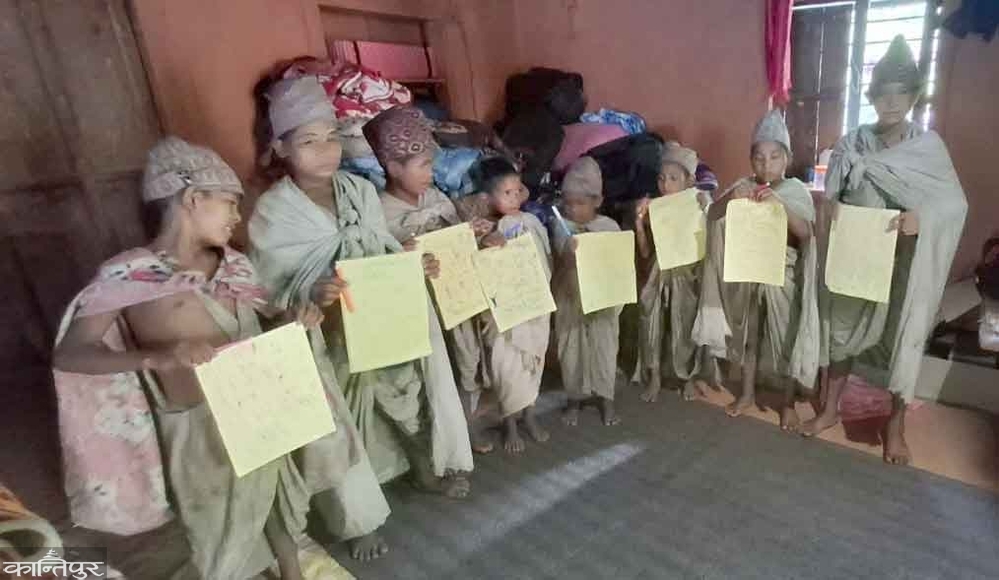
Khatri, they should be taken away from the village to a place where parents and chiefs do not see them. They don't sit and study continuously for one/two hours . They only want to read for 5 to 10 minutes at a time. Khatri said that it is difficult to stay in one place for more than this time.
The non-governmental organization Social Service Center (SOSEC) has been conducting the project since 2075 by placing a couple of teachers and health workers in the Raute community. Khatri says that he has been working for their change since 2076. However, he informed that teaching has been started for those who want it only some time ago. According to
Khatri, after they started watching videos on their mobile phones, they also started reading. "After watching the video, even if they show a desire to change, they cannot do it because of the fear of their parents and chiefs," he said.
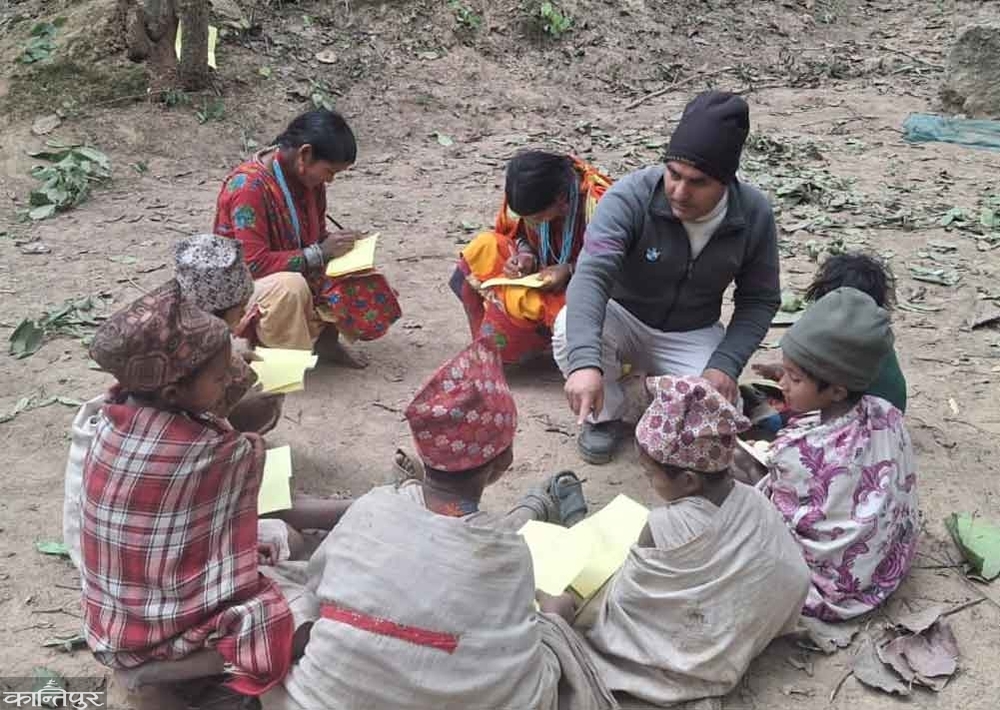 In Surkhet's Barahatal Rural Municipality-2, the children who are studying outside the village under the watchful eyes of their parents. Photo courtesy: Lal Bahadur Khatri.
Khatri said that they are teaching the new generation to wash their hands and feet, cut their nails and eat food after washing their hands. They have been taught by showing videos. Parents and heads of the Raute community do not agree to allow them to read. Raute chief Dil Bahadur Shahi and Bir Bahadur Shahi say that they should not do what their ancestors did. Their argument is that society will deteriorate if read.
Another chief, Suryanarayan Shahi, says that things are slowly changing. "We don't tell them to read because their parents don't read," he said, "They will read slowly." Later, they will learn by themselves, they will change. 13-year-old boy Rapil Shahi expressed his desire to study if his parents allowed him. "If you find out that you are reading, you will have to run away," he said, "My father-in-law let me read." Learning to write names without reading anything else . When you see others reading it, you feel desire .
Now the number of routes is 137. They keep moving from one place to another. They who live in the forest feel the lack of firewood and hunting animals and move quickly. Even though the slums are dirty and some die, they migrate . After reaching the forest, they make wooden carts and make a living by mixing them with grain leaves in the village .
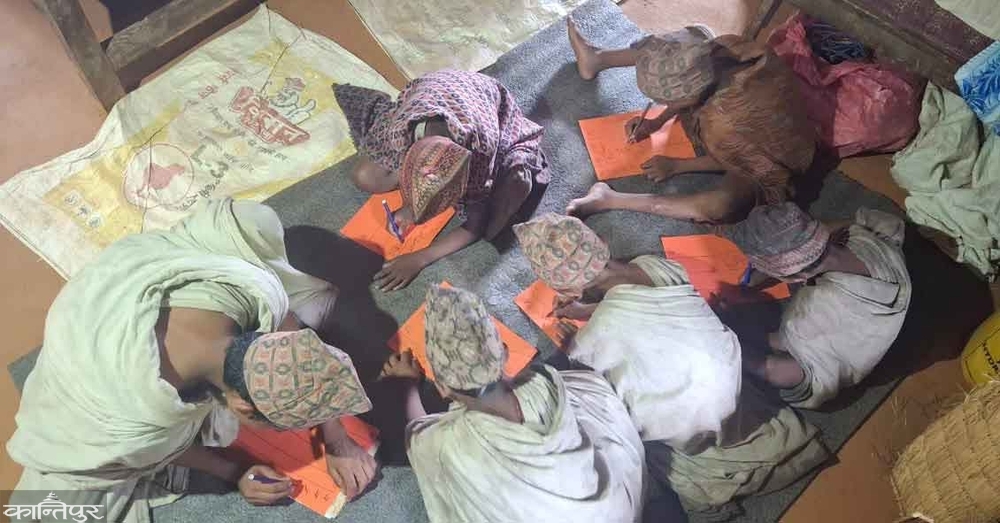 While living in Guras Rural Municipality of Dailekh, the route children are hiding from their parents and learning to read in the house of the locals. Photo courtesy: Lal Bahadur Khatri.
Their daily routine is to make wooden materials, hunt monkeys, and reach nearby villages to beg. They carry wooden vessels made by themselves to reach the village to exchange food and arrange accommodation by predicting the time to come back. By making circular and oval enclosures with green apples and gocha, children play and beat rice and keep a place in the middle. Chapro is made by women .

