Demand for increasing the budget saying that underprivileged students get 400 rupees scholarship annually, 200 rupees monthly stipend for principals and 10 thousand rupees monthly operating expenses of schools are insufficient.
We use Google Cloud Translation Services. Google requires we provide the following disclaimer relating to use of this service:
This service may contain translations powered by Google. Google disclaims all warranties related to the translations, expressed or implied, including any warranties of accuracy, reliability, and any implied warranties of merchantability, fitness for a particular purpose, and noninfringement.
Netra Chapagai, President of Samajwadi Vidyarthi Union, is standing and protesting in Maitighar Mandla for the whole day demanding reform of public education. He came to Kathmandu after standing in the capitals of all the seven provinces for 2/2 days and protesting for 14 days. He has been standing in Maitighar since last Sunday.
He complained that the government and the Ministry of Education did not pay attention to the issues raised by him. He stands on the side of the road in the middle of cold from 10 am to 5 pm .
His main demand is that the Education Act should be promulgated as soon as possible according to the recommendations of the Higher Education Commission report 2075. Among the 15 points, most of Chapagai's demands are focused on improving community schools. Last May also, he stood and staged a dharna for two weeks at Maitighar . The sit-in ended after an agreement was reached with the then Education Minister Sumana Shrestha.
However, after six months of the Ministry of Education not showing readiness to implement the agreement, he said that he started the sit-in again to exert pressure. In addition, he met Education Minister Vidya Bhattarai last October and suggested 14 points to implement the previous agreement.
Although he met Minister Bhattarai himself and drew attention to it, after not receiving a hearing, he started a sit-in from Bhattarai's home town, Pokhara, passing through Dhangadhi, Janakpur, and now he has arrived in the federal capital, Kathmandu.
Early childhood development (ECD) education should be brought into the school structure, the annual scholarship amount of 400 rupees given to students should be increased, free electricity and water should be provided to community schools up to 100 units, the administrative expenses of schools should be increased, free education should be provided, teachers should be paid He put forward demands such as not being allowed to join organizations, residential schools should be run in hilly districts, the monthly stipend received by community school principals should be increased, and if there is a lack of budget for education reform, an educational reform fund should be created. have moved .
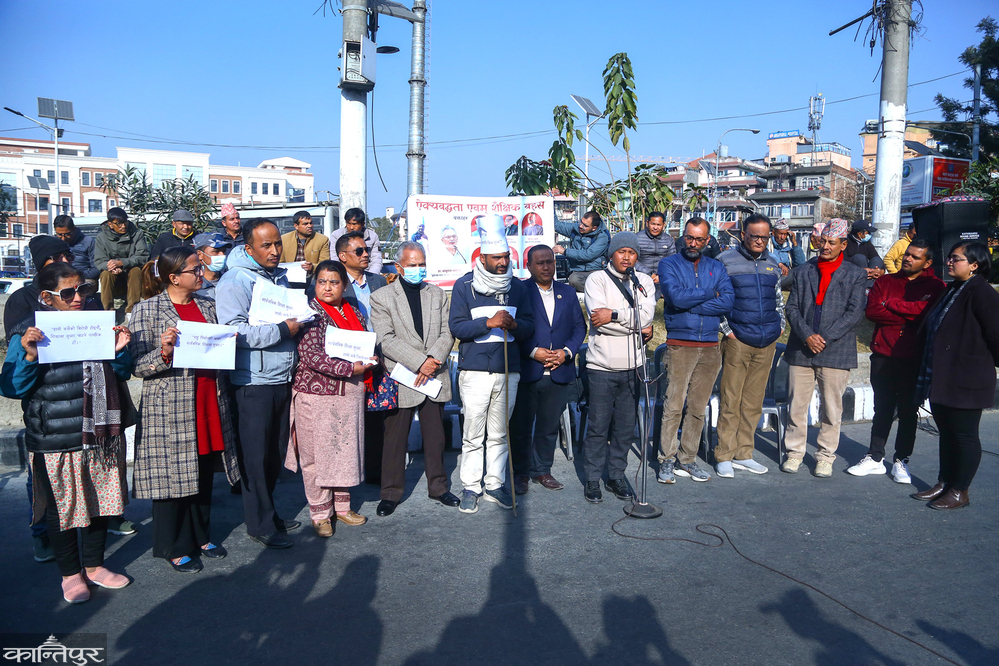
Former Prime Minister Bavuram Bhattarai, former Education Minister and MP Shishir Khanal and others were present at his sit-in on Wednesday and stood for about 2 hours and expressed their solidarity . Political parties, student organizations, civil activists, teachers' federations, ECD teachers and school staff have also been showing solidarity.
The school education bill was registered in the parliament during the previous government's tenure, but it could not be passed. The bill is under consideration in the Parliament's Education Committee. The committee is doing the work of collecting suggestions at the state level. In the bill, ICD education is not included in the structure of school education . Dharnarat Chapagai has put forward the demand that school education should be recognized and ECD education should be a priority of the government.
He said that the overall education will improve only if the ECD education is improved. He demands that the state should increase the investment in ECD education, provide excellent service facilities to the teachers who teach there . ECD teachers are forced to teach at low wages.
'Now there is a government of two-thirds of Congress and UML. If this government wants to, it is possible to improve education,' he said, 'Who has stopped them from improving public education?' ; They get a monthly salary of only 15,000.
Since 2060, only 400 rupees per year scholarship has been given to underprivileged students, he demands that it be increased. "Since 2052, the principal has been receiving a monthly allowance of Rs 200," he said, adding that the ward office receives Rs 2 lakh for operating expenses. The school gets only 10,000.'
Basic schools get 10 to 20 and secondary schools get 30,000 for administrative expenses. He complained that the state does not pay attention to the reform of public education. He suggested that school operating expenses should be increased to at least 1 lakh.
"Water and electricity bills in big schools in the city are more than one lakh per month," he questioned and added, "Government gives free electricity to temples." Why can't schools be given 100 units of electricity per month for free?'
Although secondary education is free, Chapagai expressed his displeasure that the government charges fees in the name of exams and certificates. "The government says it needs a budget to meet our demand, but it says no. We have also given an option for that." An amount of 10 billion can be collected in the educational reform fund . For that, CSR (investments made by companies in public interest) should be utilized.'
During the educational debate program with solidarity in the sit-in of Chapagai, former Prime Minister Bavuram Bhattarai said that the state has not given first priority to education. He pointed out that the country's economy will improve only if investment in education can be linked with production and employment.
He pointed out that there should be no discrimination between citizens to get education and health services. "Improvement is not possible from the big parties in power." New ideas and leadership are needed," he said. Former Education Minister and National Independent Party MP Shishir Khanal said that the issue of public education reform should be an issue from the community to the House.
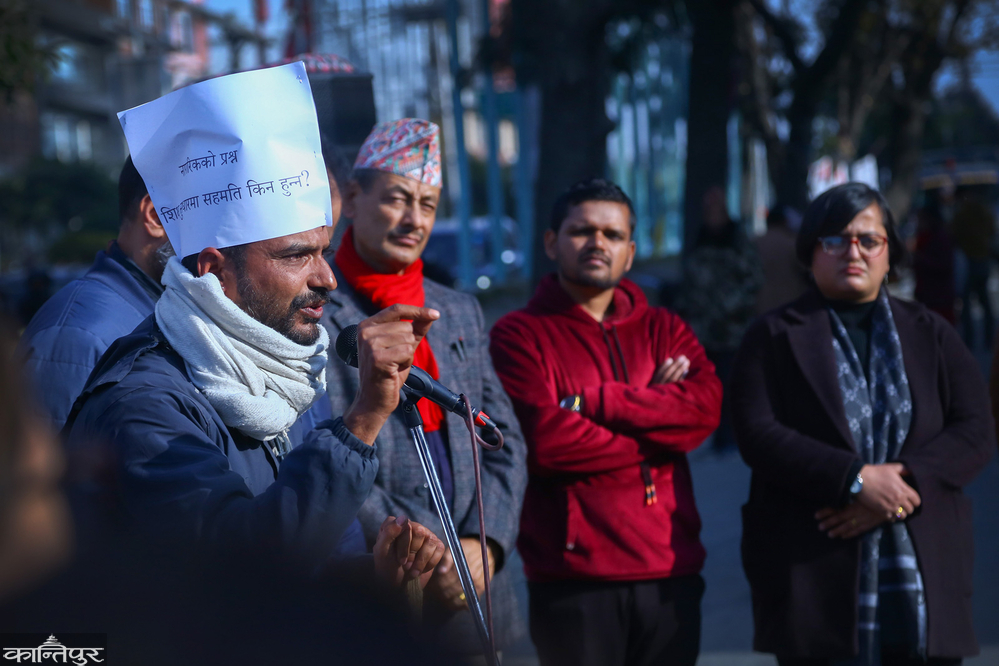
'The number of students studying in public schools is decreasing . One education is bought and another education is free . "Education itself has been building two societies," he said. He said that the education system is falling into the trap of party politics.
Citizen activist Dumbar Khatiwada complained that the state's investment in education is inadequate. He alleged that instead of solving the problems of the citizens of the state, they are increasing discrimination and unrest.
Viveksheel Common Party General Secretary Ranju Darshana expressed her displeasure saying that political parties have failed to make education universal. Free education is written in the constitution. But it has not been implemented,' she said, 'The state has been manipulating the citizens.'
Shishir Upreti, an activist of the large-scale civil movement, accused some leaders of political parties and those in power to undermine and weaken public education. The Vice President of Nepal Teachers' Federation complained that the government did not pay attention to the implementation of the agreement for education reform.
He said that the government could not even provide teacher posts in public schools. There are no teachers in big schools with students. In schools where there are no students, there are teachers . "Instead of sending permanent teachers, the government sends relief, volunteer teachers," said Jayanti Basnet, an ECD teacher from Lalitpur, demanding that the ECD level be made an integral part of school education.
'Salary should also be begged and eaten . The state doesn't even call us teachers, but calls us support workers,' she said, 'are we just watchers of children or what? It should be clarified in the Education Act.'

