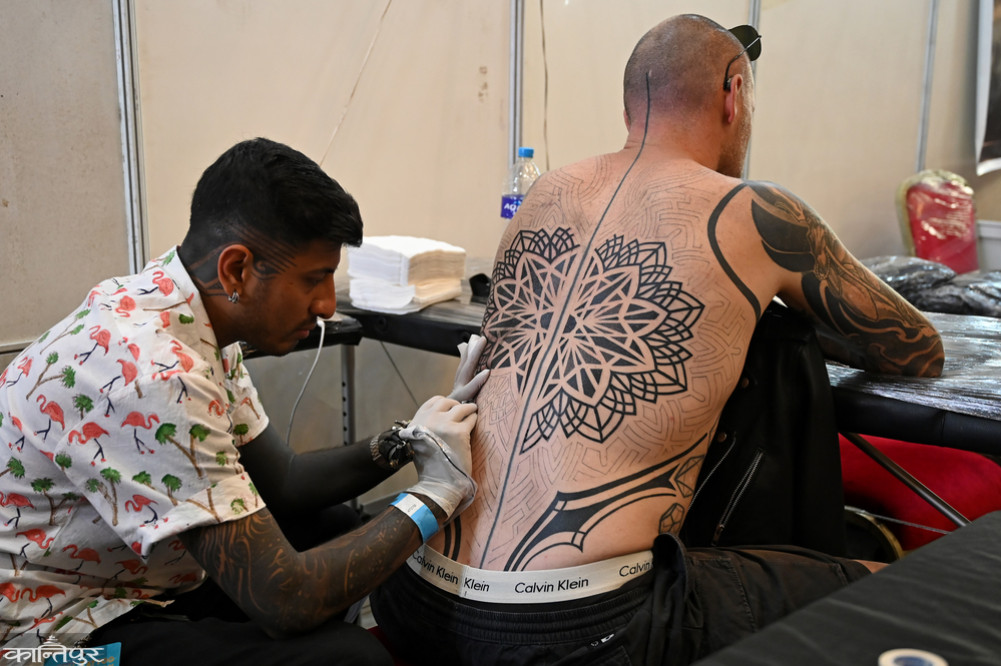
Brazilian artist Caco Menegas says, “Tattoos are a way to express emotions to the outside world, where I try to connect with the body.”
We use Google Cloud Translation Services. Google requires we provide the following disclaimer relating to use of this service:
This service may contain translations powered by Google. Google disclaims all warranties related to the translations, expressed or implied, including any warranties of accuracy, reliability, and any implied warranties of merchantability, fitness for a particular purpose, and noninfringement.
Colombian tattoo artist Camila expresses her respect for women, nature, and animals through her art. In particular, the ‘dots’ used in her tattoos symbolize the seeds carried by women. She says, ‘Women in countries like India are very creative. They are influenced by nature. They transform it into creation.’ She has also been expressing her feelings through tattoos with a similar mindset.
Similarly, at the recently concluded 13th International Nepal Tattoo Conference in Kathmandu, Malaysian artist Nagaiya presented her art through her ‘Raktadhatu Tattoo’ studio. Her designs are inspired by the ‘Pua Kumbu’ textile art of the Iban community. ‘Before using these arts, I take permission from the women weavers of Borneo so that there is no misinterpretation,’ she says. Nagaiya's 'hand-tapping' method is considered risky because it involves tattooing with needles. According to him, this method has been used in Borneo for over 2,000 years. Where ink was traditionally made by mixing sugarcane juice with charcoal or ash.
Brazilian artist Caco Menegas works in the 'Sacred Geometry' style, which uses lines and shapes with spiritual and symbolic meanings. He said that tattoos are a way to express your feelings to the outside world. He said, 'Tattoos are a way to express feelings to the outside world, which I try to connect with the body.'
Tattoo art has been established around the world as an important means of expressing personal expression, emotion and cultural identity. This type of art has been popular in Nepal for a long time, and its popularity has been increasing in recent years. 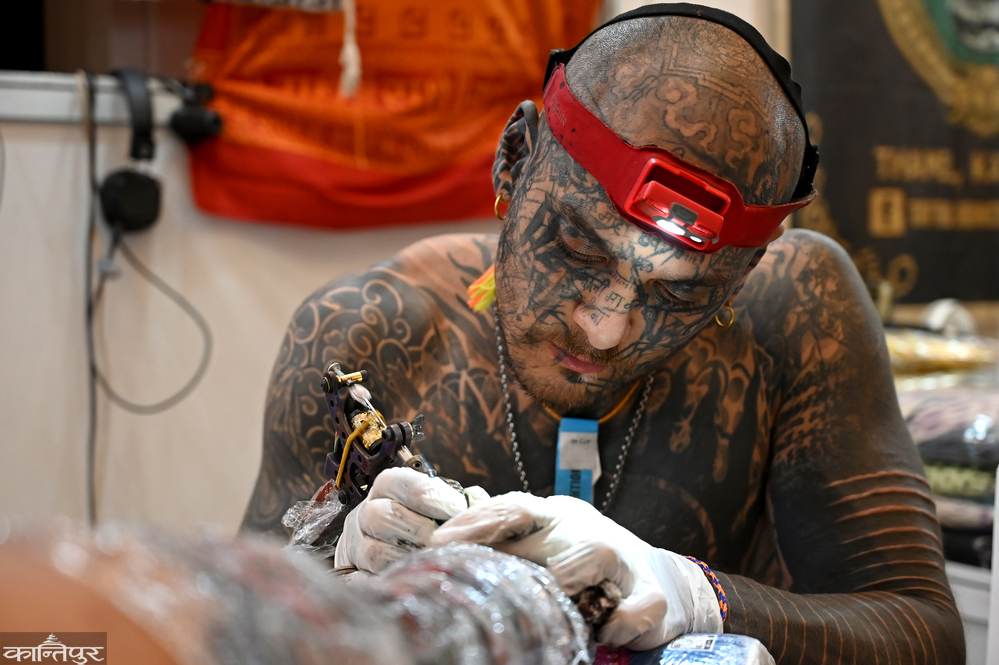
More than 250 artists from 22 countries participated in the 13th International Nepal Tattoo Conference held at the Heritage Garden in Sanepa from 12 to 15 Chaitra. 95 tattoo booths were set up at the conference. The conference also included live music, food stalls, commercial stalls and cultural dance performances. The main objective of this conference was to strengthen the tattoo community and connect the participating artists with the culture and traditions of Nepal, said Om Prakash Gurung, the owner of the organizer, 'Nepal Tattoo Private Limited'.
Tattoo company owners also gave feedback at the conference. Kamal Dulal, the owner of Mystic Ink Nepal, said that he initially started working with traditional tattoos. Later, he expanded after realizing that inspiration could also be drawn from Nepali cultural elements. Stating that the perception of tattoos in society has changed, he started reflecting cultural importance in tattoos as well. He said that 10-15 years ago, the public perception of tattoos was the exact opposite of what it is now. 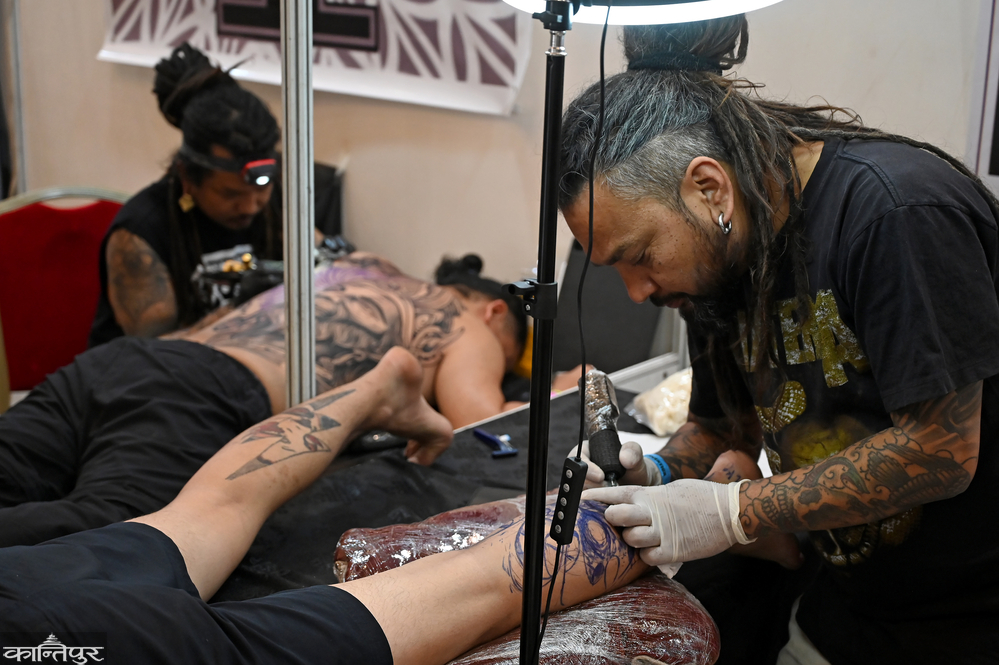
Gurung also says that the perception of tattoos has changed now. Earlier, people used to hide when getting tattoos for fear of their parents finding out, but now they come with their parents. He said that the tattoo industry is moving forward with the development of technology and increasing public awareness.
Although various styles of tattoos from around the world were displayed at the conference, Nepal's traditional tattoo art was poorly represented. Original styles like the Tharu community's 'Godna' or the Newari 'Lha-Chyogu' were increasingly overlooked commercially.