Amana's life had many ups and downs. When her eldest son was 13 years old, her husband had gone to India to earn money, but one day, God brought an unexpected storm. The news of her husband's death came. On one side, Amana had the whole mountain of life in front of her, and on the other, the narrow circle of 'single women' drawn by society.
We use Google Cloud Translation Services. Google requires we provide the following disclaimer relating to use of this service:
This service may contain translations powered by Google. Google disclaims all warranties related to the translations, expressed or implied, including any warranties of accuracy, reliability, and any implied warranties of merchantability, fitness for a particular purpose, and noninfringement.
Votes are votes, goods are goods, mountains are mountains
Life has cut the net, it is always in my heart...
When 51-year-old Amana Rokaya of Achham's remote Ramaroshan Rural Municipality-5 Patal stands in the Deuda game and sings this piece, her voice is not just music, but the echo of a lifetime of experience and struggle can be heard .
As she sings 'Life has cut the net', her eyes recall those bittersweet moments of the past, where she made her identity by crossing the invisible lines drawn by society . This is not just a song for her, but also an explosion of emotions that have been suppressed in her heart for years .
Amana's life has had many ups and downs . When her eldest son was 13 years old, her husband had gone to India to earn money, but one day, God sent an unexpected thunderbolt . The news of her husband's death came. On one side, Amana had a whole mountain of life in front of her, and on the other, the narrow circle of 'single women' drawn by society.
Growing up in the rhythm of Deuda since childhood in her maternal home, Kalikot, she had seen a discriminatory society that did not even mention the name of her daughter when she was born and made a fuss when her son was born. After marriage, the fear of what society would say and the pain of being told that she was 'teasing with the man she was going to marry' kept her confined to her home for almost 2 decades.
After her husband's death, society pressured her to remain silent and invisible. But, she made Deuda a medium to express the pain and struggle in her heart. In the initial days, this journey was not easy.
For a single woman, holding hands with a man and standing in Deuda's game, society not only considered it unnatural, but also started ostracizing her. This dispute went beyond the doors of the house and reached the sons.
The society's criticism also touched the sons and they urged their mother not to go and play Deuda. But, Amana did not lose courage. She firmly reminded her son and daughter-in-law. 'I have not done anything wrong, this is our ancestral art.' After the intention was clear, I reminded her that nothing bad will happen if she plays Deuda,' said Amana. 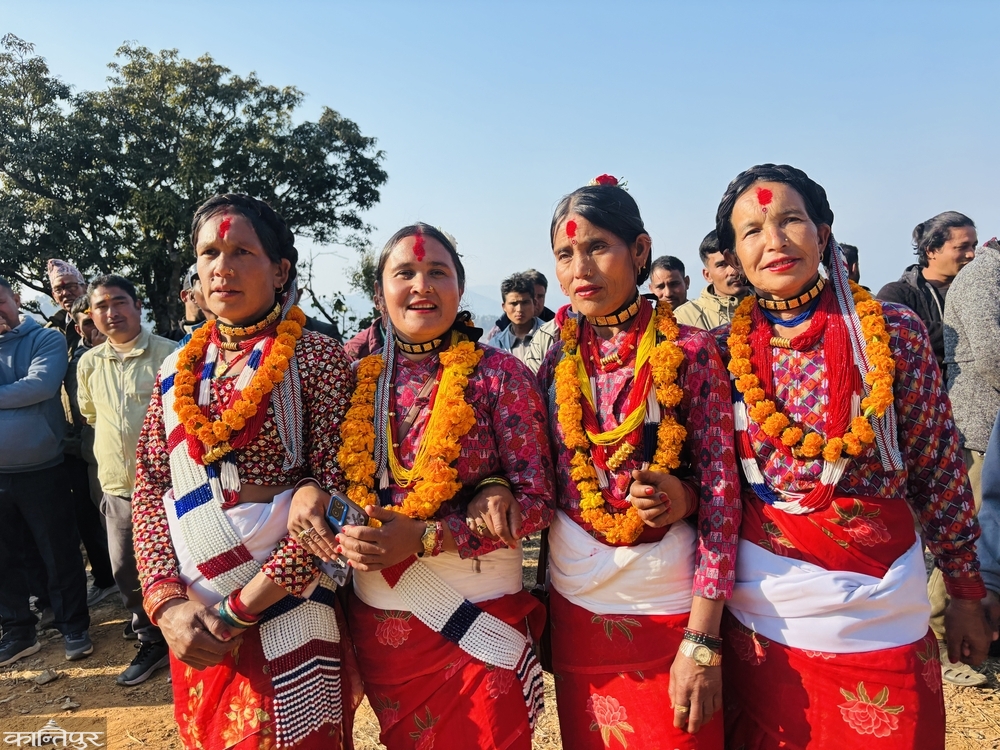
Amana's determination gradually started to fill not only the family, but also other women in the village. ‘A small group has formed among those who say that women should not play Deuda,’ said Amana. ‘After I came out, my niece Sharada Bohara and 51-year-old Deurani Gauri Rokaya also gathered courage.’
Now, the group of these three is well-known in the Deuda Khlas of Achham, Bajura, Doti and Kalikot. The society that used to chatter yesterday now flocks to see their art.
This group is now also successful commercially. They are invited professionally for weddings, fasts, political party programs, and other cultural programs. During the wedding season and elections, they are often invited to play Deuda. They are honored with garlands of flowers and garlands of money.
First a desire, now a way of earning money.
When this group has to go somewhere to play Deuda, they charge at least 30,000 rupees. Not only has she made herself financially self-sufficient, she has set an example that single women and rural women can also live a respectable life by selling their art.
‘Although it is natural for Deuda to have love and affection, for us it is a means of preserving a sacred art and culture,’ says Amana. ‘Deuda has become like a medicine for me, which makes me forget the pain of losing my husband and the loneliness of being a single woman.’
Despite this decade-long continuity, Amana says that the narrow-minded view of society has not completely changed. ‘No one is afraid of Amana, Sharada and Gauri Trimurti anymore,’ she said, ‘We have proven that art has no caste, religion or status.’
She said that it was not easy for Deuda to find its footing in the remote and Karnali region, while going through the ups and downs of Rama Roshan. "Even the mountain-like walls that society has built can be easily broken down with a piece of song," she said. "When many see our team, they say that women's voices are now becoming louder in the distant Deuda culture."

