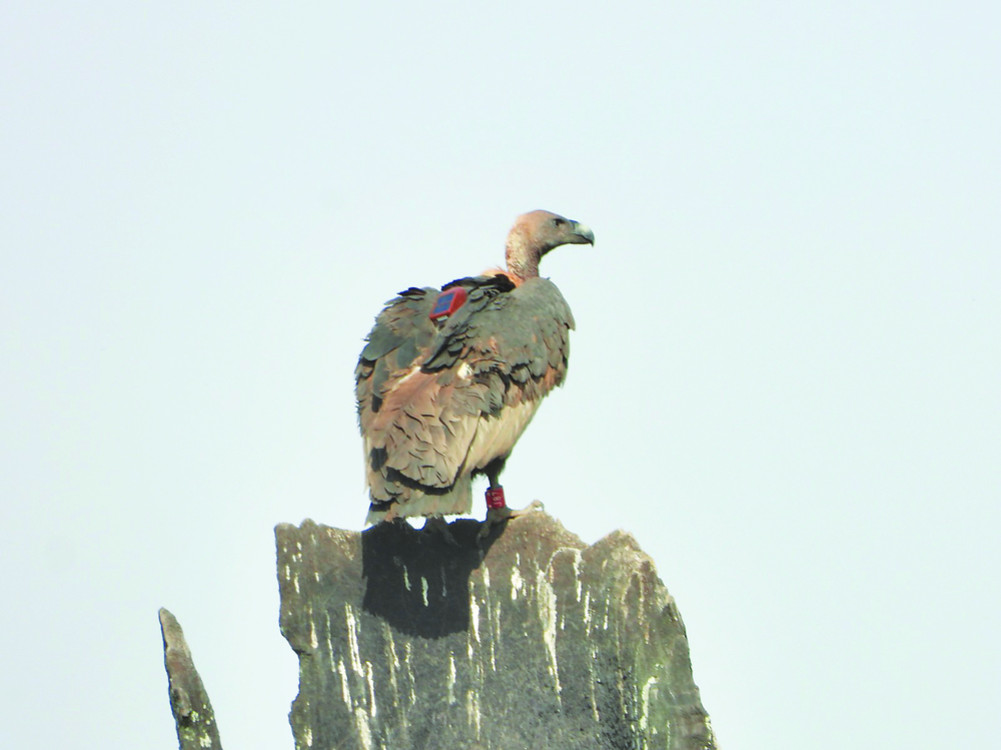
According to Dilip Chand, project officer of the Nepal Bird Conservation Association, the vulture is still roaming in the forest areas around Sagar.
We use Google Cloud Translation Services. Google requires we provide the following disclaimer relating to use of this service:
This service may contain translations powered by Google. Google disclaims all warranties related to the translations, expressed or implied, including any warranties of accuracy, reliability, and any implied warranties of merchantability, fitness for a particular purpose, and noninfringement.
How far can a vulture, considered to be a predator of nature, fly in a day in search of food? A vulture equipped with a Global Positioning System (GPS) in the Tarapur area of Shuklaphanta National Park has reached Maharana Pratap Sagar (Pong Dam) in Himachal Pradesh, India.
The vulture, which was GPS-tagged on 23rd Chaitra, had reached Maharana Pratap Sagar on 4th Chaitra. According to Dilip Chand, Project Officer of the Nepal Bird Conservation Association, the vulture is still roaming in the forest area around the Sagar. “After leaving here, the vulture is roaming in the forest around the dam,” he said.
The adult vulture of the Dangar species, which reached Maharana Pratap Sagar area after covering an air distance of 520 kilometers from Tarapur area of Shuklaphanta National Park. The vulture reached Himachal via Jim Corbett National Park in India. The Bird Conservation Association is also coordinating with conservationists in India to study the vulture. Chand informed that there is continuous coordination with the Bombay Natural History Society (BNSC), which is working on vulture conservation in India. ‘The movement of the vulture is good, that is why it seems that there is no problem now,’ he said, ‘If it stays in one place, there may be some problem, but that is not the case now.’ He also informed that discussions are underway to send a team of the Bird Conservation Association to Himachal to understand the condition of the vulture.
By March 2025 and 2026, the association had installed GPS on 15 dungar vultures in the Hirapur and Tarapur areas of the park. Of these, 11 are adults and 4 are semi-adults. Other vultures have also been found to return to Pithoragarh, Lohaghat in Uttarakhand, India, and the Mahakali River in Uttar Pradesh in search of food.
These vultures have reached Pancheshwor and Mailauli in Baitadi, Amargadhi in Dadeldhura, and Godavari in Kailali. ‘It is also seen that vultures return to these areas in a single day and return after wandering for one or two days,’ said Hirulal Dagoura, an ornithologist at the Bird Conservation Association, ‘vultures are traveling far and wide in search of food.’
The GPS has been installed to study the journeys made by vultures in search of food and habitat. The association had also studied vultures by installing GPS a decade ago. The study is still being conducted regularly. ‘Where has the vulture gone every day? How far has it traveled? Everything is being studied,’ said Project Officer Chand, ‘If there is no movement of any vulture on a certain day, we have to go for rescue.’ According to him, vultures have been rescued from various areas of India with the help of BNHC before.
The Hirapur and Tarapur areas of Shuklaphanta National Park are considered suitable habitats for vultures. Vultures are regularly seen in those areas. The association has been installing GPS in vultures from that area.