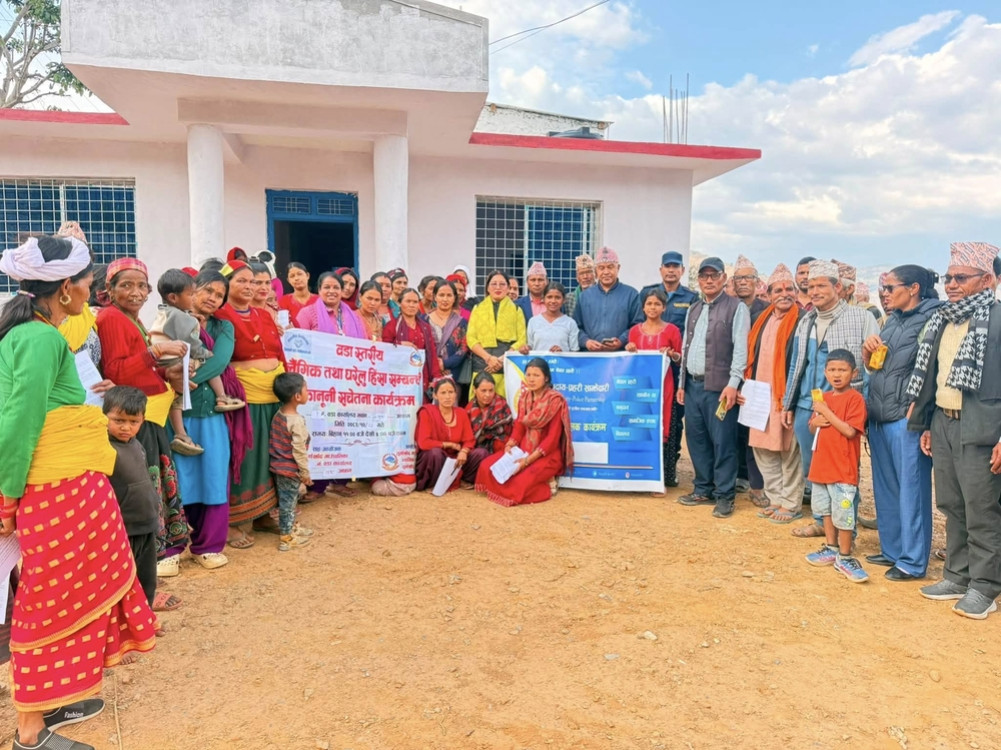
Women here are hesitant to bring their pain to light due to lack of legal awareness. The old mentality of considering the police administration more trustworthy than the judicial committee still persists in the villages.
We use Google Cloud Translation Services. Google requires we provide the following disclaimer relating to use of this service:
This service may contain translations powered by Google. Google disclaims all warranties related to the translations, expressed or implied, including any warranties of accuracy, reliability, and any implied warranties of merchantability, fitness for a particular purpose, and noninfringement.
The local judicial committee coordinator is having a hard time resolving cases for the deputy mayor or vice-mayor of the municipality. They have said that due to lack of legal knowledge, local level 'judges' have not been able to play an effective role. Few of them come from political backgrounds. Some have reached the level of justice through the stove and fairs.
The second local level election changed the rhythm of life of 48-year-old Sardevi Khadka of Chaurpati Rural Municipality-5. Active in social activities, she has become the vice-mayor from the Nepali Congress. She has studied only up to the 2nd grade. Now, she is the coordinator of the rural municipality's judicial committee as per the constitutional provisions. In the early days, as she did not understand the law, she needed help in the case debate and decision-making process. 'I got married at the age of 13. I studied up to the 2nd grade with my family,' she said, 'then I fell ill and dropped out of school.' There was no time like now when I felt like I had to study. She said that she used to participate in social activities in the village. She said that she did not think that she would become the vice-chair of the rural municipality when the responsibility of the judicial committee came up.
She decided to go to school at an older age to face the challenges of fulfilling the responsibility. ‘The coordinator of the judicial committee used to say that he was the judge of the rural municipality,’ she said, ‘But, I had a problem even recognizing letters. How can I administer justice if I am not educated?’ Now, even though she has left other work, she studies daily. She said that the responsibility of the judicial committee made her a student. ‘Now I have decided to enroll in grade 9 and study,’ she said. This year, she passed grade 8.
There is still no courtroom with physical infrastructure in Chaurpati, and there are no legal advisors available. Khadka has been resolving domestic violence and in-laws’ disputes through reconciliation. ‘We will keep an eye on the cases sent after reconciliation to see if they are reconciled or not,’ she said. ‘There have been no problems with the cases sent after reconciliation so far.’ According to her, a courtroom and a judicial committee advisor are needed. She said that these things have not been completed yet. She said that three cases have been sent after reconciliation in the current fiscal year.’
Bimala Shahi, former district secretary of the NGO Federation and vice-chairwoman of Turmakhand Rural Municipality, said that she had to face legal and practical complications in this area. Shahi, who studied up to M.Ed., had a hard time playing the role of the judicial committee in the initial days. ‘I had no knowledge about law. I had not even taken any training,’ she said. ‘I have taken training 4/5 times now. It has become easier than before.’
She said that giving the responsibility of administering justice to someone who comes from politics also causes confusion at first. She says that geographical remoteness and lack of legal awareness are the main challenges. ‘The responsibility of the judicial committee is a new experience for me,’ she said, ‘People far from the headquarters do not have access to justice.’ Turmakhand has allocated a budget of 500,000 for legal awareness and has organized awareness programs in 8 wards. ‘There have been no very complex cases,’ she said, ‘domestic disputes are resolved through reconciliation.’
Article 217 of the Constitution provides for a three-member judicial committee at the local level under the coordination of the deputy chief or vice-chairman. Following the constitutional provision, the responsibility for law and justice at the local levels lies with the vice-chairman and deputy chief. Due to the lack of adequate resources, physical infrastructure, and legal support, complications have been seen in the administration of justice.
The experience of Netrakala Devi Shahi, vice-chairman of Dhakari Rural Municipality, clarifies the challenges seen in the role of the judicial committee. She was only an active member of the Nepali Congress, who studied till 12th grade. Known as a leader in the village, she won the post of municipal vice-chairperson. After that, judicial responsibility came to her shoulders. She says that citizens are not sufficiently informed about the jurisdiction of the committee and its legal status in rural areas. According to her, women hesitate to express their pain due to lack of legal awareness in the villages. The old mentality of considering the police administration more trustworthy than the judicial committee still persists.
‘I became a people’s representative without understanding politics,’ she said, ‘Four years have passed in confusion about how to work in the judicial committee.’ According to her, cases of heinous crimes like rape also come to her saying that they need to be resolved. She said that such cases are sent directly to the police. She said that citizens do not come to the committee because they trust the police more than the judicial committee. There are no legal advisors in the municipality. She said that there is social pressure to settle rape and other serious criminal offenses in the village.