Complaints about lack of budget for studies.
We use Google Cloud Translation Services. Google requires we provide the following disclaimer relating to use of this service:
This service may contain translations powered by Google. Google disclaims all warranties related to the translations, expressed or implied, including any warranties of accuracy, reliability, and any implied warranties of merchantability, fitness for a particular purpose, and noninfringement.
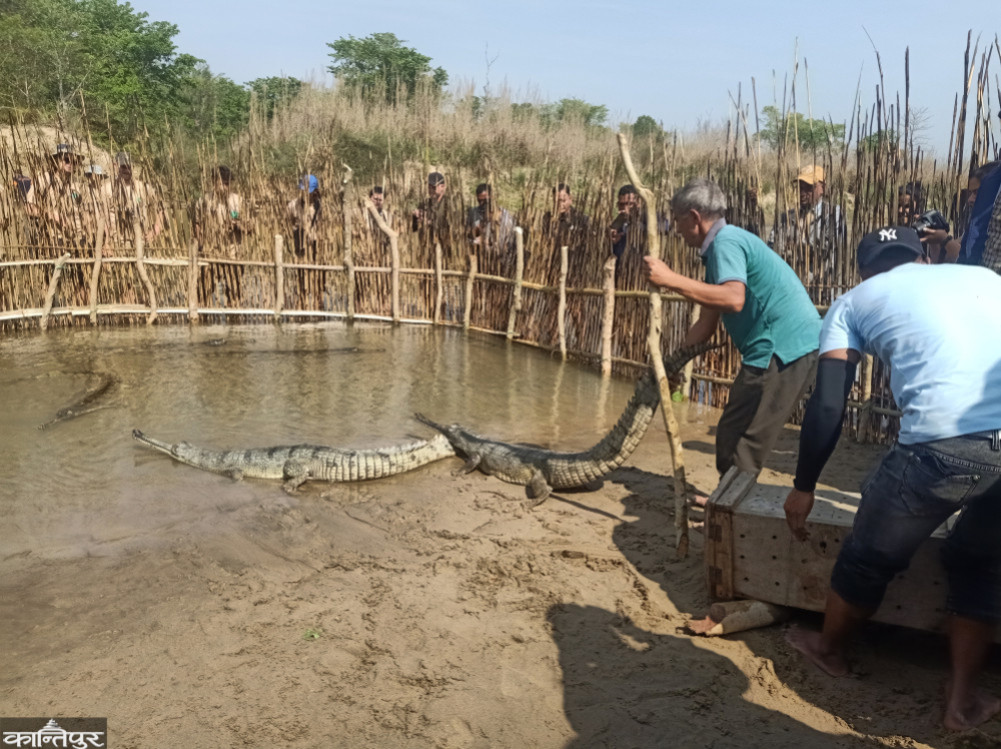
Two years ago, a gharial crocodile was released in the Chaudhar River of Shuklaphanta National Park. 25 gharial crocodiles brought from the Kasara area of Chitwan were released in the Pitarghat area of the Chaudhar River in Chaitra, 2080. Although the crocodiles were regularly monitored for some time after their transfer, there is not much information about their condition now. Monitoring has not been carried out.
The crocodiles were regularly monitored for the first one or two months. At that time, they were seen around the transfer area. Monitoring has not been carried out since then. The park complains that regular studies have not been carried out due to lack of budget and manpower.
‘We don’t know what the crocodile’s condition is now. No crocodiles have been seen in the Chaudhar River,’ said Purushottam Wagle, conservation officer of Shuklaphanta National Park. ‘There were reports of it being seen in the Chaudhar River around Beldandi in the winter around Magh, but it was not confirmed whether it was a gharial or something else.’
During the relocation, a fence was put in a certain area. It was placed in two fences to ensure that it could blend in well. The crocodile broke through the fence and entered the river unhindered. Since then, regular monitoring has been carried out for a few days, but no inquiry has been made about its condition.
‘There is no separate program for the study of the gharial, we do not even have the technical manpower,’ said Wagle, the park’s conservation officer, ‘The department itself should decide the program for the study or it can be done only with the approval of the department.’ According to him, a budget of around Rs 3/4 lakh is required for the study.
Only technicians who have knowledge about the habitats, food, etc. where crocodiles can live can conduct the study. Such technicians are not in Shuklaphanta National Park. Wagle says that the study should be done by hiring them from the department or Chitwan.
The flood that occurred in Ashar 2081 also caused great damage to the park area. It is also estimated that the flood in the Chaudhar River at that time may have washed the gharial away and reached India. The survival rate of the relocated gharial is very low. Technicians say that the survival rate is low in the area where it was transferred from the breeding center due to lack of food, new migration areas, etc. .
The endangered gharial lives in clean water . Its food is fish . The river where the gharial lives is considered clean . Gharials are also considered important for the cleanliness of the river and water .
Gharial crocodiles were seen in the Chaudhar River in the 1990s . Based on that, a feasibility study was conducted and 25 crocodiles were transferred from the Kasara area of Chitwan . There was a plan to transfer 50 gharials to the Chaudhar River . But after transferring 25 in the first phase, the program was limited to that .