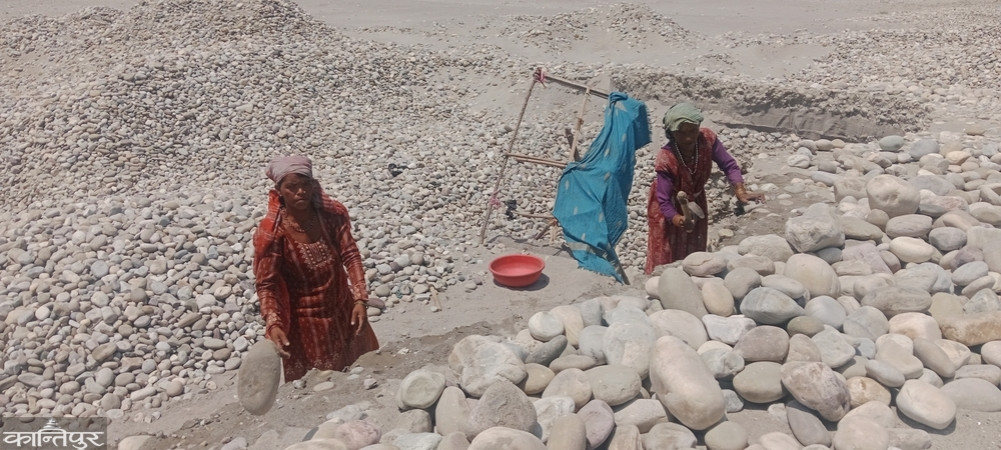
”It's very hot, and it's impossible to walk around during the day,” says Draupati Sarki of Bhujela, Bhimdatta Municipality-11, who has been sorting gravel and sand in the Mahakali River for four years. ”We have to work with our faces covered with cloth.”
We use Google Cloud Translation Services. Google requires we provide the following disclaimer relating to use of this service:
This service may contain translations powered by Google. Google disclaims all warranties related to the translations, expressed or implied, including any warranties of accuracy, reliability, and any implied warranties of merchantability, fitness for a particular purpose, and noninfringement.
Jitram Parki of Mahakali Tole, Bhimdatta Municipality-11, Bhujela, is 50 years old. He lives on the banks of the Mahakali River and has spent more than half of his life in the Bagar. His daily routine is to reach the Bagar carrying a shovel in the morning and return home only late in the evening.
He has been working as a sand and gravel carrier in the Bagar of Mahakali for 25 years. He has been supporting his family by selling the sand and gravel he carries. He reaches the Bagar of Mahakali around 6/7 am with his wife Tara. In the afternoon, he eats lunch brought from home and returns home around 6/7 pm.
In the middle of the month of Jestha, the heat is increasing day by day in the Western Terai. The maximum temperature is reaching 40/41 degrees. It is impossible to walk in the Bagar of Mahakali during the day due to the hot stones and sand. Moreover, the hot sand that comes with the heat makes it impossible to work. Ignoring all this, hundreds of workers like Parki are now busy moving gravel and sand in this same area. 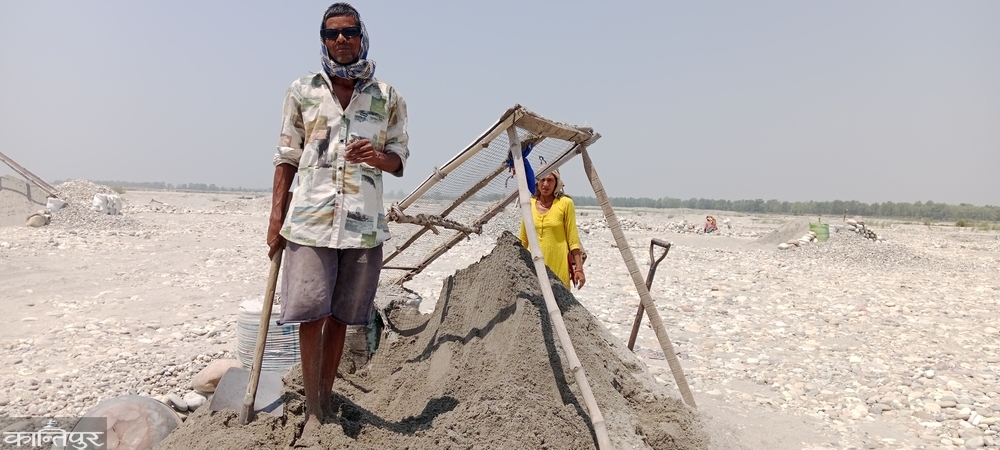
‘The heat is so intense, what can we do if we can’t work during the season? It’s a problem to even get food,’ Parki said. ‘We take a one-hour break during lunch, and at other times we have to work regardless of the sun and rain.’ Parki says that two people can pick a trolley of sand in two days. Currently, a trolley of sand is being sold for 1,700. Similarly, two people can pick a trolley of gravel in four or five days. The gravel is being sold for 2,700.
The work of picking gravel and sand in Mahakali is carried out from Kartik to Jestha. Since the excavation work stops in mid-June, work is going on in full swing even in the scorching heat. Some people have built huts in the riverbanks at this time. They say that it is a waste of time to come from far away and live in the riverbanks.
‘It is very hot, and it is impossible to walk around in the heat during the day,’ says Draupati Sarki of Bhujela, Bhimdatta Municipality-11, who has been working in the riverbanks of the Mahakali for four years. ‘You have to cover your face with a cloth and work.’ She said that on very hot days, she takes a break for three to four hours during the day. 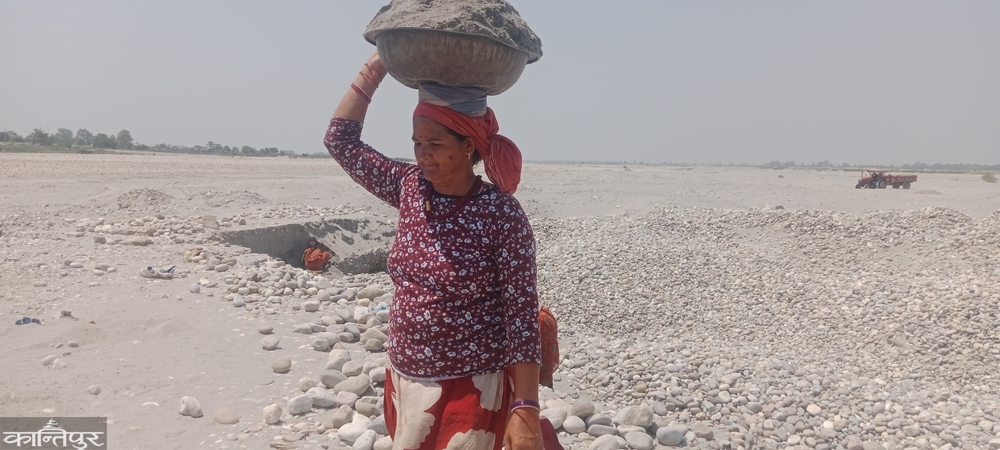
Draupati also reaches the riverbanks in the morning. She returns home only in the evening. Sometimes, when the water level in the Mahakali rises, there is a problem in coming and going. She says that sometimes the water level rises and we have to stop in the riverbanks.
She has half a katta land in her name. She has built a small house on it. She has incurred a loan while building the house and sending her husband for foreign employment. She says that she is working in the field of gravel and sand, regardless of the heat, as it is difficult to meet household expenses.
67-year-old Gojadi Sarki is also working in the field of gravel and sand with her niece Lila. She migrated from Lekam in Darchula and reached the banks of the Mahakali River and has been busy with the field for the past four or five years. She said that if she can carry a trolley of sand in two or three days, she will earn seven or eight hundred rupees.
Her sons have gone to India for employment. Her husband is old and cannot work. She has to buy everything. Sarki is busy using shovels and spades in the Bagar even in her old age, hoping to make it easier for her family to make ends meet. She says that only after she can dig and move gravel and sand with the same shovels and spades can she earn a living in the evening and morning.
Whether it is the bitter cold of Pus-Magh or the scorching heat of Baisakh-Jeshah - at any time, hundreds of workers like Sarki are seen busy moving gravel and sand in the Bagar. Those who have come from far away have stayed in the Bagar even in the bitter cold. They are still living in huts in the Bagar. They return home only after the excavation work in the river and canal stops in mid-Jeshah. This means that along with those who work in the Bagar, those who have come from various parts of Kailali and Kanchanpur have also come from the hilly districts of the Far West. Some Indian citizens are also seen carrying sand and gravel.