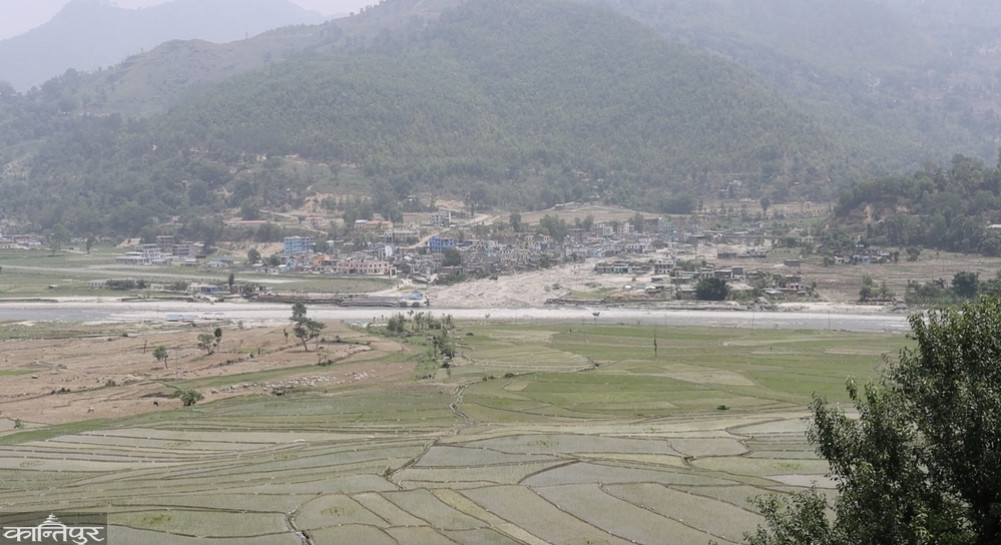
The primary objective of this project was to stop migration, but the results were the exact opposite, said Rajendra Kunwar, mayor of Sanfebagar Municipality.
We use Google Cloud Translation Services. Google requires we provide the following disclaimer relating to use of this service:
This service may contain translations powered by Google. Google disclaims all warranties related to the translations, expressed or implied, including any warranties of accuracy, reliability, and any implied warranties of merchantability, fitness for a particular purpose, and noninfringement.
The 15-year-old government plan to develop 10 markets around the Mid-Hill Highway into a well-organized and modern new city has now fallen into disrepair. The project's goal seems to be on one side, but the results are going in another direction. According to the project, the integrated development plan, which was launched with the aim of settling at least one lakh people per city by 2090 and stopping migration from the hills, is as if inactive. There is now a problem of budget freeze. There is no plan on what to do. This project has fallen into government apathy.
Although the government has been claiming to have assimilated the balanced urban development of the National Urban Policy, 2071 and the United Nations' Sustainable Development Goals, the ground reality is different and disappointing. The Integrated Development Plan (IDP) report of the New City Project has envisioned Sanfebagar in the district as a major regional economic center in the hilly region of the Far West. The report has prepared a list of well-organized road networks, sewage disposal, open spaces and modern urban facilities. According to the experience and understanding of Rajendra Kunwar, the mayor of Sanphebagar Municipality, the situation of government documents and on-site work is reversed.
According to him, the implementation of the project is weak. The plan is limited to paper. Even the budget received is not being spent. ‘Last fiscal year, the allocation of Rs 60 million for the new city was frozen without any work,’ he said. ‘On the one hand, there is a tendency for contractors not to work, on the other hand, there are complications in the budget implementation process.’ He said that the budget has not been received for the project this year. Kunwar said that according to the Municipal Development Act, 2045, a committee will be formed with the chief chairman of the concerned local level and that the same act is the only legal basis for the new city project. ‘Even after so many years since the project started, there is no legal basis,’ he said. ‘Work is being done based on the Municipal Development Act, 2045.’ The government is not serious about these issues. The government report has considered the 38-year-old Urban Development Act as the legal basis. Due to this, there are frequent legal hurdles in the construction of complex infrastructure and land management of modern cities. The government came up with a concept targeting one lakh citizens, he said, but there was no concrete plan and will to fulfill it. The primary objective of this project was to stop migration, but the result has been the opposite. He said that the flow of people from the hills to the Terai and Kathmandu has not stopped due to the lack of production and self-employment opportunities at the local level. According to him, villages in the hilly areas are becoming empty. The technical report of the project has shown that about 19.9 percent of the land in Sanfebagar is more than 30 degrees, making it very challenging for physical infrastructure development. He says that in such a geographically complex area, additional investment, special engineering, and continuous budget flow are needed, but the allocated budget is cut or the amount received is frozen, which is a challenge in achieving the goal of establishing a city by 2090.
According to international standards, a new city is considered a new city if it has education, health, creativity, security and inclusion, information technology, infrastructure, online services, transparent and open government, identity, innovative entrepreneurship, productivity, and green business. Infrastructure such as bus parks, amusement parks, vegetable markets, roads, drinking water, sports fields, modern settlements, schools, colleges, hospitals, vegetable markets, and industrial areas are available.