All schools in Surma and Saipal rural municipalities, as well as schools in Talkot, Masta, Kedarsyun rural municipalities, and the northern areas of Bungal and Jayaprithi municipalities, have been closed until mid-June.
We use Google Cloud Translation Services. Google requires we provide the following disclaimer relating to use of this service:
This service may contain translations powered by Google. Google disclaims all warranties related to the translations, expressed or implied, including any warranties of accuracy, reliability, and any implied warranties of merchantability, fitness for a particular purpose, and noninfringement.
While the government is running a nationwide school enrollment campaign, dozens of schools in Bajhang have been closed for the collection of yarcha. Most of the schools here have been closed until mid-Jeshta as all the students have gone to the lake to pick yarcha.
All schools in Surma and Saipal rural municipalities and schools in the northern areas of Talkot, Masta, Kedarsyun rural municipalities and Bungal and Jayaprithi municipalities have been closed until mid-Jeshta. Locals have said that more than 50 schools in this area are closed. Student enrollment in those schools will begin from Asad 1.
Since yarcha is the main source of income, children from 7/8 years old to the elderly who can walk have gone to the lake this season. After the school closure, teachers along with students have also started going towards Patan to collect yarcha. ‘We are also preparing to go to Lek in a day or two,’ said Jeevan Bohara, a teacher at Kanda Secondary School in Saipal. ‘Rather than staying at home when schools are closed, if we go to Lek, we will also earn income.’ He said that most teachers who live in other municipalities also go to Lek with their students.
Since the students have gone to Patan with their parents, admissions will start from Asad 1, said Gyan Bahadur Bohara, head of the education and sports branch of Saipal rural municipality. There is also a plan to admit students only from Asad 1. Schools in this area are closed for one and a half to two months every year during the yarcha collection season. The vacation during this period will be combined with the rainy season, said Bohara, head of the education branch of Saipal.
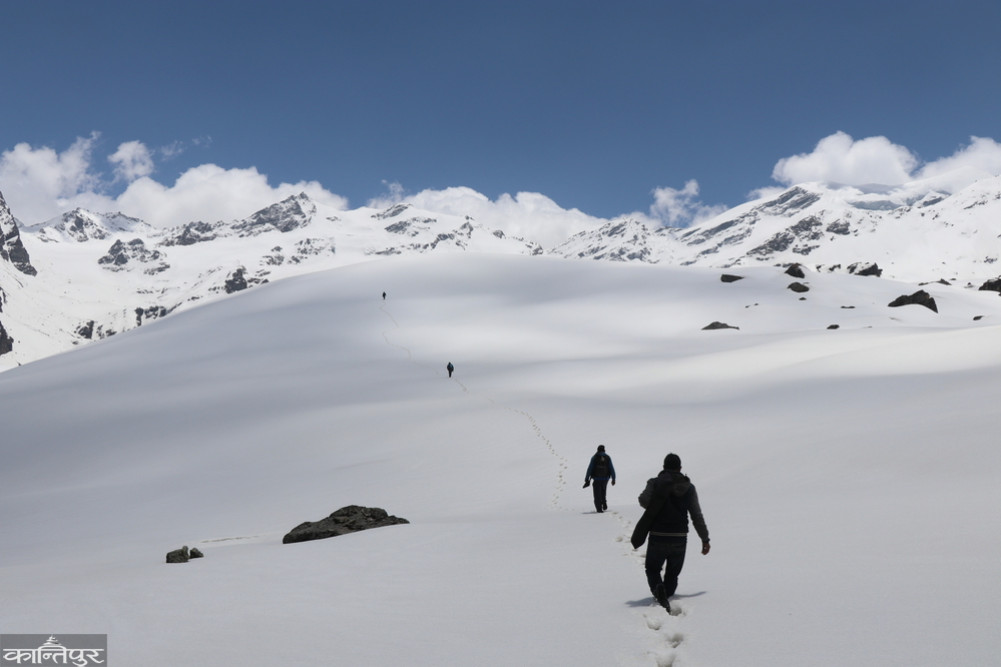
Most of the families have already left. Some of the remaining families are preparing to leave today. Now, all the villages will be empty in two to four days. -Rajendra Dhami, Former Chairman, Saipal Rural Municipality In mid-Baisakh, the sky in Saipal changes shape in an instant. Sometimes there is a glimmer of sunshine. Suddenly, black clouds appear and it starts snowing with thunder. Since the last week of Chaitra, this cycle of weather has been repeated daily, and the Yarcha Patans here have become black with snow. The road to Patan is also covered with snow.
The journey to Patan to collect Yarcha has become more difficult due to the continuous snowfall. 'There is snow all over the road. When there was no snow, we could reach Patan in two days. This time it took three days,' said Tasi Tamang of Saipal Rural Municipality-4, who reached Syangban Patan with relatives and neighbors, shoveling snow. 'The road has also become slippery and dangerous due to the snow.' He said that the difficult road of cliffs, mountains and rocks is even more dangerous due to the snow. "It has become more difficult for children and women, we have barely reached the place where we will pitch our tents," he said.
Like a Tassi, who was supposed to reach Patan to collect yarcha in early April, the collectors of Bajhang are leaving for Patan two weeks late due to continuous snowfall. They are going to Patan at great risk, hoping that the snow will melt in a day or two if the weather clears. The collectors, who had reached the village after delivering provisions towards the end of Chaitra, had stayed in the village in the hope that the weather would clear.
‘This is the time when insects are more abundant, if the sun shines, the snow will melt,’ said Dhansara Bohara of Dhalaun, who walked from Saipal to Raidhugi Patan, ‘We will stay in tents until the weather is clear, and I walked thinking that we will look for insects as soon as the snow melts.’ She said that some who reached Patan in the first week of Baisakh have already started looking for yarcha.
Not only Saipal, but this year most collectors from Talkot, Surma, Masta, Chhabis Pathivera, Durgathali Rural Municipality, Bungal and Jayaprithi Municipality have come out late to collect yarcha. As the locals head towards the lake with their families, the villages in the northern region have started looking deserted. They go to Patan with the necessary tarpaulins, tents, food, clothes and other daily necessities. Those who have sheep, horses and mules carry the goods to the collection area on four legs and those who do not have them carry them. Most of the collectors' families go to Patan towards the end of Chaitra to pitch tents and gather firewood, and then other family members climb the mountain.
During the Yarcha collection season, people from the northern part of the district who have gone to Dhangadhi, Mahendranagar, Kathmandu and other places for work and studies also return. Birendra Rokaya of Talakot said that locals who have gone to various places in India for short-term employment also come during this period. Locals from all the villages in the northern region stay in the Yarcha collection area from Baisakh to Asar. Only the disabled, the elderly, newly-born women, and children who cannot walk are left in the village. 'Most of the families have climbed the mountain,' said Rajendra Dhami, former chairman of Saipal Rural Municipality. 'Some of the remaining families are also preparing to leave today. Now, in two to four days, all the villages will be empty.'