According to a 2020 study of hill water resources conducted by the Water Utilization Foundation, 25 to 30 percent of traditional springs in Achham have completely dried up.
We use Google Cloud Translation Services. Google requires we provide the following disclaimer relating to use of this service:
This service may contain translations powered by Google. Google disclaims all warranties related to the translations, expressed or implied, including any warranties of accuracy, reliability, and any implied warranties of merchantability, fitness for a particular purpose, and noninfringement.
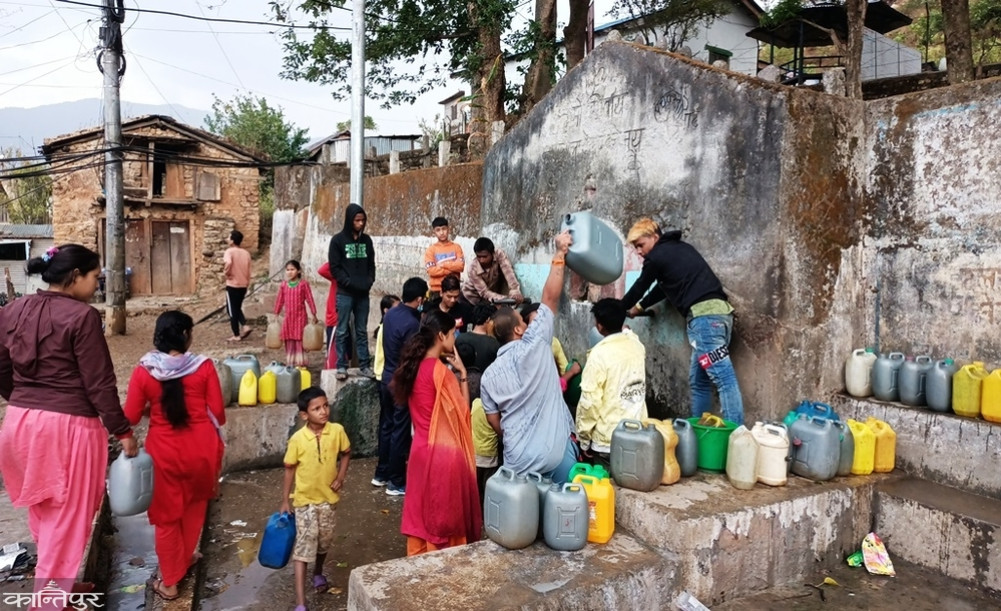
Mangalsen-5's Maina Bik is 65 years old. She spent 6 decades of her life around the same stream. Since she got married at the age of 7 and came to Mangalsen, her daily life, which has been filling water from the Jharfunga stream, has changed dramatically. 'We have been drinking water from this stream for years.' Earlier, there was a lot of water in the stream,' she said, 'We didn't have to wait in line. Now, we have to wait in line for 4/5 hours.' She said that water stopped flowing in the stream after the spring dried up.
80-year-old Udayaram Jaisi of Mangalsen-5 is a witness to the water crisis. He says that the current weather and water sources are not like before. 'Now, it neither rains on time nor does it get sunny,' he said, 'The more the spring dries up, the more time has changed between then and now.' It's amazing to see this.' Jaisi's experience is also confirmed by the data from the Demographic and Health Survey 2022. According to the survey, the average time taken by women in rural areas of the district to fill a jug of water has increased from 45 minutes to 3 hours.
The problem of drinking water is not limited to the district headquarters. According to Manasara Bhandari, 55, of Mangalsen-6, there is a rush to fill the only well in the village from early morning. She said that she is unable to do household chores while waiting for turns to fill. 'There is no flow, the water from the well becomes murky when everyone fills it and carries it,' she said. 'There is a shortage of drinking water here for months.' She said that the water shortage has occurred after the spring dried up due to drought. 'The villagers have left the settlement because they have to suffer for drinking water,' she said. According to him, the shortage is due to the drying up of the streams and springs. According to Amarnath Shahi of Kamalbazar-6, the water sources are being buried and dried up due to the indiscriminate digging of roads. ‘Indiscriminate digging of roads did not take into account cultivable land, community forests and water sources,’ he said, ‘this also led to their destruction along with development.’
In 2018, during a study conducted by the then District Land Conservation Office, it was found that an average of 3 to 4 natural drinking water sources per 1 kilometer were directly buried or diverted during the construction of rural roads without conducting an environmental impact assessment (IEE). Technical analysis has shown that about 25 percent of the district’s traditional wells and ‘recharge areas’ (water-receiving areas) of the ponds have been completely blocked by the soil and debris generated by the road excavation.
The study warned that water discharge in the district's main watershed has decreased by 15 to 20 percent compared to the previous 5 years, and revealed that more than 90 kilometers of drinking water and irrigation infrastructure are at high risk of landslides.
According to the district administration's 2024 data, 132 drinking water taps, 48 wells, 21 water ghats and 14 small hydropower projects in the district are at risk of landslides due to the unorganized use of dozers. According to former District Coordination Committee Chief Nar Bahadur Kunwar, roads have been dug without technical studies. 'Dozers were used to cut through forests, settlements and water sources,' Kunwar adds, 'roads have been dug without technical studies. In some places, roads have been dug in a different direction than the one studied.'
The municipality had taken the initiative a few years ago to protect the springs. In 2076, more than 1,200 recharge ponds were built in 3 days in Chaurpati Rural Municipality under the leadership of the then chairman Harka Bahadur Saund. The locals had started efforts to revive the springs by donating their labor.
The ponds, which were built with the aim of collecting rainwater on uncultivated land, were profitable in the first year. However, the ponds have been buried in the soil. According to Chaurpati Rural Municipality Chairman Bhim Bahadur Saund, the problem is that the new leadership that came after the 2079 local elections did not continue the plan to recharge the ponds.
According to Ambika Chalaune, mayor of Panchadeval Binayak Municipality, the problem has been further complicated by the local level not following environmental standards while constructing roads and not paying attention to effective work such as recharge ponds. ‘Even though the road connects the village, the same road has killed the water source that is considered the lifeblood of the village,’ she said. ‘With the increasing number of young people going abroad and moving to the Terai, only the elderly and children are left in the village, which has led to an extreme shortage of manpower for farming and social work.’
Women and teenagers are suffering from the water crisis. Indra Kami of Mangalsen-10 spends her days collecting water. ‘The days pass by filling up with water.’ She said. ‘We cannot do household chores. We struggle day and night for drinking water.’
Along with the hassle of household chores, taking care of children and cattle, the worry of running out of water in the source also causes mental stress for women. According to local teenager Ishika Bhandari, she misses school when she goes to the river to bathe and wash clothes during her period. 'During her period, she has to bathe and wash clothes for 7 days,' she said. 'Even if she goes that far, she doesn't get a turn, she misses school.'
The problem of hair loss is more common in women aged 20 to 45 due to the compulsion to carry water. Water scarcity is not limited to quenching thirst, it has also affected the agricultural sector, which is considered the mainstay of the district.
According to a report released by the Directorate of Agricultural Development, Sudurpaschim Province in 2023, wheat and barley production in Achham has decreased by 20 percent due to a 30 to 40 percent decline in winter rainfall.
As water sources dry up, irrigation canals are dry. Due to which, cultivable land has started to become barren. The current problem of 'environmental refugees' in the district is compounded by a 2020 study of hill water resources conducted by the Nepal Water Utilization Foundation, which found that about 25 to 30 percent of traditional springs have completely dried up. The move by more than 89,000 people to leave Achham is not just in search of employment but as a last-ditch effort to escape the water and gas crisis.