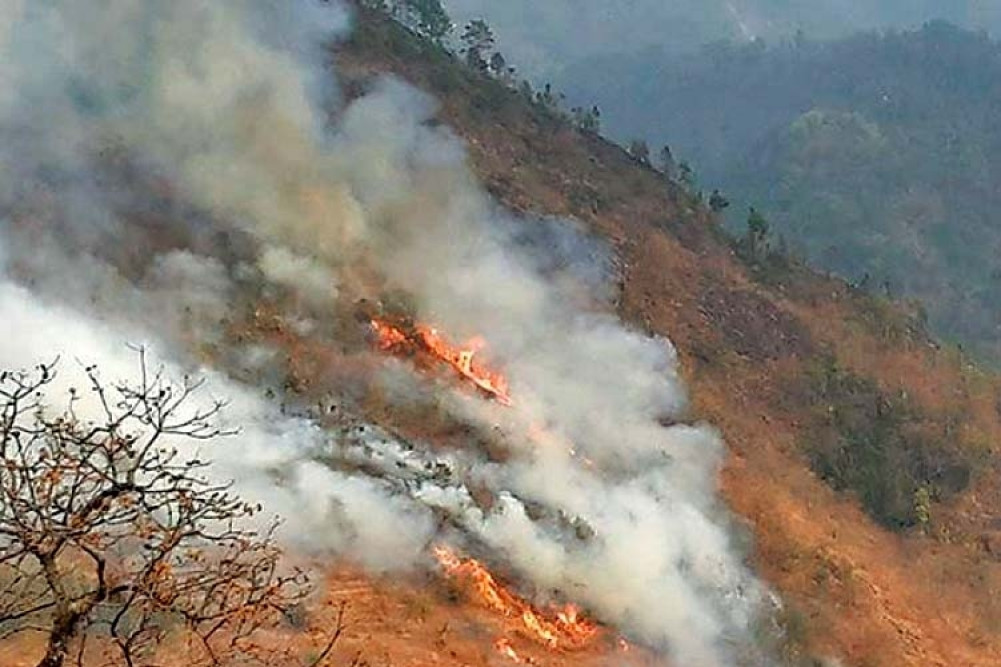
The lack of modern tools and equipment has made control even more difficult.
We use Google Cloud Translation Services. Google requires we provide the following disclaimer relating to use of this service:
This service may contain translations powered by Google. Google disclaims all warranties related to the translations, expressed or implied, including any warranties of accuracy, reliability, and any implied warranties of merchantability, fitness for a particular purpose, and noninfringement.
Forest fires have started increasing in the forest areas of the Far West Province. So far, about 15 percent of the forest area has been affected by it. According to Hemraj Bista, Director of the Provincial Forest Directorate, the impact of fires is particularly severe in the forests of the Chure region. This has directly affected forest conservation, biodiversity and the livelihood of local communities.
Director Bista said that the forest fires in the Chure region are more severe than in the plains. He said that although the fires can be controlled relatively easily in the plains with the active participation of community forest user groups and forest employees, the geographical remoteness of the Chure region has emerged as a major challenge.
'The Chure region is steep, remote and without a road network, reaching the fire-stricken area is risky, and some places cannot be reached at all,' he said. 'On top of that, there is a lack of modern machinery and equipment, which has made control even more difficult.'
He said that it is very challenging as forest security personnel and employees have to go to the Chure region on foot to control the fires. This has increased the risk of small fires turning into large fires.
According to him, human activities are the main cause of fires. Local herders set fires in the hope of quickly growing green grass, while picking mushrooms, burning wheat stalks in fields, and fires set while cleaning drains spread to the forest area, causing fires.
In addition, natural causes and climate change have also increased the risk of fires. Especially due to the effect of 'El Niño', as temperatures rise, the humidity in the forest area decreases and dryness increases, making the possibility of fires high. Its impact has also been felt in the forest areas of the Far West.
Fires have destroyed the habitat of wildlife and caused great damage to forest products including herbs, grass, and wood. This has had an adverse impact on the daily lives and income of local communities dependent on the forest.
The situation in Shuklaphanta National Park is relatively under control compared to previous years. According to the park's Assistant Chief Conservation Officer, Binay Kumar Jha, there have been fewer fires in the park area this year compared to previous years.
The park administration has stated that it has prioritized preparedness for fire control. Stakeholders have stated that the risk is increasing in the community forest area. According to Mahesh Dutta Joshi, Chairman of the Community Forest Coordination Committee, Kanchanpur, community forest officials and users have been protesting for a few days demanding the immediate implementation of the sustainable forest management procedure, so the necessary attention has not been paid to forest conservation.