He said that even the third generation had to join the movement demanding restoration.
We use Google Cloud Translation Services. Google requires we provide the following disclaimer relating to use of this service:
This service may contain translations powered by Google. Google disclaims all warranties related to the translations, expressed or implied, including any warranties of accuracy, reliability, and any implied warranties of merchantability, fitness for a particular purpose, and noninfringement.
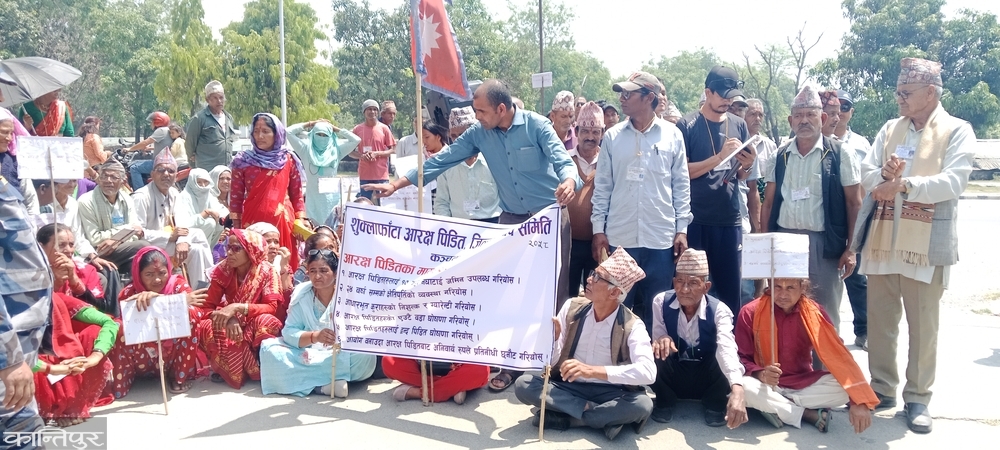
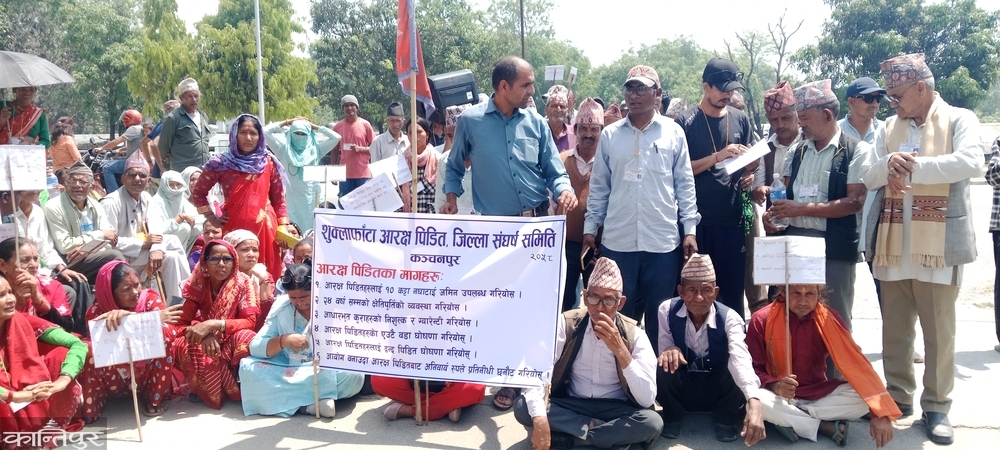
The displaced people of the then Shuklaphanta Wildlife Reserve have been holding rallies and sit-ins for a week. They are demonstrating despite the scorching heat. The displaced people, who have been living in huts on vacant land in front of the Division Forest Office, are holding demonstrations and sit-ins in front of the Mahendranagar market and the district administration every day, demanding rehabilitation. They had held a rally in the market on Wednesday and demonstrated semi-naked in front of the district administration.
The displaced people have been protesting under pressure since the formation of the new government. ‘Our movement has been going on for years, and it is still a continuation of that,’ said Krishna Prasad Bhatta, a displaced person during the expansion of the reserve. ‘Our property has been snatched, the government has not looked into it yet, injustice has been done to us.’ He said that even the third generation has had to join the movement while demanding rehabilitation.
The victim said that they were displaced at gunpoint during the crisis and that they are continuously putting pressure on them. ‘How much will we tolerate the agitation, oppression, and settlement abuses,’ said another displaced person, Nirmala Bhatta. ‘We have suffered everything, now we will continue to pressurize until our demands are met.’
They say that the district administration had to sit in front of the administration regularly to bring the problem of displacement to the government. ‘Who would have wanted to live in the scorching sun of Vaishakh?’ Another displaced person, Jeet Singh Air, said, ‘We have been suffering more than this for years.’ He said that he had to spend his days sometimes in the forest and sometimes elsewhere.
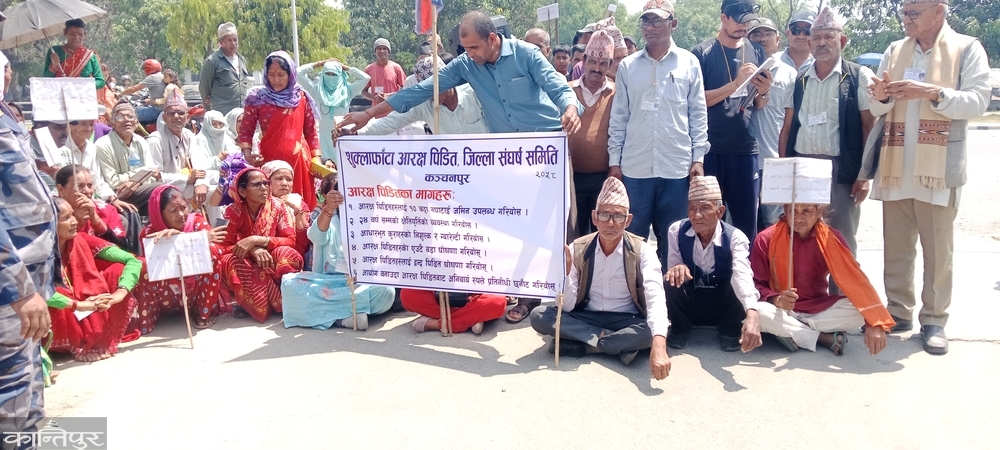
After the then royal hunting reserve was declared Shuklaphanta Wildlife Reserve in 2033, the eastern area was expanded. By 2058, the settlement was evacuated from the expanded area of the park. The problem of displacement, which started in 2033, has not yet been resolved. The eastern area of the reserve, which had an area of 150 square kilometers, was expanded to 305 square kilometers.
Shuklaphanta was upgraded from a reserve to a national park in 2073. Most of those displaced at different times have not been able to be resettled and have been living in the core area of the park and other forest areas.
In the Dhaka camp in the core area of the park alone, 602 displaced families are living in houses and tents. Similarly, 180 families are living in the Tarapur area of the park and 13 families in Lallare Danda.
Apart from this, the displaced say that 2,473 families are living in 14 different camps. There are also different figures from different commissions regarding the total number of displaced people. Some have said that 2,473 families have been displaced, while others have submitted reports to the government that the actual number of displaced people is less.
Various commissions and task forces have been formed since 2037 for the rehabilitation of the displaced. So far, 32 commissions have been formed. The commissions and committees formed with a period of 3 months to a year have not yet been able to identify the exact number of displaced people.
The last time the 32nd commission was formed under the coordination of former Court of Appeal judge Jayanand Paneru, it showed 2,027. Before that, in 2071, the commission of former Court of Appeal judge Thakur Prasad Sharma had submitted a report stating that the number of displaced people was 1,480 and that they should be rehabilitated. The previous commissions had put the number of displaced people at 2,473. The Sharma-led commission is the 29th.
The subsequent two commissions have taken the number determined by Sharma as the basis. The third commission formed under the coordination of Surendra Bam had recommended that 10 kattas of land or Rs. 6 million be given to the displaced people identified by Sharma's commission per family. The Paneru-led 32nd commission submitted its report on 26 Poush, 2081.
The commission has suggested that Rs 1 million per family be given as relief to those living in parks and forest areas and that they be immediately removed from the forest area, Rs 700,000 to families living outside the forest area, and Rs 500,000 to families who have received land certificates but have not been able to use the land.
Various commissions and task forces formed so far have distributed more than 4,042 bighas of land to 5,200 families in various places in the district. They have been resettled by giving them land in Bagphanta of Bhimdatta Municipality 19, Pipraiya of 13, Dhaka of Beldadi, Laxmipur of Rampur Bilasipur, Simalphanta of Shuklaphanta Municipality, and Sundarpur of Bedkot.

