Women's ornaments like Gunyu-Choli, Paisa Mala, Athanni-Chauanni reflect the social and cultural status. Items related to wedding rituals such as Doli used to carry the bride, traditional millstones, Dhikki, and clocks used for measuring time are also kept in the museum.
We use Google Cloud Translation Services. Google requires we provide the following disclaimer relating to use of this service:
This service may contain translations powered by Google. Google disclaims all warranties related to the translations, expressed or implied, including any warranties of accuracy, reliability, and any implied warranties of merchantability, fitness for a particular purpose, and noninfringement.
The ‘Dotyali Museum’ has been established with the aim of preserving the traditional lifestyle, customs and culture of the Far West. The Dadeldhura Public Library has built such a museum.
The Dadeldhura Public Library was established in 2061 BS. Materials that have been used for generations have been collected and preserved in the museum. Efforts are being made to pass on original materials to the next generation by establishing the Dotyali Museum since 2073 BS.
Daily consumption items, clothing, customs and traditional practices are gradually disappearing from the rural areas of the Far West. With the modern lifestyle, market influence and changing interests of the new generation, their preservation is becoming a challenge as old materials are disappearing from homes.
The library has stated that it has established the ‘Dotyali Museum’ to preserve such old materials and customs that are disappearing from society. Library chief Pushkar Bahadur Deuba said that the museum was built to preserve the materials used by our ancestors and pass them on to future generations. 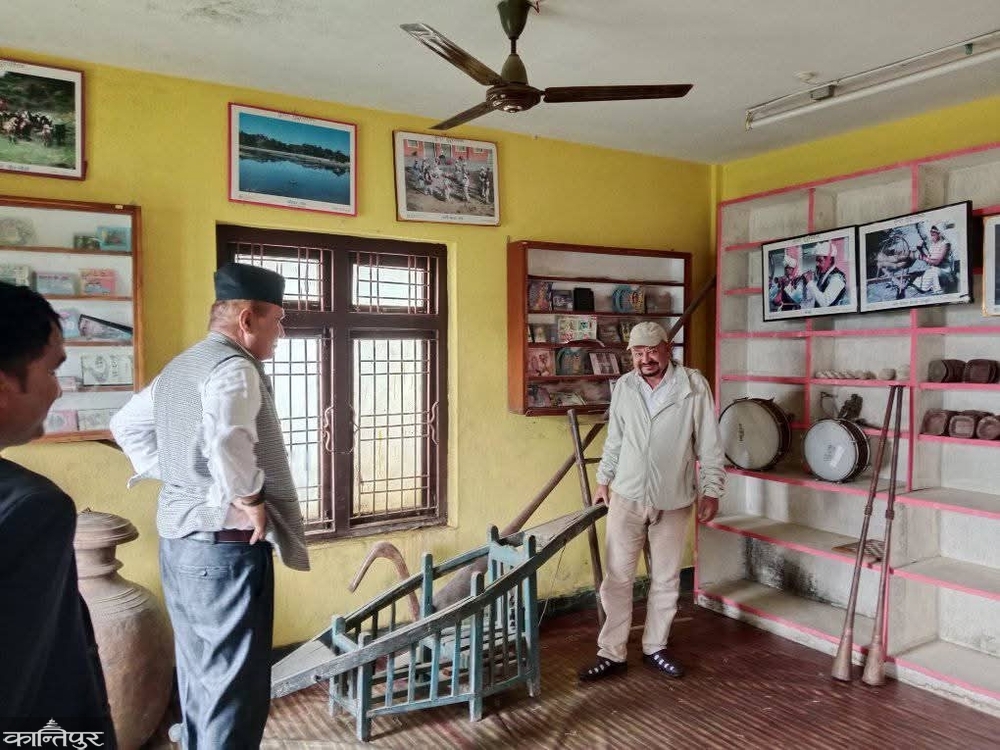
‘The clothes, jewelry, daily necessities, old weapons and other items used by our ancestors are disappearing,’ he said, ‘We are working to collect those items and store them in the museum.’ The museum currently houses various types of traditional materials. From agricultural tools like plows, yokes, namlo, damlo to baskets made of reeds and bamboo, suppo, and bhakari, grain storage utensils are also kept here. Such materials give a glimpse of the rural lifestyle and traditional agricultural system.
The clothes and jewelry used by the older generation have also become an attraction. Jewelry like women’s gunyu-choli, money necklaces, and athani-chauanni reflect the social and cultural situation. Items related to wedding rituals such as a doli used to carry the bride, a traditional millstone, a dhikki, and a clock used to measure time are also kept in the museum. These items give a direct impression of what the society of the Far West was like, how people lived, their clothing, food, and traditions were. Deuba informed that the concept of establishing the museum came up in 2073 BS. Initially, the plan was taken forward with the help of the Division Forest Office. He said that Amargadhi Municipality also supported it and now some materials have been received from the Taragaun Development Committee under the Ministry of Culture, Tourism and Civil Aviation.
‘The concept came from the Forest Office, then the municipality supported it,’ Deuba said, ‘Now some materials have also been received from the Taragaun Development Committee, which has further supported the museum.’ According to him, support worth 3-4 lakh rupees was received from Amargadhi Municipality. From which various materials have been collected . The collection of materials is ongoing . Deuba said that he has been working to find old materials in villages and bring them for a price if necessary . ‘We find and bring old materials from every household,’ he said, ‘If someone wants to donate, it will be kept in the museum with the name of the donor .’
Some challenges have also been seen during the collection of materials . Recently, there has been an increasing trend in village traders exchanging steel and plastic utensils for old clay and copper utensils . Deuba says that due to this, old materials are disappearing rapidly . The museum is taking forward the conservation of materials in coordination with the local community . Villagers have been urged to preserve their old materials and make them available to the museum . The work of adding new materials to the museum is still ongoing .

