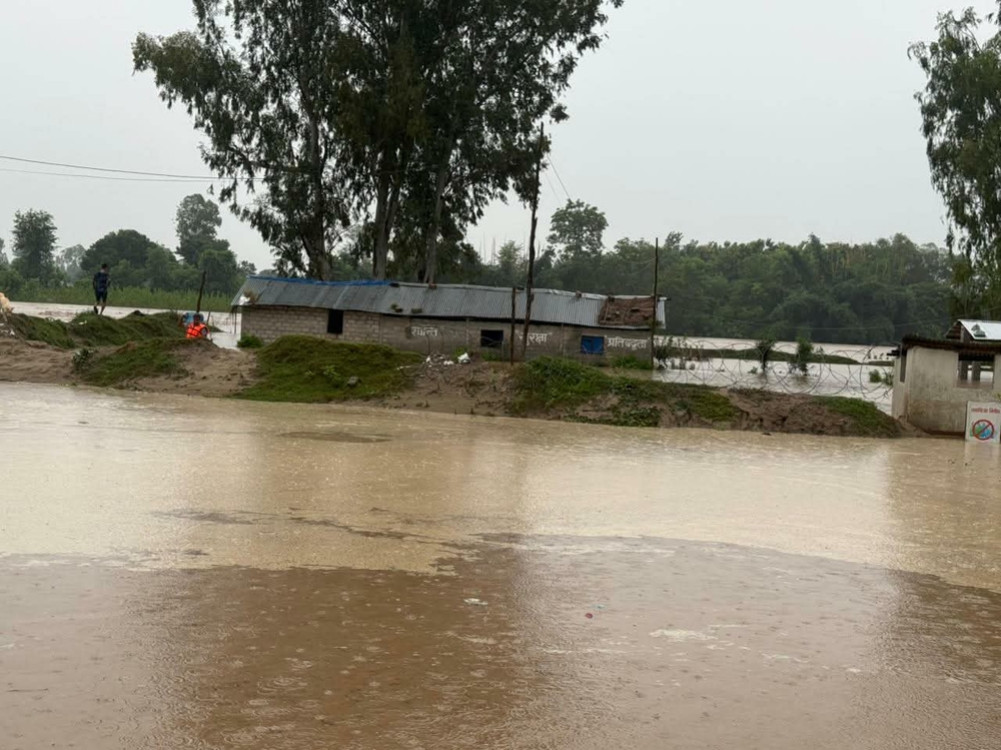
Although Dodhara Chandani Municipality is at high risk in terms of flood-related disasters, the budget allocated by the local level is not commensurate with it. It seems that very little budget has been allocated for flood prevention, from spreading awareness in riverside settlements to relocating them to safer places and from building embankments in high-risk areas.
We use Google Cloud Translation Services. Google requires we provide the following disclaimer relating to use of this service:
This service may contain translations powered by Google. Google disclaims all warranties related to the translations, expressed or implied, including any warranties of accuracy, reliability, and any implied warranties of merchantability, fitness for a particular purpose, and noninfringement.
In the first week of Bhadra, more than half a dozen settlements on the banks of the Jogbuda River, including Baduwaltol, Paterakhalla, Sundarnagar, Kanchanbhoj, and Kutiakbhar, were submerged in floods.
More than 40 families were displaced due to the flood. The Armed Police Force's BOP in Sundarnagar was also displaced due to the flood.
The displaced were immediately placed in schools. But they had to rely on NGOs to provide them with food, clothing, and bedding. After the flood in the river receded, the locals started moving away the mud and water inside their houses and living in their homes again.
Last year, more than a dozen settlements on the banks of the Jogbuda River were submerged in the floods that followed the heaviest rains since the start of the monsoon season in Nepal. Even then, the local level was forced to rely on NGOs for everything from rescuing the drowned to providing shelter, food, and rehabilitation for the displaced.
The Dodhara Chandani Municipality area across the Mahakali River is at high risk of flooding and erosion every year due to the Jogbuda and Mahakali. Moreover, settlements on both sides of the Jogbuda River are flooded every year and locals are displaced.
Dodhara Chandani Municipality has always been at high risk in terms of flood-related disasters. But the budget allocated by the local level does not seem to be in line with that. The municipality has placed more emphasis on roads and physical infrastructure. It seems that very little budget has been allocated for spreading awareness among the settlements living on the river banks, moving them to safer places, and constructing embankments in high-risk areas, as well as for prevention.
In the current fiscal year 082/083, the municipality has allocated only 1.1 million for disaster management. It seems that only 50 thousand to 100 thousand have been allocated for disaster management from ward offices. In the budgets brought by the municipal executive for the last three fiscal years, it seems that budget has been allocated like a shard of a coin for disaster management, from construction of embankments to prevention.
Due to the lack of sufficient budget allocation for the construction of embankments on the banks of the Jogbuda and Mahakali rivers, as well as rescue and relief during disasters, the municipality is having to rely on NGOs. ‘Floods have displaced people every year, but when we are displaced, we cannot even eat properly,’ said Prem Rokaya of Dodhara Chandani Municipality-8 Sundarnagar, ‘There is no prevention work, nor is there proper management for the displaced.’
This year, Sundarnagar across Jogbuda was severely affected by the flood. Carrying relief bags, they met the ward and the municipality and the then Home Minister Ramesh Lekhak. Saying, ‘Not relief for us, but build a concrete embankment,’ they even sat on a dharna in the ward and municipality. When Lekhak went to monitor the flood-affected areas in the third week of Bhadra, they were sitting on a dharna carrying relief bags in the Chandani Bazaar. During the meeting with them, the author also assured that necessary initiatives will be taken for the construction of the embankment.
The residents of Dodhara Chandni have been making such demands and receiving assurances for years. The construction of concrete embankments on the Mahakali and Jogbuda rivers has become a major election agenda in every election. But after winning the election, this agenda fades. In some places, embankments are constructed in a haphazard manner. But there is no program and budget to work sustainably to prevent the erosion of the Mahakali and Jogbuda rivers and floodwaters from entering the settlements by making a master plan.
‘It is unlikely that the municipality’s budget can control such a river, only a small budget comes from the federal government,’ said Chandra Bahadur Singh, ward chairman of Dodhara Chandani Municipality-10, which is the most affected by the floods of the Mahakali and Jogbuda rivers, ‘Our budget can only be used to distribute small relief and activate the community disaster management committee during disasters.’ There are also problems in purchasing necessary materials for the disaster management committee.
Half a dozen settlements in Dodhara Chandani Municipality-10, including Kutiakbar, Shanti Tole, Baidi Phata and Achhami Tole, are at high risk of flooding. As the Mahakali floods block the flow of Jogbuda and enter the settlements, there is a problem of inundation every year. Two safehouses have been constructed in Kutiakbar with the help of the Nepali Army and various NGOs. Currently, residents of the area live in the same safe house during floods. Ward Chairman Singh says that a safe house is also being built in Jogbudawari Shanti Tole.
The embankment built by the international NGO JAICA on the Mahakali River four decades ago is dilapidated. The embankment is dilapidated in places in the 22-kilometer area from Bayalband to Kutiakbar on the Nepal-India border, and there is a risk of collapse at any time. Even though repair work is being done in some places, locals say that they cannot rely on it.
‘Although the executive has allocated less budget for disaster management, a separate fund has been created for it, and it is spent from that,’ said Harisingh Dhanadi, spokesperson for the Dodhara Chandni Nagar Executive. ‘It is spent from that fund as per the need.’ He said that budget is also being allocated for disaster management in the wards.
Spokesperson Dhanadi said that an embankment is currently being constructed in Kutiakbar, Dodhara Chandani Municipality-10 with an investment of Rs 50 million. A 700-meter embankment will be constructed in Kutiakbar. The supervision of the contract process and construction work will be carried out by all the provincial government bodies. He said that the municipality is currently repairing the embankment at the site where the Jogbuda River collapsed in the Sundarnagar area.
‘We have to rely on the province and the union for the construction of the embankment, we do not have much budget, we are doing disaster management work with a small amount,’ said Dhanadi, ‘Even this is not enough.’ Every monsoon, one and a half to two hundred families from the banks of the Jogbuda River are displaced. Settlements including Paterakhalla in Ward 3, Sundarnagar in Ward 8 and Kutiakbar in Ward 10 are flooded every year.
Various policies have been formulated for climate-related disaster mitigation, starting with the Local Adaptation Action Plan (LAPA). But as budget allocation is not made according to those policies, there is a problem in flood-related disaster mitigation, says Tarkaraj Joshi, Associate Professor of Environmental Science at Sudurpaschim University.
‘There is a system to allocate budget from the lower level for disaster mitigation, but it has not been implemented,’ he said, ‘It seems that only a little has been spent on disaster budget preparation. It seems that there should be spending on spreading awareness at the community level from the development of an early warning system.’ He said that the problem is also due to the lack of disaster and environment departments at most local levels and the lack of manpower in those that do exist.
According to the 2078 census, there are 9,657 families in 8,891 houses in Dodhara Chandani Municipality. Of which 19,254 are males and 24,232 are females, with a population of 43,486. Most of the settlements are located on the banks of the river. Settlements along the river have been getting flooded even during normal rains.