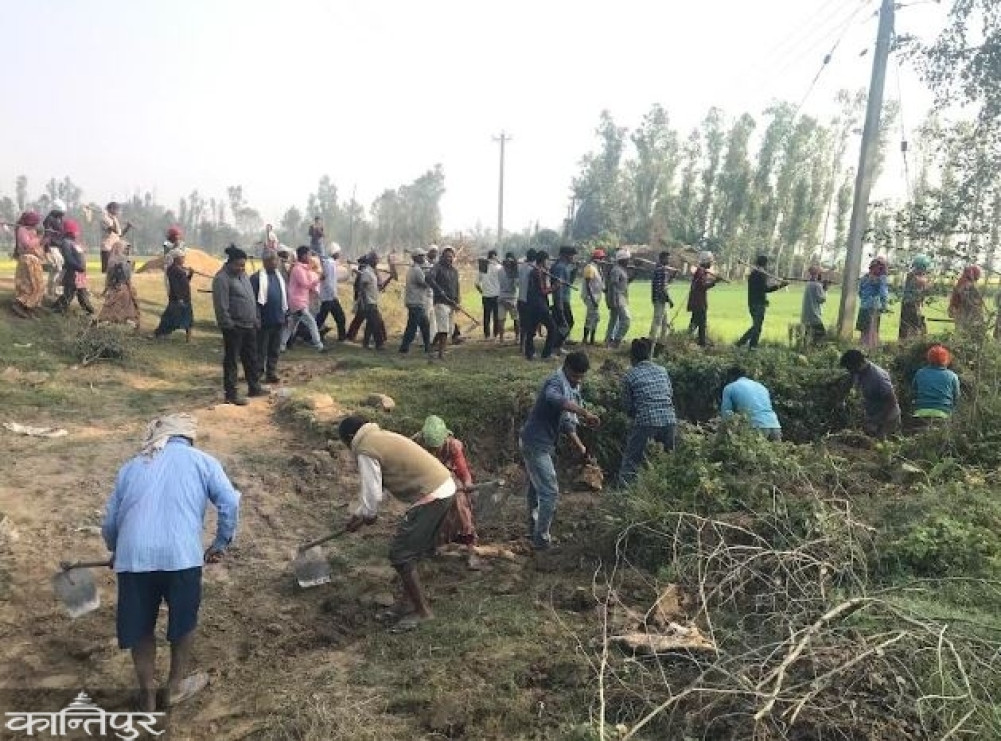
Every year, locals have been donating their labor to clean the approximately 20-kilometer-long Gaunaiya irrigation canal, which irrigates the fields of 400 families in Wards 1, 2, and 3 of Bhajani Municipality.
We use Google Cloud Translation Services. Google requires we provide the following disclaimer relating to use of this service:
This service may contain translations powered by Google. Google disclaims all warranties related to the translations, expressed or implied, including any warranties of accuracy, reliability, and any implied warranties of merchantability, fitness for a particular purpose, and noninfringement.
At around 10 am, one person from each house in Kailali's Bhajani village came out with a spade. The day before, they had decided on a place to meet the next day.
Some carrying shovels on their shoulders, some carrying shovels in their hands, gathered from 400 families from 12 villages to clean the canals. The residents of the Tharu community have been cleaning the canals every year as a form of Shramdaan to irrigate their fields.
The Gaunaiya irrigation canal, which is about 20 kilometers long, irrigates the fields of 400 families in wards 1, 2 and 3 of Bhajani Municipality. As it is the time to irrigate the wheat crop in the Terai, the locals are doing Shramdaan to clean the canals.
Most of the men in the Tharu community are out of the house in search of work. The number of women is also higher in Shramdaan to clean the canals. The canals, which have been operating for generations, are damaged by floods and erosion during the rainy season. They have been gathering like this every year to repair the canals to water the wheat.
The Tharu community still has a tradition of working collectively. The 20-kilometer-long Gaunaiya canal, which irrigates the fields of farmers in Bhajani-1, 2 and 3 wards, has its source in the Kanda River. After the construction of a concrete dam in 048 BS, they no longer have to do labor at the source in the Kanda River.
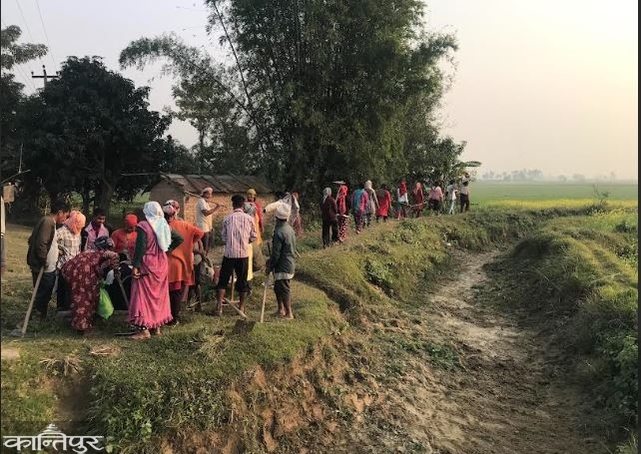
Even though the dam is concrete, the canal leading to the villages in front of it is still unpaved. They have been doing labor every year for its maintenance and cleaning. ‘It is not enough for one or two families to do this cleaning. Every year in Mangsir, everyone should do labor for at least four days,’ said local Baburam Chaudhary.
On Monday, they gathered at the bridge in Kanda village and cleaned the canal flowing between Bhajani-3 Kanda, Chakuliya and Perhanni villages. 401 families from 6 villages including Danga Bhajani, Gaunaiya, Chakuliya, Thegarpur, Madhuban, and Sirjanabasti in Ward-1, 12 villages including Rajwara in Ward-2, and Kanda, Padaria, Thekipur, Pakariapur, and Dhusi in Ward-3 were involved in the cleaning.
The method of cleaning the wells has also been around for generations. 400 people are divided into groups of 6-7 people. Baburam said that he has been doing this because it is easier to work in small groups. Each one carries a bamboo stick about four meters long. A group is divided into four meters. And some work to cut weeds, some to clean the mounds, and some to remove the soil. ‘During the well cleaning, we feel excited as if it is a festival,’ said Baburam.
Their collection and management is being done by the Kanda Bhajani Water Users Committee. The work of mobilizing the water from the villages is done by the officials of the Toll Development Organization formed voluntarily by the locals. ‘This is the evening well of the 12 villages of Bhajani that are irrigated.’ It has been a tradition since the ancestors to clean this well once a year,’ says Benulal Chaudhary, the chairman of the Water Users Committee. ‘The Toll Development Committee is responsible for monitoring and mobilizing who has come and who has not come from the village.’
The work of Shramdaan is done from 10 am to 4 pm. There is a rule that one person from each family must participate. There is a custom of each village being present separately every evening. Those who are absent without prior notice will be fined 600 rupees per day, said Saraswati Chaudhary, the chairman of the Shiva Parvati Toll Development Organization, Rajwara. ‘Officers of 17 tole development organizations formed in 12 villages do the mobilization work on a voluntary basis,’ said Saraswati. ‘Good people also help in this work.’
Even three decades ago, the residents of the hills used to call the Bhajani area ‘Malwar.’ There was no dense settlement here like now. In the last decade, the face of Bhajani has changed. The houses of families who migrated from the hills have been increasing. ‘We do not live by looking at the government. The canal is ours, the fields are ours, and the future is also ours. That is where we come together,’ said Bhajani leader Hariram Chaudhary. ‘I am worried that the residential area is expanding as cultivable land is being destroyed.’
They are proud of their tradition of cleaning canals as part of Shramdan. ‘This work is like a model of our community unity and labor. If we had been looking to the government, the canal would probably have been closed long ago,’ says Bhim Chaudhary of Rajwara, ‘We don’t even look to the government for our work. We have been solving all the other village problems ourselves.’