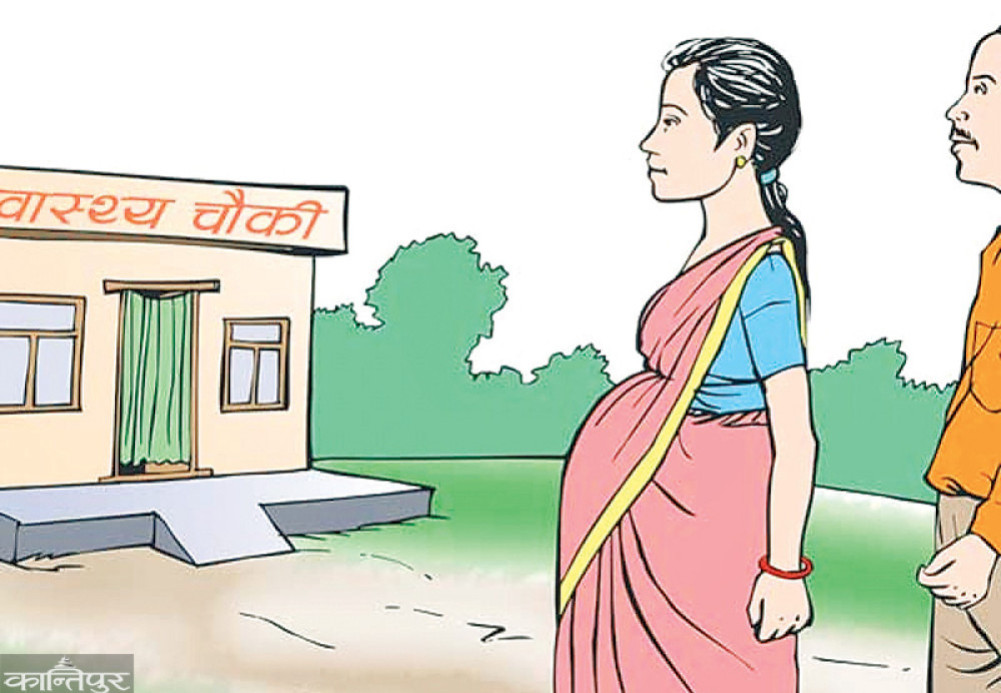
Improved access to health facilities, 24-hour maternity services, and public awareness campaigns targeting mothers and children have helped reduce the rate of home births.
We use Google Cloud Translation Services. Google requires we provide the following disclaimer relating to use of this service:
This service may contain translations powered by Google. Google disclaims all warranties related to the translations, expressed or implied, including any warranties of accuracy, reliability, and any implied warranties of merchantability, fitness for a particular purpose, and noninfringement.
The rate of institutional deliveries in Dadeldhura has begun to improve. The rate of home deliveries has declined in the last few years due to continuous efforts to increase institutional deliveries.
Due to the hilly terrain and remote settlements, the rate of home births was high in Dadeldhura for a long time. However, this rate has started to improve after the efforts of health institutions, local levels and various programs.
Ganesh Pal, Public Health Inspector of Ajaymeru Rural Municipality, said that now the institutional birth rate has come down to zero after safe maternity services are available at health centers. He said that public awareness programs have been widely carried out in the last four/five years to reduce the number of home births to zero.
In the last fiscal year 2081/82, the rural municipality was declared a zero home birth municipality. Pal said that there is no data on any woman giving birth at home last year and so far in the current fiscal year. He informed that Ajaymeru Rural Municipality is the first municipality in the entire Far West to be a 'fully institutionalized maternity municipality'.
Improvement in access to health facilities, 24-hour maternity services and public awareness campaigns targeting mothers and children have helped reduce the rate of home births. Similarly, local levels have been providing incentives for regular check-ups of pregnant women, prenatal counseling and maternity services.
The rate of home births in Ganyapadhura Rural Municipality is also zero. The rural municipality's health inspector, Vasudev Naunyal, said that there are 59 female health volunteers in the rural municipality. He informed that there is at least one health volunteer in every tole. He said that women go to health facilities for delivery with the advice and consultation of health volunteers.
However, due to lack of road access and problems with movement, some cases of home births have not stopped. Of the seven local levels in the district, 47 people gave birth at home in the last fiscal year, including 27 in Parshuram Municipality, 9 in Alital Rural Municipality, 9 in Bhageshwor Rural Municipality and two in Amargadhi Municipality, which is also the district headquarters, according to the District Health Office.
All pregnant women in Ganyapadhura Rural Municipality, Navadurga Rural Municipality and Ajaymeru Rural Municipality of the district gave birth at health institutions. There are statistics that the rate of home births has not yet been reduced to zero due to various reasons. According to the Dadeldhura Health Office, the rate of home births due to lack of transportation facilities is 49 percent. The number of early home births due to labor pains is 21 percent, while 13 percent are found to have given birth at home due to unnecessary circumstances.
According to the Health Office, the number of women who give birth at home is 9 percent because there is no one to take pregnant women to the health institution to deliver them. The Health Office has made public the statistics of four percent giving birth at home without labor and two percent without knowing the due date of labor.
The rate of giving birth at home is challenging . It has been found that 72 percent of women still give birth at home because health institutions are more than 30 minutes away
According to the Health Office statistics, the number of women giving birth at home has decreased in the last year compared to the fiscal year 2080/81 . There are statistics of 95 people giving birth at home in 2080/81, while 47 women gave birth at home in 2081/82 .
The Head of the Health Office, Keshar Bahadur Saud, said that they are still raising public awareness that all women should give birth at health institutions . He said that they are raising public awareness among local levels, people's representatives, women's health volunteers, and mother groups.
Public Health Nursing Inspector Asha Thapa, working at the Dadeldhura Health Office, said that the 'number of home births' is determined based on whether a pregnant woman has visited a health institution for check-ups once and later gave birth at home.
So far, there are 34 birthing centers in Dadeldhura and free maternity services are available from 35 health institutions, including one federal hospital, according to the Health Office.