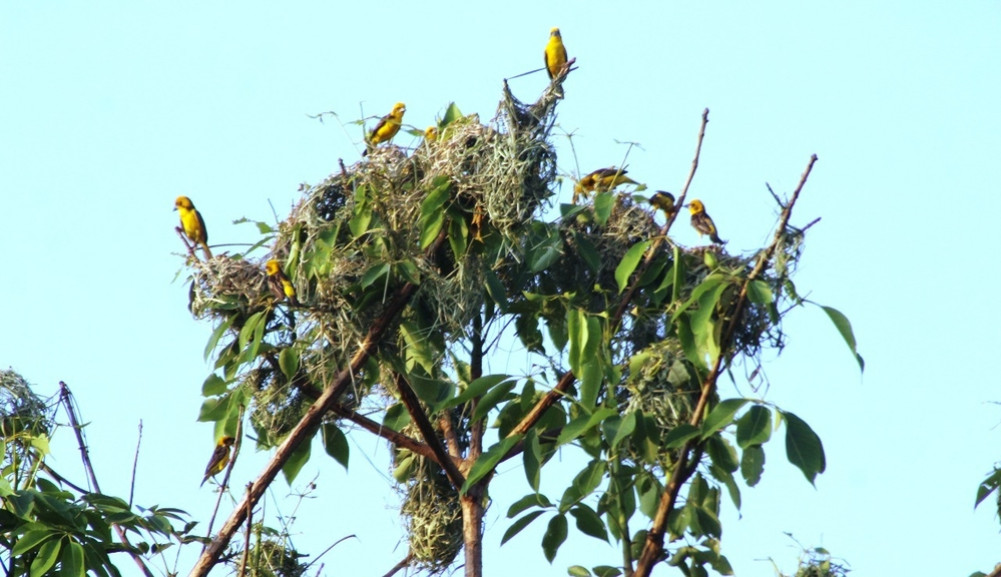
Last year the number of rare golden tortoises was 213
We use Google Cloud Translation Services. Google requires we provide the following disclaimer relating to use of this service:
This service may contain translations powered by Google. Google disclaims all warranties related to the translations, expressed or implied, including any warranties of accuracy, reliability, and any implied warranties of merchantability, fitness for a particular purpose, and noninfringement.
In Shuklaphanta National Park, the number of rare golden tortoise has decreased. In the five-day count conducted in collaboration with the Nepal Bird Conservation Association (BCN) and the Shuklaphanta National Park, it has been found that the number of topcharas has decreased compared to the past.
According to Hirulal Dagoura, an ornithologist of the association, the number of birds has been found to be 184 in five days of counting. In the count made last year, the number of artillery was 2 hundred and 13. "Grassland destruction is the main reason for the destruction of the golden cannon," he said.
According to him, woodpeckers nest in the trees and grass in the grassland. Those areas outside the conservation area are being destroyed. Currently, only the grassland within the protected area of the park remains. Golden eagles go to the farmer's fields near the park for food. 'After the indiscriminate use of pesticides in agriculture, the birds have been dying after eating the crops that have been treated with pesticides,' Dagoura said.
He says that the number of birds of prey is decreasing even when other birds of prey eat the nestlings and eggs during breeding.
Purushottam Wagh, conservation officer of the park, speculates that the number of this bird may have decreased due to migration. He said that there is no difference in the grassland habitat inside the park.
According to him, the golden cannonball is found only in the Terai region. In Nepal, there are four species namely Chestnut, Dharke, Baya, and Golden. The golden eagle is a rare endangered species in the world. This bird breeds from May to September. Among the protected areas of Nepal, only in the Shuklaphanta National Park, the Golden Hornbill nests in the middle part of the park's grasslands.
Zoologist Dagoura said that it is called golden cannon because it looks like a sparrow and is yellow in color. "Birds make nests by artistically cutting leaves on tree branches, after making nests, they give birth," he said.
In 1996, the golden eagle was first seen in the park. Since then, the park has been regularly protecting it and collecting data. The golden eagle, which is a friend of the farmer in the park, likes to eat insects.
It is also considered as a social bird because it nests, lives and forages collectively in the park. It is characterized by nesting in thorny trees near lakes and wetlands near parks.
parks and associations A technical team of eight people worked on counting the golden topchara for five days in the park area. Within the park, the counting of golden eagles has been done in Sikari Lake, Shuklaphant, Maluvela, Lalpani, Haraiya Phanta, Panchhital, Birsingh Tapu, Sundariphanta, Sinhapuraphanta, Lalpani, Radhapurphanta, Badani Khera, Andaiyapataiya.
In the park spread over an area of 350 square kilometers, more than 400 species of birds are found along with the golden parrot.