We use Google Cloud Translation Services. Google requires we provide the following disclaimer relating to use of this service:
This service may contain translations powered by Google. Google disclaims all warranties related to the translations, expressed or implied, including any warranties of accuracy, reliability, and any implied warranties of merchantability, fitness for a particular purpose, and noninfringement.
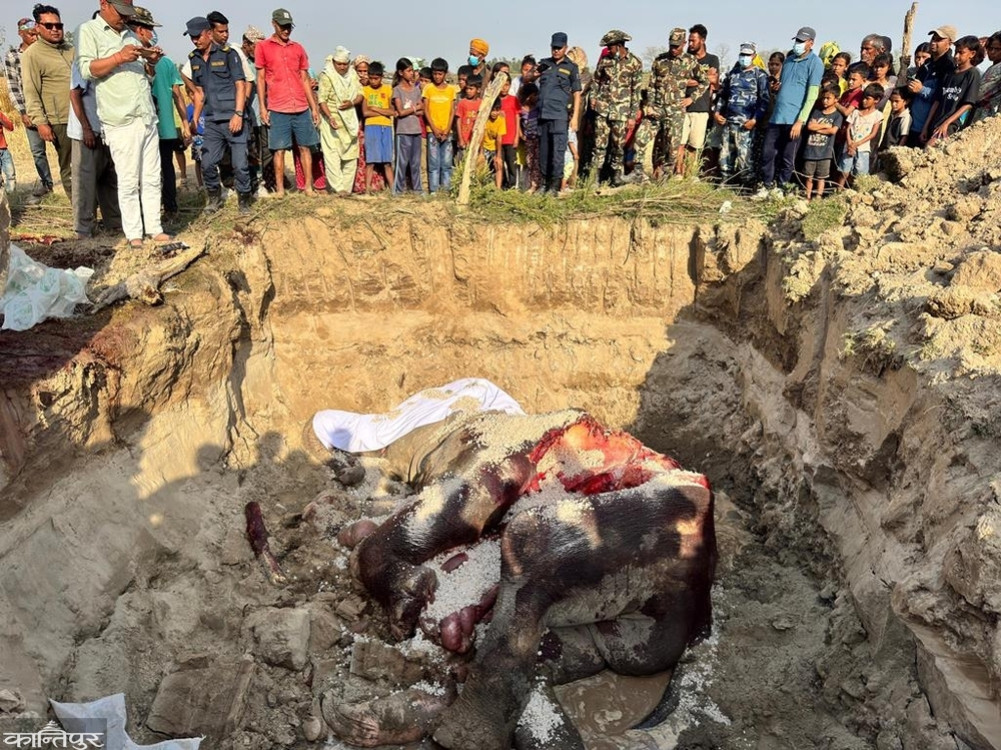
Four days ago, an adult male elephant was found dead near Dashagaja in Dodhara Chandni Municipality-3 Baduwal toll. The trunk of an elephant found dead near a wheat field towards Nepal was electrocuted. The postmortem revealed that the elephant died due to the current.
The park office has appointed conservation officer Rajesh Lamsal as the investigating officer of the incident. Whether the elephant got electrocuted due to electric shock or due to some other reason, more things will be revealed after the investigation.
A month and a half ago, an adult elephant died due to electric shock in Lalzhadi Rural Municipality-4 Persia. In the investigation of the Division Forest Office, the case process was also taken forward by arresting one person who claimed that the elephant had died due to electric shock. But the District Public Prosecutor's Office did not proceed with the process saying that there was no basis to register the case.
These two incidents are an example of the increasing human-wildlife conflict in recent times. Just last week, the tiger that entered the wheat field in Teduwa, Belauri Municipality-2 was captured after two days. Last July, a woman died after being attacked by a tiger in Dodhara Chandni Municipality-2. The tiger was also captured after two days.
'Traditional routes of wild animals are disappearing, sometimes there are development constructions and there are slums,' said Purushottam Wagle, conservation officer of Shuklaphanta National Park, 'Elephants are animals that travel longer routes and need a lot of area for feeding, because of this there are problems from time to time.'
According to him, wildlife has become a problem because of the development and construction activities taking place in the traditional corridors on both sides of India and Nepal. This year alone, three people died and two were injured due to elephant attacks in the district, according to the data of the Division Forest Office.
There is no description of the damage done to the crops by elephants and other wild animals. One person has died due to tiger attack in Dodhra Chandni in the central area of the park. Farming is also being damaged due to wildlife encroachment in the areas around the park. "Development and construction structures in protected areas and other forest areas are also happening at a fast pace, this has also blocked the wildlife corridor," Wagle said, "Conflicts have increased when there is development and settlement in traditional corridors."
Recently, the number of wild animals in the protected area has been increasing continuously. He also said that because wild animals enter the settlements in search of food, there will be a situation of conflict.
The number of humans and wild animals is more in the area of the Terai region. Rambichari Thakur, Head of the Division Forest Office, says that the conflict is increasing as development activities are also going on in this area at a rapid pace.
'Corridors should be built for wild animals to go from one protected area to another protected area, this will improve the survival of wild animals and also prevent the extinction of any species during a major epidemic,' said Thakur, 'but we have settlements and construction of large structures in the corridor.' Due to East West Highway and Kaluvapur Belauri Road, it has been divided into sections.
In the Laljhadi Mohana Protected Area, the corridor is now blocked due to development construction. It is a traditional corridor from India's Dudhuwa National Park through Laljhadi to Chure Phedi to Shuklaphanta and back by road. From Chure, it is considered the traditional route of elephants to return to the Nandhore region of India, crossing the Mahakali through the Brahmardev Corridor. But now the route has been obstructed in places. This has also led to elephants and other wild animals entering the settlements.
Two years ago, an adult elephant died after getting trapped in a safety tank built near the office of a community forest in Shuklaphanta municipality in the central area of Shuklaphanta National Park. "Elephants coming from Dudhuwa in India have also started staying in Shuklaphanta for a long time now," said Wagle, conservation officer of the park. Conflicts are being created when they enter the slums in search of food. If the traditional corridor of wildlife is not managed in time, the human-wildlife conflict will increase and there is a risk that it may become serious in the future, conservationists say. Therefore, they say that big plans should not be made for all-round development in protected areas along with traditional road management.