We use Google Cloud Translation Services. Google requires we provide the following disclaimer relating to use of this service:
This service may contain translations powered by Google. Google disclaims all warranties related to the translations, expressed or implied, including any warranties of accuracy, reliability, and any implied warranties of merchantability, fitness for a particular purpose, and noninfringement.
This song is famous in Far West. For the daughter-in-law, as the month of January approaches, it reminds her of her mother. In the Far West, it is customary to put babar (cell roti) and puri on green leaves and take them to the house of the daughter and sister, and to invite those who are far away to Maiti and prepare special food dishes and feed them.
At the place where the daughter and sister are, when Maiti puts food on green (sal, banana) leaves and arrives at the dailo, the daughter feels the love and importance of Maiti.
Compulsorily given to daughter-in-law once a year, there is a tradition of wrapping it in green leaves, i.e. sal leaves and banana leaves. Since green leaves are a symbol of perfection, the practice of showing green leaves in the month of Magha has come from tradition.
In this way, it is customary to go to the daughter-in-law's house and give food to the mother-in-law, so the month of Magh is called Maghi Tyar. In January, daughter-in-law and mother-in-law come to the house. Daughter-in-laws who are able to attend Maiti's house go to eat Tihar while Maiti's daughter-in-laws who are not able to attend Maiti's house have to go to the house of Maiti and compulsorily celebrate Tihar throughout the month of January. Throughout the month of January, there is a large presence of pilgrims coming to the villages here to celebrate the festival with their daughters. Another important tradition of Cheli Tihar is to show green leaves to girls in January.
61-year-old Dhauli Budha of Dhakari Rural Municipality-1 Nandipur came to buy oil at the only coal in the village at 6 in the morning. After heating oil in coal and cooking cel roti in the same oil, he has to give poko (cell roti wrapped in green leaves, puri) to his Nandas in 3 villages. She is making preparations for the poko that will be given till the last day of the month of January. More than any other time, there is a rush to get oil in the month of January.
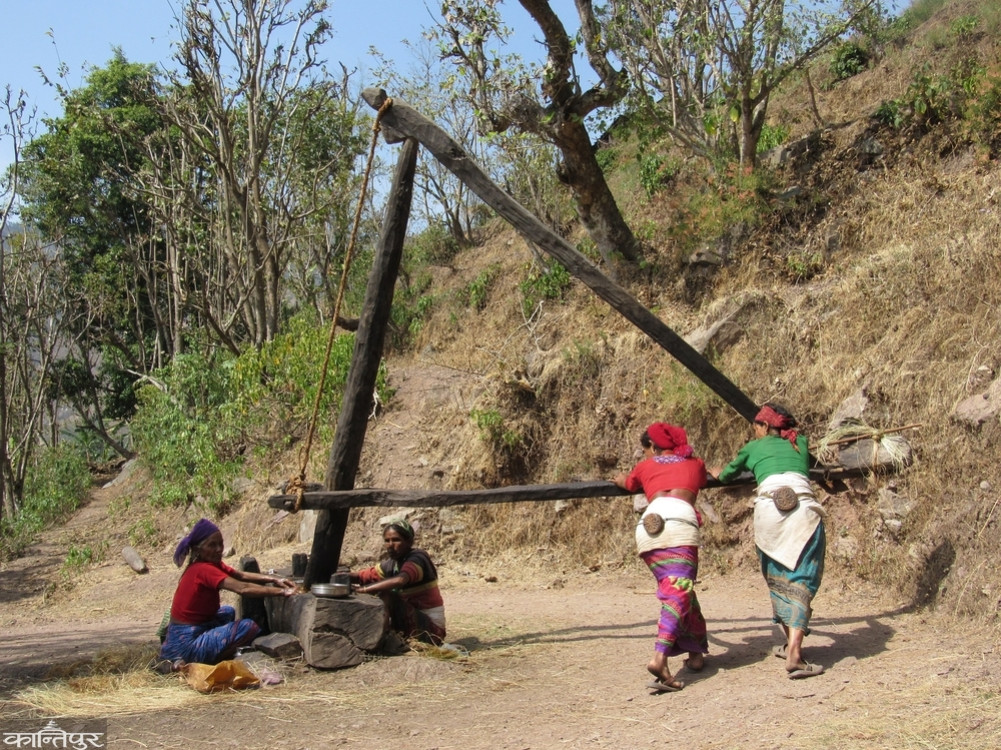
She had taken time a week before to get 5 liters of oil for the whole day. Although there is a water mill near the village, she has come to collect oil using a large jar-like device which is traditionally used for collecting mustard. "Until now, the oil that was burned in the mill and brought from the market has not been used in my house. When you cook Selpuri in this way, the taste is different," she said.
Like Dhauli, 50 houses of Nandipur and even from Hichma, Dhakari, Dhungachalna, Ghodasain, this coal is crowded with people who come to get oil in the month of January. Locals believe that the old technologies that were closed after the mills came into operation in other places are more protected in this place. Now this is the only coal in the whole village. Oil burned on coal is like medicine for the pregnant mother and child. There is no fear of any adulteration in it. Neither money is spent,'' the local Ratnadevi budha said, 'Nanda has also given birth. On this occasion, she asked him to burn oil on the coal.'
According to him, this month is spent going to the house of his daughter and Nanda. Mother-in-law cannot always remember her daughter. Everyone has their own obligations. It is also a great opportunity to meet as it is compulsory to arrive in January.'' She said that it is a tradition to wrap the chelaf in a green leaf and give it to the chelaf of other villages besides the sisters and daughters.
Deuda's charm
In Magha, the custom of playing Deuda is also in wonder. Which is also seen as a means of having fun by being a Jethani-Deurani gathering. "There is always work on the stove. He doesn't even have the time to play nice with his elder brother Deurani. Magh is the month to have fun, to share sorrows and joys.'
Maina Saud of Dhakari said, 'It increases intimacy.' Women play Deuda in groups. It plays a supportive role in community unity, friendship, mutual support, and exchange of goodwill. If someone has a disagreement, reconciliation is done. Therefore, Maghi is also considered as a day to strengthen relationships.