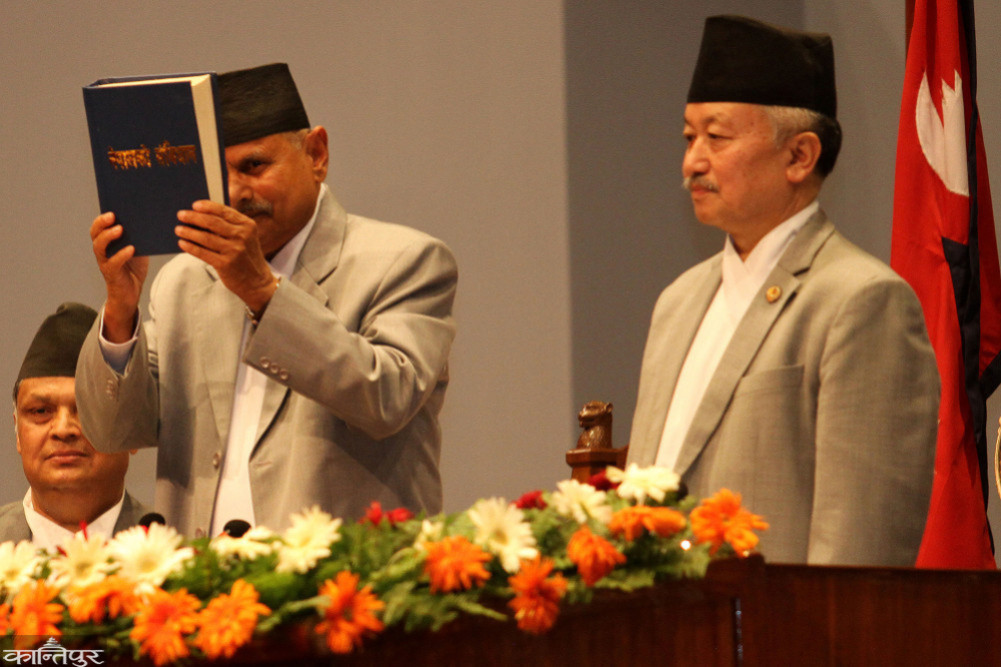
The federal system of governance should be made more effective by addressing the people's dissatisfaction with federalism.
We use Google Cloud Translation Services. Google requires we provide the following disclaimer relating to use of this service:
This service may contain translations powered by Google. Google disclaims all warranties related to the translations, expressed or implied, including any warranties of accuracy, reliability, and any implied warranties of merchantability, fitness for a particular purpose, and noninfringement.
The government led by Balendra Shah has started preparing a debate paper on constitutional amendment positively. According to Article 274, there is a provision to publish the bill on constitutional amendment for public information. If the issue related to the boundaries of the province or the rights of the province mentioned in Schedule-6 needs to be amended, there is a provision to obtain the consent of the province concerned within three months. If the consent of the province is not obtained, the proposal on constitutional amendment will be ineffective. Therefore, the process of constitutional amendment is complex.
Therefore, it is necessary to identify the following topics in the debate paper that the government is trying to prepare and act accordingly. First, the provisions in the constitution regarding constitutional amendment should be looked at. According to Article 54, there is a provision that a committee will be established in the federal parliament as per the law to monitor and evaluate the progressive implementation of the directive principles, policies and obligations of the state. According to this provision, while reviewing the progressive implementation of the directive principles, the implementation of fundamental rights should also be reviewed. Because the directive principles in Part 4 of the Constitution are an extension of the fundamental rights. This review also reviews the socialism mentioned in the preamble and other places.
Secondly, according to Article (265) of Part 27 of the Constitution, the National Women's Commission, the National Dalit Commission, the National Inclusive Commission, the Indigenous Peoples' Commission, the Madhesi Commission, the Tharu Commission and the Muslim Commission should be reviewed after ten years of the constitution. While reviewing these commissions, other commissions like the National Human Rights Commission and some other provisions of the constitution should also be reviewed.
The third point regarding the review of the constitution is the form of government. Although the parliamentary system of government has been adopted as the form of government, there are provisions that are incompatible with the West Ministerial parliamentary system, such as the inability to move a no-confidence motion against the Prime Minister for two years. The fourth topic of the review of the constitution is the system of governance. We are currently in a federal system of government. According to the current federal structure, there are many ambiguities regarding the distribution of powers at three levels and their exercise. The federal system of governance, as well as the distribution of powers at three levels as mentioned in the schedules of the constitution, should be seriously reviewed. Such a review is necessary to make the federal system of governance more effective by addressing the people's dissatisfaction with federalism.
The fifth point of the constitutional review 'governance system' is related to the representation of the people. It can be divided into two parts - the number of people's representatives and the electoral system. There is a complaint that the number of people's representatives has become too large in a country like ours. If the federal system of governance is to be implemented effectively, the number of people's representatives should be reduced at the center or the union. The constitutional review is also necessary to improve the electoral system for electing people's representatives. The sixth point of the constitutional amendment is related to the structure of the judiciary and the role or powers of the Chief Justice.
Although the executive and managerial powers were divided between the provincial and local levels when the constitution was promulgated, the judiciary was kept unified. But in political, social and practical terms, the illusion arose that the judiciary was also in accordance with the federal structure. When such illusions and reality differed, dissatisfaction with the judiciary grew. An example of this illusion is the role and authority of the Chief Justice in the province. The provincial assembly makes laws, but the chief justice of the province does not have the authority to prosecute or file cases for compliance with those laws. In this way, the province makes laws, but has to rely on the center for implementation. This should be reviewed.
The seventh point of the constitutional review is related to the amendment of Article 133. There is an established tradition that the court will invalidate the law made by the parliament if it conflicts with the constitution. However, the justice system itself is in disarray due to the system of having to go to the Constitutional Bench of the Supreme Court to have all the laws made by the local and provincial assemblies annulled to the extent of the conflict with the constitution. 753 local levels and 7 provinces have made thousands of laws. Due to the lack of expertise and experience in making laws, many of those laws are in conflict with the constitution. The fact that one has to come to the Constitutional Bench of the Supreme Court in Kathmandu for the constitutional remedy of ‘revoking such laws’ is mocking the current federal system of governance. Therefore, this issue should be reviewed.
The eighth point of the constitution review is related to the review of the Constitutional Bench. Although all the benches of the Supreme Court are ‘constitutional benches’, it is said that the Constitutional Bench was arranged to settle the political equation at the time of the constitution-making. Therefore, there is a need to review the justification or management of the Constitutional Bench. The ninth point of the constitutional review is the review of the Judicial Council and the Constitutional Council. The tenth point is also the review of the constitution based on the experience gained from the practice so far.
It is necessary to review the constitution on the basis of the above-mentioned points and then proceed with the work of amending the constitution after further study, research and interaction.