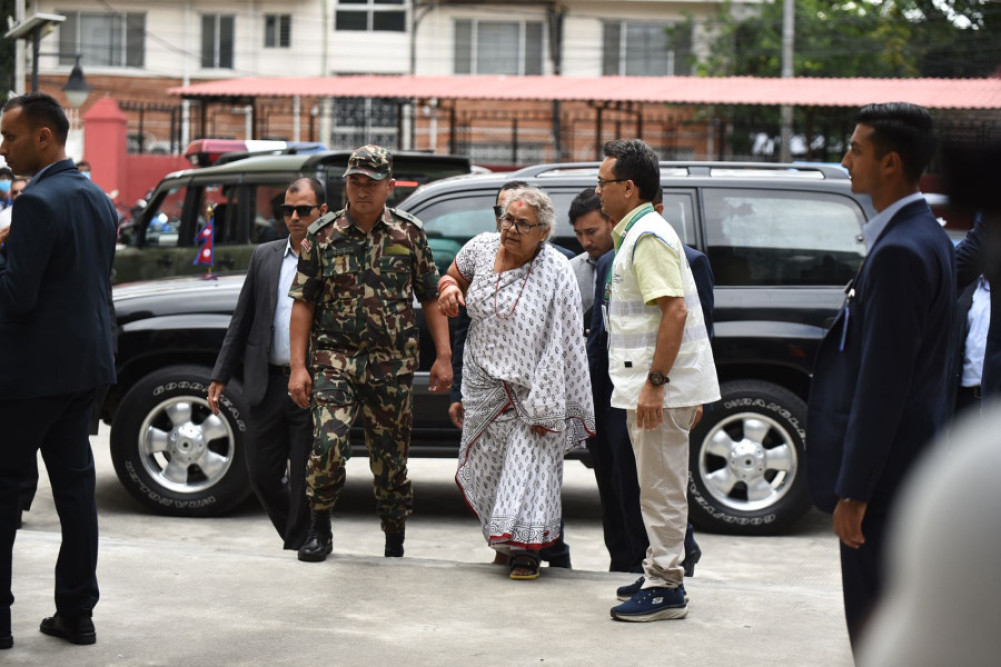
Let's stop using the word ”mother” for women with talent or ability. Women in positions of power and leadership do not need the sign of motherhood to prove their authority.
We use Google Cloud Translation Services. Google requires we provide the following disclaimer relating to use of this service:
This service may contain translations powered by Google. Google disclaims all warranties related to the translations, expressed or implied, including any warranties of accuracy, reliability, and any implied warranties of merchantability, fitness for a particular purpose, and noninfringement.
Former Chief Justice Sushila Karki took the oath as Prime Minister, creating a historic atmosphere in Nepal. Her appointment to the country's executive post has finally led to a peaceful and orderly election. This highlights her diplomatic and strategic prowess and decision-making ability.
Within a short time after she took office, people started addressing her as 'Ama'. Such addresses seemed to be an attempt to overshadow her political thinking.
When male leaders are called 'Ba'. Then, their presence is seen as strength, guidance, laughter and decision-makers. When we celebrate International Women's Day in March, it is not enough to just talk about those who get the opportunity to lead. Instead, we should also talk about the mindset that we are going to decide.
I have no disagreement with the emotional significance of being addressed as 'Ama' or 'Ba'. However, I am concerned about the exaggeration and patriarchal framing of their leadership by these addresses.
On the surface, calling a female leader a mother is a sign of respect and love. But, as we know, language is never neutral. It is intertwined with different perspectives, cultural norms, and power structures. Which often reflect social, political, and historical biases.
When a man comes to power, he is described as a strategist, mediator, leader, or decision-maker. Their power is taken politically or institutionally. Women are often defined emotionally. They are seen only as caregivers or protectors.
To view political leaders only as mothers is to undervalue the authority they have. To view them this way is to evaluate their legitimacy based on care, sacrifice, or moral convictions rather than political judgment or strategy.
The idea that women are acceptable leaders simply because they look like mothers does not expect women to have the ambition, decision-making power, conflict, or planning that men expect.
This narrow thinking erases diversity. Not every woman is a mother. Not all women want to lead by being a symbol of motherhood. However, when political discourse starts calling female leaders mothers, it indicates that women need a motherly identity to reach power.
Many women in power around the world have been accepted as a symbol of motherhood. For example, Indira Gandhi was called ‘Mother India’. Corazon Aquino was called ‘Mother of Democracy’. Jacinda Ardern has also been repeatedly brought into the debate through the rhetoric of motherhood.
Feminist scholars such as Cynthia Inloy and Carol Pettman have repeatedly argued that society is increasingly reducing women’s rights and power by tying them to the role of caretaker. This reinforces the idea that women are only acceptable and relevant to leadership when they become mothers.
However, the qualities often associated with feminism (such as compassion, emotional intelligence, collaboration) are leadership qualities, not just motherhood. Listening, conflict resolution, understanding social dimensions, and learning are important for government criticism, but these qualities are easily associated with motherhood. This suggests that women are good leaders only because they are caregivers. However, these abilities are political skills, not personal characteristics.
Women who exercise power in ways that break away from patriarchal thinking are criticized. This shows the tension between femininity and authority. Feminist philosophers such as Bell Hooks and Judith Butler have advocated a broad and expansive definition of feminism. They argue that patriarchal gender roles have no bearing on personal identity.
Women are strategic, compassionate, assertive, intellectual, and practical as well as caregivers. Limiting feminism to the role of motherhood or motherhood limits not only women's role in politics but also their imaginative leadership.
Even when women achieve significant success, society often praises them as mothers' sacrifices or criticizes them for it. For example, when a woman wins an election immediately after pregnancy and childbirth, she is applauded. Her commitment to motherhood is shown separately. However, her strategic vision, political vision, and the courage she showed to compete in deep-rooted power structures are often underestimated or sidelined.
While the rhetoric of motherhood shapes political perspectives, the structural reality shows that this issue needs to be debated. For example, out of the 3,406 direct candidates who contested the election, only 388 (almost 11 percent) were women. And, only one was openly from a sexual and gender minority community.
In this divided society, the few women who are elected have the added pressure to raise the voice of all.
Political philosophers have long separated this from practical representation. The responsibility to address gender inequality does not lie with women alone, but with leaders of all genders.
Therefore, let us stop using the word ‘mother’ for women with talent or ability. Women in power and leadership do not need a maternal sign to prove their authority.
Leadership should be seen in terms of vision, responsibility, and ability to govern, not in terms of tradition. If we start defining women in terms of their reproductive and gender identities, we risk diminishing the political vision that women show when they rise to power.
Moving beyond the word mother does not mean rejecting care, compassion, or love. Rather, it is about fully appreciating women's leadership solely on the basis of the role they play in politics. It is about acknowledging them as thinkers, strategists, mediators, technocrats, decision-makers, and architects of the present and the future.