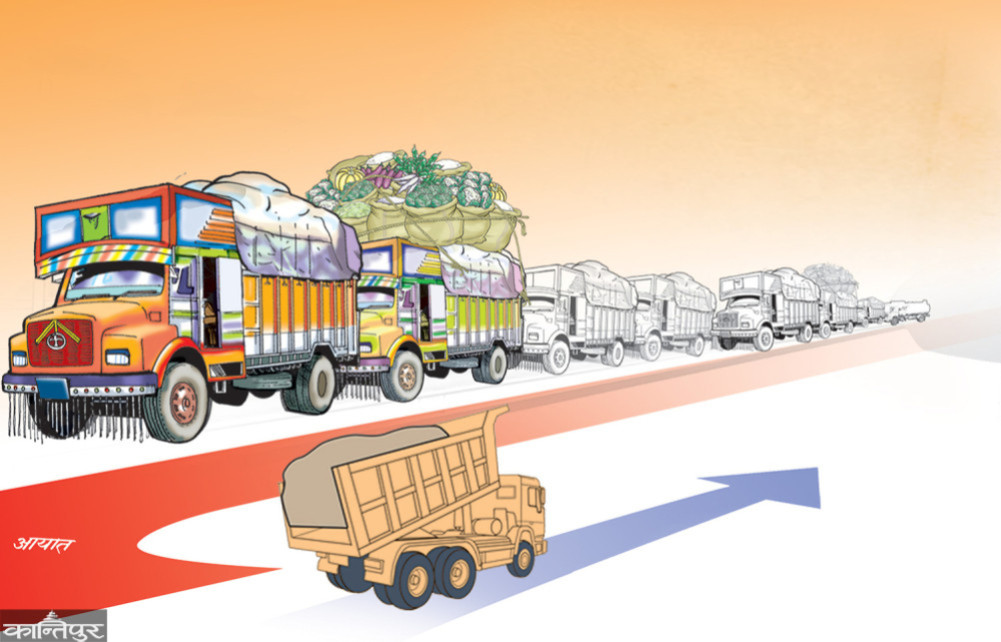
It is necessary to ensure strict monitoring and punitive measures to prevent illegal smuggling of Indian products from being sold in the Nepali market.
We use Google Cloud Translation Services. Google requires we provide the following disclaimer relating to use of this service:
This service may contain translations powered by Google. Google disclaims all warranties related to the translations, expressed or implied, including any warranties of accuracy, reliability, and any implied warranties of merchantability, fitness for a particular purpose, and noninfringement.
It is well known that Nepal's economy is in a very weak state. The country's economic situation is deteriorating and people are increasingly worried about an uncertain future. In the meantime, the movement from "Zen-G" has also changed the power.
In the past, the 'High-Level Economic Reforms Recommendation Commission' has given its 243-page recommendations to the Nepal government and the head of that commission, Rameshwar Khanal, has been appointed as the finance minister in the interim government. Let's hope, we will succeed in making Nepal's economy problem-free by adopting the policy changes as per the suggestions.
It is inevitable that the effect of the new GST policy that India is going to adopt will affect the Nepalese economy. From the beginning, the price of Nepali products, especially daily consumer products, is higher in Nepal than in India, so the tendency of Nepali consumers is more towards cheap Indian products. Similarly, there are Nepalese consumers who buy materials worth crores from the Indian border market, which is connected with an open border of 1800 km. Now there is confusion about the situation due to the new GST policy in India.
India's new-generation Goods and Services Tax (GST) policy, with reduced rates on consumer goods, will surely strengthen the Indian economy. As Indian consumers get rid of such a heavy tax burden, their spending propensity will increase in the market, low inflation is a good sign for any economy. This should be considered as a far-reaching economic policy of India. However, the possibility of its adverse effect on the Nepali economy has also increased. Due to the risk of theft and smuggling of Indian products due to the open border between Nepal and India and the tax system and tax burden of Nepal, the possibility of its direct impact on the industry and production, demand and supply, market and the overall economy has also increased.
The Government of India has announced a major shift in the Indian market, manufacturing and economy by simplifying the Goods and Services Tax (GST) rates. The New Generation GST Slabs (Rates) have been announced by the Ministry of Finance of India and the GST Council. The previous rates of 5 percent, 12 percent, 18 percent and 28 percent have now been changed to 0 percent, 5 percent, 18 percent and 40 percent. GST will be levied at the rate of 0% to 5% on all products consumed by the general public.
Goods that used to charge 28 percent will now charge 18 percent. A new rate of 40 percent will be imposed on tobacco products and some expensive vehicles and other luxury items consumed by the upper class. Thus, in the policy adopted by India, collecting more tax from the able-bodied class and reducing the inflation rate by giving its benefits to the general class seems to be an act of public interest. This new rate of GST has come into force from this Dasain Ghatsthana day i.e. 22nd September 2025. We all know the fact that due to Nepal-India open border, Nepali consumers prefer to buy Indian products and its impact on Nepali market and products. This new GST rate will further reduce the price of Indian consumer goods and the risk of its impact on Nepalese consumer goods has increased.
This change and reduced tax rate will add a huge challenge for Nepali industrialists and businessmen in the days to come. Due to open borders and unhindered passenger movement to and fro, Nepalese consumers mostly buy their daily necessities from the Indian market along the border. In addition to this, the situation of illegal theft-smuggling of Indian goods worth thousands and crores and openly selling them in the Nepali market is not hidden from anyone. As the Indian market will become more affordable due to the new GST reduction rate, both Nepali consumers and piracy will increase, which will directly affect the Nepali industry and market.
Now in India, 0% to 5% GST is levied on the producer price of general consumer goods and pharmaceutical products, but 13% VAT and excise duty and other taxes are levied on the same goods made in Nepal, so it is certain that they cannot compete with the Indian market and products. The pricing of products in Nepal and ensuring that Indian consumer goods are available at a much lower price than the cost of delivery to the consumer, Nepali consumers are more attracted to Indian products than domestic products - this is sure to have an adverse effect on Nepali industry and business.
In view of this real risk, the government of Nepal needs to formulate a policy so that its tax system (tax rates) is lower than Indian products. In addition, it is necessary to ensure strict monitoring and punitive measures to prevent the sale and distribution of illegally smuggled Indian products in the Nepali market. Due to the open border, there is also a need for strict control over buying from the Indian market across the border.
If the border between Nepal and India had been closed and passenger traffic had been restricted, the above GST rate change would not have affected the Nepalese industry and market. Like Bangladesh, Pakistan and Bhutan, Nepal's separate tax system would not have any difficulty for the industry-business and revenue collection and the operation of the economy of its country, but it does not seem possible in the current situation.
India's new GST slab, in addition to the risks mentioned above, there is a danger that there will be no investment in Nepal and its far-reaching effects will weaken the Nepali economy. In addition, employment cannot be created in the country. This is a matter of great concern to all of us.
VAT in Nepal is only 13 percent. Excise duty is levied separately according to the product. One can easily imagine what our situation is in front of the price of consumer goods made in a huge neighboring country like India compared to the range of customs duties and other taxes on raw materials which are imported from foreign countries. In the previous arrangement, such a large amount of Indian consumer goods used to enter Nepal through the India-Nepal open border, now where will it go in the new 'tax regime', we are getting scared when we imagine this automatically and we call on the Nepalese government and all stakeholders including the relevant ministries to bring about changes in the tax system of Nepal and to manage the open border, to control the sale and distribution of goods imported by evading customs.
Considering the above situation and possibility and risk situation, the government of Nepal needs to formulate policy immediately. According to the report submitted to the government by the commission formed under the chairmanship of former finance secretary Rameshwar Khanal, it is absolutely necessary to implement a new economic policy to implement the new GST of India as well as immediate and long-term measures.
Under the new GST policy adopted by India, it is clear that there is an option to collect high tax rates. It is necessary to implement the policy of high tax collection from high sources in Nepal as well. The policy of levying taxes on high-end consumer goods like common consumers and common class does not seem justified anywhere. Therefore, it is imperative to reduce the tax rate on high value items such as cars, mobiles, etc. and on common daily consumption food items, clothes, medicines and other items.
– Jaju is the Managing Director of Asian Thai Foods Limited.