Caste permeates every part of our social life - we look with the eyes of the caste, we speak with the voice of the caste, we smell the people of the caste, we act from the body that carries the caste. We say that it is not counted by keeping it aside.
We use Google Cloud Translation Services. Google requires we provide the following disclaimer relating to use of this service:
This service may contain translations powered by Google. Google disclaims all warranties related to the translations, expressed or implied, including any warranties of accuracy, reliability, and any implied warranties of merchantability, fitness for a particular purpose, and noninfringement.
Umadevi Badi, a symbol of resistance to Badi and the women's movement, was discussing social issues about Dalit women's knowledge. Umadevi narrowed her eyes and said with a smile, "I have never seen so many academic personalities in my life. I never knew that there is such a hall in Nepal Pragya-Pratishthan too. Today, I felt that we are a symbol of honor for Badis and Dalits as well.
Well, Uma Didi, is there a Pragya-Pratisthana for Dalits or not?
You may think- No, which hall is that, Dalits cannot enter? Where is it that in Nepali society, the water does not flow, it has to be sprinkled, except for rice? How can you believe that he has a brain when he does not believe that he is a human being? Also, how do 'our' men think that common Dalit women like Uma Didi have knowledge? Dalits are not able to work easily in the house of knowledge production of the Nepali state. What is the meaning of the question of who is inside and who is outside in this knowledge production?
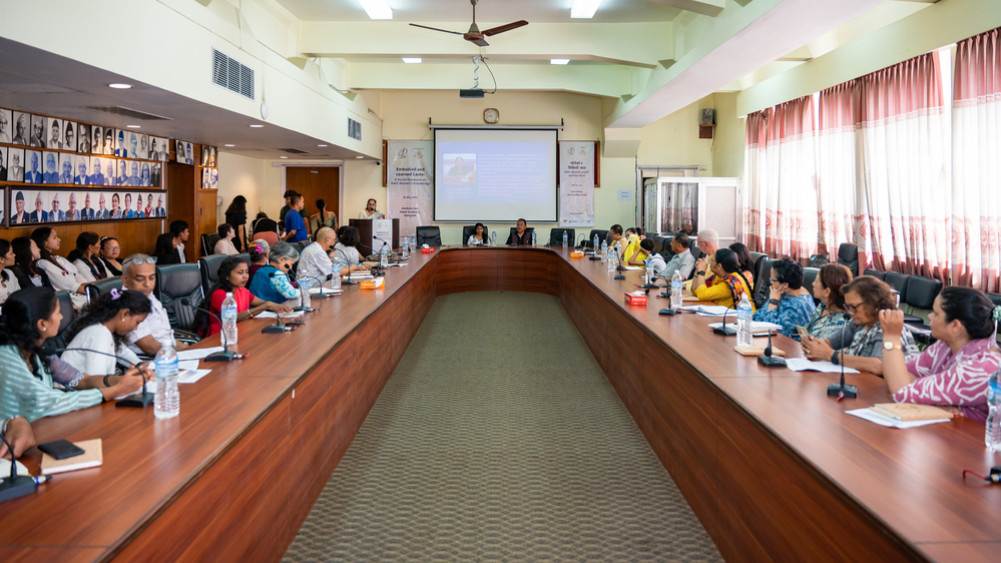
I remember Parijat Didi advising 'Old Jamie of the City Hall' in her story not to die without understanding, 'You are taller than this City Hall, aren't you? Jamie, you eat four rupees. What has to do with your country and government? If it had been concerned, you would have been able to enjoy that very pleasant building. What kind of cultural programs from abroad are shown there. What kind of dances do they bring? How many parties are held, have you ever had tea there? That's why I tell you that this city hall is standing on your chest? What kind of knowledge and wisdom has been transmitted from the government institution established as a center not only of knowledge, but also of wisdom? Nepal Academy was established in 2014 to produce knowledge from the state. The same academy has been changed from Royal Nepal Academy and Nepal Government Pragya-Pratishthan to Nepal Pragya-Pratishthan. Has this organization been rejuvenated in terms of design and production or not? On 10th July, 2082, in the program of 'Bhogeko og Sekeko Jaat: Social discussion about Dalit women's knowledge' organized by 'Just Futures Initiative' and Pragya - Pratishtana, let us hear the self-reflection expressed by Chancellor and national poet Bhupal Rai, 'The Pratishtana is famous as an organization working in Nepali language and literature. What kind of academic knowledge has been produced in Nepal so far about literature and culture written in Nepali language? As this institution celebrates 68 years, the question of which community and language is being produced seriously raises the question. After meditating on this question, after I came, we made the slogan 'All languages, all knowledge, all wisdom-prestige'.'
Sharing his experience, he says, 'Especially writers are aware of this organization, but people other than that are not aware of its existence. Academics should not only sit in the office and enjoy their wisdom, but should also be interested in people's affairs and learn from the knowledge of the community. With this thought, we went to the Kumal community of Chitwan through the program 'Vidyalayama Chancellor' and 'Raithane Gyan Utsav'. While giving information about the history of the institution, a scholar from the Kumal community stood up and said, "You said that the institution has a long history, where have you been?" The teacher, who has been in the teaching profession for 25 years, stood up and said, 'I have never seen the face of the Chancellor. I am seeing the chancellor for the first time in my life.' After hearing that, I thought - Pragya-Pratishthan should be connected with the people. The institution decided to organize the program through the department of five main subjects - language, literature, social science, philosophy and culture, covering the wide dimensions of knowledge in the society. Now the relationship between the people and the establishment is starting to be felt. In this context, we have come in collaboration with 'Just Futures Initiative'.'
The various shapes and forms of an old, strong and complex institution like caste cannot be understood unless attention is paid to the caste privileges enjoyed by the 'higher' caste based on the caste structure.
When I hear this fact, I cry like a forehead dam hits the door of Halau Kanchaba's house in Palpa and I remember - the program held at Smriti Bhawan of Tribhuvan University, another institution that produces 'knowledge'. In 2016, we organized an international program on 'Politics of self-esteem and equality: Dalits of Nepal' under the leadership of 'Darnal Award for Social Justice'. At that time, the professor of the Central Department of Sociology and Anthropology told me over the phone, "This level of international program under the leadership of Dalits has not been held in our department." I did not ask whether such a program is only in the department or the first in the university. In the meantime, in collaboration with the department, we have been conducting intellectual discussions on various dimensions of caste and sexuality. Vice chancellor Rai says seriously, 'If we cannot eliminate the differences that have been torn apart by the caste system for thirty-five hundred years now, what kind of change will paper socialism bring? This program is the first in the history of Pragya-Pratishthan about caste system.'
After hearing the expression of the Chancellor, some of the participants clapped their hands in a happy posture. I was confused whether to clap or not. What does this fact say about the interrelationship of knowledge production, caste system and Dalit women's knowledge from Prajna-institute with a history of almost seven decades, which is being invested from the state level?—I asked myself.
Exploring the structure of Pragya-Pratishthan, the works produced from it and the ethnic background of the authors of those works, Kiran Gautam writes in 'Janko Jaat-Satta', 'From the initial committee of Pragya-Pratishthan in 2012 to 2072, 63 percent of the 237 officials in the leadership level of the institution including the Chancellor are Brahmin-Kshetri, 20 percent Newar, 6 percent Madhesi, five percent Rai-Limbu, two percent Gurung and Magar and Thakali. Dalits were one percent respectively. Among the 730 writers and translators involved in the publication and translation of poetry, stories, novels, art, history, culture, philosophy, language, grammar, dictionary, etc., published through the foundation in 6 decades, Brahmin-Kshetri 54 percent, Newar 14 percent, Madheshi eight percent, Rai-Limbu five percent, Gurung, Magar, Tamang and foreign nationals one percent each and 10 percent from other communities. The officers of the institution and the publications published by it are dominated by the Brahmin-Kshetri and Newar communities.'
While reading such facts, the state's comments on the caste system and the discussion of castelessness by the state's institutions active in 'knowledge production' are formed before the eyes. Caste permeates every part of our social life - we look with the eyes of the caste, we speak with the voice of the caste, we smell the people of the caste, we act from the body that carries the caste. We say that it is not counted by keeping it aside. State administrators and intellectuals ignore caste. They think it is better to talk about class than caste. After accusing the person who raised the issue of caste as a racist! A group that has special rights and privileges shows itself above the caste. They do not see caste in their thoughts, behavior and actions. Is the special-privileged caste without caste? Indian sociologist Satish Deshpande says, 'The comment that upper caste people are free from caste (castelessness) and that caste is the lower caste is what keeps caste attached.'
In Deshpande's opinion, caste is interpreted in the sense of untouchables, 'lower' castes or Dalits in most of the political and intellectual discussions. The 'upper' caste people are shown to be free from casteism, while they still enjoy caste benefits. The upper castes control the 'visibility' of their presence, while the presence of the lower castes is 'hyper visible'. Why such a wrong image was created, the so-called scholars who are of high caste, they cannot see caste, especially their own caste. An ancient, strong and complex institution like caste cannot be understood in its various forms unless attention is paid to the caste privilege enjoyed by the 'higher' caste based on the caste structure.
Although it is claimed that there has been a reduction in casteism in public life, it seems that caste and gender masks are hung in the Devkota hall of the institute. It is not that there are not 8-9 women out of 111 people, but you have to search like a rock. Women's movement leader and geographer Dr. Sumitra Manandhar Gurung says, 'I was shocked as soon as I entered the hall of the institution for the first time, there are very few women's faces in the line of photographs. Now let's not go to what caste women are. When I saw such a visual narrative (photo-story), I thought - Are there really no contributions of women to the language, literature and culture of Nepal?' Time will tell if the name of Dalit women who are considered to be bitulo will be added to the line of the same photo in the future. Whose voice did we hear that day? What voice did we hear? Did we hear any screams of the blood, sweat and tears of Dalit workers who were pressed under the floor of Pragya Bhawan? Did the collective wisdom of Dalit women wake up that cry?
There are big chairs and tables in Devkota Hall, where big people sit. Mike can only be touched by adults. The discussion this time was not like the regular program. A black-skinned Madhesi Dalit woman was sitting on the middle chair. She is Sona Khatik, Radio Journalist and Executive Director of Just Futures Initiative. To his right, the head of the social science department of the institute. Kaushila Risal and on the left was the chancellor of the institute, Bhupal Rai.
Was Sona, who looked confident from the outside, confident? She says, 'I have never sat in such a position. It was hard to sit down. There is no comparison between the two great men of lesser status. One mind said, the way the veterans on my right and left are sitting confidently, will they say that I am sitting in the same way? Another mind said, this is a challenge. Then courage, strength and pride all came together.
Sona's intellectual height of four feet five inches does not match her physical height. His motto is "I am not an equal person". She is struggling to become a complete person, not only among non-Dalits, but also within Dalits. Even hill Dalits feel a little different from Madhesi Dalit women. Sociologist Gail Omwait says, "Caste is a system in which a person's membership in a society is determined by his birth in a certain group, and such groups are given a certain status in the wider social hierarchy." Since caste itself has a strong hierarchical structure, there are different categories within each caste. In the caste system, social values, dignity, prestige and status are determined according to caste. This is what Dr. Bhimrao Ambedkar said 'graded inequality'.
Sona says, "My difficulty was not due to the fraternity of caste with the veterans who were sitting as equal organizers, but rather in the difference in academic status, certification and age." To understand this difficulty, the concept of institutional capital raised by French sociologist Pierre Bourdieu is useful. Bourdieu says, "Through institutional capital, a person acquires education and necessary skills, on the basis of which he gains position, knowledge, status, respect, dignity and prestige in society." In the society we are experiencing, race, caste and sexuality are institutional capital, from which the value, dignity, prestige and status of individuals and communities are determined.
Although efficient, Sona also uses symbolic capital as a Bourdieuian concept as an organizer of equal status, giving the chancellor a sense of timelessness. Sanju Das, another Madhesi Dalit woman, indicates that time is up and Chancellor Rai understands the time of Dalit women. And, the speech concludes, "As long as I remain in the institution, we will always be with the knowledge campaign of Dalit women."
A discussion on the interrelationship of caste, sexuality and class in the social life of Nepal has begun, focusing on the experience and learning of Dalit women. In this discussion, an attempt has been made to analyze the relationship between these important concepts from a Dalit feminist point of view. The Dalit feminist approach focuses on the knowledge, experience, struggle and resistance of Dalit women. This is a view that also looks at other oppressions related to caste, sexuality, and class. It challenges the Brahminical patriarchy of South Asia, it also questions 'mainstream' feminism that ignores caste categories and advocates only sexuality. It helps to analyze unequal power-relationships.
Sociologist Sharmila Rege says, the Dalit feminist perspective also pays attention to the dimensions of power within marginalized communities. It challenges women's agency or agency within the community by unknowingly trying to prevent it. Writing of Dalit Women is a means of reminding the history of ethnic harassment, struggle, and resistance.
presented around the same principle, six Dalit women- four Madhesi and two hill-dated women's writings. Sitaming Day of Daughter Dawling, the capital, who came from Rautahat, sees the living experience of the feastist historian woman. And, two types of caste seems to: one, landlords. Another, landless breeds! She says, 'We are sitting on the landlessness.' STOY-BREAK Mahottari Ravidari has resisted the genus ransom discrimination against the teacher in his sons. She writes, 'Do all sides have not read?' He does not just question the Dalit women's proness, is not just to question, and the Dalit women's story is not just questions. Love is shown to be encouraged to study the Dalit child. & Nbsp;
Parsaki Madhi Mahara Madhesh Dalit women digs the meaning of getting read. When Kathmandu comes to study, she is grateful for our inhabitants. Having a critical approach to the practice of daily life through the letter 'for mediege' for daily life ', she asks her mother-in-law and her own.
is asking for the existence of the unmodity, "said," Now it is said, "Why is Dalit's book," she is written anything about the Mishards? Why is it only taught by kings? 'Sarki-Break ranged Patriatchy community in Kathmandu, Kathmandu also analyzed Patriarchy. Grandparents are reluctant between the mother and father's employment and the bamboar skin shoe in the bamboo skin boots factory and conflicts. Sociologist says on the basis of Gale Omvhet, "is a physical reality, which is the base. It is not just one form, is a concrete commodity. This has shaped the base the basis of society historically. This has played a role at the financial statistics today. "What daluf-BREAK Maoist, the status of the products, and producers of Nepal, where did he analyze additional price? Isn't the class exploit and ruled over the race system? If there is a square different from the class, the first Dalit women of the Constituent Assembly, Direct Practice of the CA Constituent Assembly members: The Boursel has analyzed ethnic power relations in the party's war and a Dalit feminist view. For years, I remember the statement of Anthology Jeerald Berimon, especially the authority and oppression, is a resent and insecurity. '& Nbsp;
we are living in such a power structure, where a long 25 million man has repeatedly remarched a casual system. Institutional displacement has been continued not only by violence and power, but by creating rulers and knowledge and support. Because of disobedience, the legal system of punishing is also sustained. It is customary to understand such a law in Dalits and ties. Dalit women are on the head of the caste system carried by such institutional disasters. The Dalit women are not the same, the Madhesi Dalit women are still marginalized. Workers' Dalit women have a lot to relax, safe, noduce, find the opportunity to live, true love and honor. There are a prestigious intellectual teacher of the Dalit community, both Dalit women are both external and internally in oppression. Under the external factor, non-Dalit powers try to uniform women's cases. Looking at the internal factor, patriarchal dominance is found as a major problem even within the Dalit community. Therefore, the 'Dalit women speak differently' (Dalit Vimeen Talk Deforcel), he argues that Dalit women need to talk differently.
is widely involved in the domestic and feverness of Dalits' language, "in the language of the society. Therefore, the sound of Dalit women is staged between dominated castes and patriarchal thinking. In my fervent and study, everything is treated as if the Dalit women are treated as a gine on a corpse. When the lense of the camera is focus on Dalit women, the pity of Patriarchy and the mainstream feminine women. Because Brahminist Patriatrist never envisions Dalit women with the ability to play knowledge on knowledge, knowledge produced and thinkers. Manthan has started about the trend that is in
society and power. The promotion of Dalit women in Mantle has started speaking. They invite the victims from Brahminist Patriarch- for the deliverance manner. This invitation is for all the levels of humanization journey. In order, feminist thinkers and writer virgin Lama were in the solidarity of the Dalit Women's movement. In trouble, Lama said, 'Nepal's female movement has missed Dalit women and his issues in the history of Nepal's feminist movement. I also miss the issue, I want to apologize. Unhappy, I shaved a race. I had to stop when my family trassedes ethnic. Now there is a time to think about Dalit women, reconsider. I am also an oppressed of ethnic structure. The state has exposed Tamangs in dislike. I can understand the pain of the community in another exponentially. '& Nbsp;
& NBSP; while the struggle with Dalit women with Dalit women from Dalit Women for two decades, I did not listen to the hospital misconceptions. I only apologize, not the person's hand, a person's hand, the sensitivity in cooperation with his dealings with his dealings, Dalits, determines the essence of solidarity. I did not even find a clay greed in the sound of Virgin Lama, I did not even have a self-knowledge of the life and knowledge of Dalit women. After so, I saw how much market grows how much market grows. She was not a revolutionary by apologizing or that she was not a revolution or a 'rat running'. She was feeling deeply and expansion of the Dalit Women's issue. Solidity shown by the Dalit Women's movement with public apologies will be clearly exposed to her writing and thinking.
helps us to understand the importance of self-determination. We do not agree that Reeg says, 'I can re-invents yourself as Dalit women as Dalit women. It is important to have a Dalit feminist view. According to Regenerate, conversion, conversion, and subsequently, such as 'they' of reaging (Social Locations). . '& Nbsp; Santi-Break Brahmin Brahmin Brahmins Self Because it completely rejects the relationship with the government structure we attended. It is a degree of bridmonist-middle-Break in the former feminist perspective. ' Dalit women and resistance of Dalit women and the opposite women against Brahminari Patriarchy, so quithdles. If this screams are to hear, it will be removed not only the Dalit community but also the concept of knowledge-building building of Nepali society.
- Pariya Pariya 'JUST FUSTERS' ID'S Founder Chairman of the Thus.