We use Google Cloud Translation Services. Google requires we provide the following disclaimer relating to use of this service:
This service may contain translations powered by Google. Google disclaims all warranties related to the translations, expressed or implied, including any warranties of accuracy, reliability, and any implied warranties of merchantability, fitness for a particular purpose, and noninfringement.
The Federal Democratic Republic of Nepal considers equal participation as an important part of governance. It is intended that the reflection of social diversity should be reflected in the structure of the state. Thus, youth representation in politics is also an important issue from the point of view of inclusion.
Nepal's National Youth Council Act and National Youth Policy, 2072 defines youth as a person between the ages of 16 and 40.
According to the 2078 census, about 40 percent of the total population of Nepal belongs to this age group. According to the law, candidates must be 21 years old at the local level, 25 years old in the House of Representatives and Provincial Assembly, and 35 years old for the National Assembly. Must be 45 years old to be appointed to a constitutional body.
Youth in the House of Representatives
According to the election results in 2079, the highest (34.73 percent) representation in the current (2079-2084) House of Representatives is in the age group of 51 to 60 years. The population of this group is 8.05 percent. The representation of youth under 40 is only 12 percent.
2 thousand 412 people registered their candidacy for 165 constituencies towards the system of being elected first. Among them, 759 (30 percent) were under 40 years of age and only 10 could win. This is 6.06 percent of the total number of elected members.
Looking at the youth participation in the party that won 10 or more seats in the election, an interesting fact is found. These parties are Nepali Congress, CPN (UML) and CPN (Maoist Centre), Janata Samajwadi Party Nepal (JSP-Nepal), Nepal Communist Party United Socialist Party (NCP-S), National Democratic Party (RPP) and National Independent Party (RASP). According to the Election Commission, the highest number of young people are represented by the RSVP. 40 percent of its MPs are under the age of 40.
8.97 percent of UML MPs are under 40 years of age. Similarly, only 4.49 percent of the Congress with 89 MPs are young MPs. There are 12.90 percent youth MPs from the 31-member Maoist Centre. 28.57 percent of the 14 MPs of RPP are young MPs under 40 years of age. There is not a single youth MP from Jaspa and CPN (S). Looking at these data, there is an indication that the youth participation in Nepali politics is weak and the established parties have given less priority to the youth.
Challenge Bagrelti
There are certain reasons why youth participation in politics is weak. The main reason for this is the tendency to repeat the same person in the leadership of political parties and governments. From the local level to the federal level, the opportunity for new people has been limited as the senior generation continues to be active in positions based on experience, access, identity, etc. For this reason, some people say that in order to give opportunities to the youth in politics, the age limit should be set in the policy and responsibility should be given.
He argues that it should be mentioned in the policy that how many terms the same person can repeat in a certain position. As the elections are becoming more expensive, there is also a comment that only candidates with money can win the elections. But because the adult members have control over the family property, the access of the youth is weak. On the other hand, it is believed that older people have more experience and that is also a positive asset for winning elections. Due to these reasons, the youth have less opportunities.
becomes the reach and identity of established political leadership. It also comes to him to mobilize means and resources. He is followed by the media and known by the people. By using it, they can stay in the main post of the party or the main post of the government.
Continuity of power and power
Diss. Sher Bahadur Deuba, who became the central president of Nepal Vidyarthi Sangh in 2028, became a central member of the Congress in 2048, has become the prime minister of the country five times and has been the chairman of the party twice in his political life of about 6 decades. Even now he is at the center of power and power as the chairman of the party. According to the agreement between Congress and UML on 17 June 2081, Deuba is preparing to become the Prime Minister for the sixth time.
The current Prime Minister KP Sharma Oli, who is also the President of UML, has been Prime Minister four times and Party President twice. He became the home minister in 2051 and is still in the leadership of power and power. In order to give opportunities to the youth, the 10th National Congress of UML, held in 2078, set the age limit at 70 years in the party constitution. But in May 2080, UML decided to remove the age limit of 70 years.
Chairman of the Maoist Center Dahal has been the prime minister three times and has been the leader of the party since its inception. Even in the Maoist center, there are voices that the leadership should be handed over to the new generation.
These leaders are occupying those positions according to the statutory rules and legal procedures. Some came unopposed through party convention and some won through election.
He came to parliament after winning the election. But the problem is that these leaders have become power centers. Even when they are in power or out of power, they can influence many activities such as budget allocation and appointment, so they have always been players. The trend of the older generation occupying the position is also seen at the provincial, district and municipal levels.
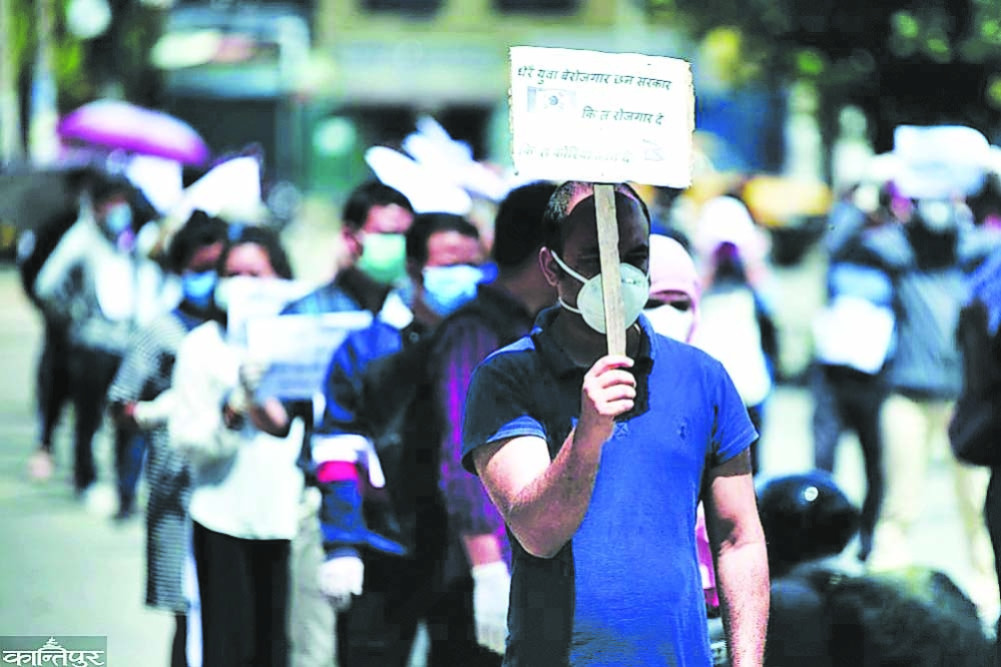
In a democratic system, no person is without choice. But even in the parties that have been around power and strength in Nepal's politics for a long time, the same person has been occupying the position and leadership for years. That is why the politicians of the last generation are not getting the opportunity. Due to this trend, the negative message is being sent to the new generation who are entering politics, so it can be seen that frustration and dissatisfaction have increased in them. Youth is indispensable for
parties. There has been a debate about the transfer of leadership and succession in
political parties. The secretariat meeting held on 28 August 2081 of UML passed an annual action plan to hold a national summit in which youth under the age of 40 participated in order to focus on the role of youth in nation building. In 2080, under the 'Mission Grassroots' programme, UML launched programs such as 'Future Youth Leaders in Wards' and 'Our Own Leaders: Self-Prime Ministers' under the slogan 'Children across the country'.
UML's Gandaki Provincial Committee had set a quota to select youth representatives below 40 years of age from each municipality in the session held in October 2080. In Congress in May 2080, some young leaders launched a party conversion campaign. The Maoist Center has mentioned in the constitution that at least 20 percent of the members of all committees will be young people under the age of 40. The Rashtriya Prajatantra Party selected 20 central members through open applications from all over the country to bring capable youth under the age of 40 to the leadership. These examples also confirm that the Yuva Shakti Dal is indispensable.
conclusion
A key feature of the system of governance embraced by the Federal Democratic Republic of Nepal is inclusive representation. Therefore, it is important to reflect the diversity of the society in the structure of the state. But the presence of youth in Nepali politics is weak. An example of this is the presence of only 12 percent of the age group of 16 to 40 years old, who make up about 40 percent of Nepal's population in the current House of Representatives.
The tendency to repeat the same person in the leadership of that party and the government he leads is very visible. From the local level of the party to the central level, the senior generation has been active in the positions based on experience, access, identity, etc., the opportunity for new people to get those positions has been limited. Because of this, the attraction of youth towards alternative politics has increased.
It is natural for voters to have the psychology of seeking a representative like themselves. Some youths are moving to new parties as opportunities are available quickly. It is necessary for the parties that have contributed for democracy to become liberal for inclusive leadership. It is necessary for major political parties to adopt a policy of compulsory resignation after a certain term in the law and party constitution to increase youth participation.
(The author is a researcher at the Democracy Resource Center.)