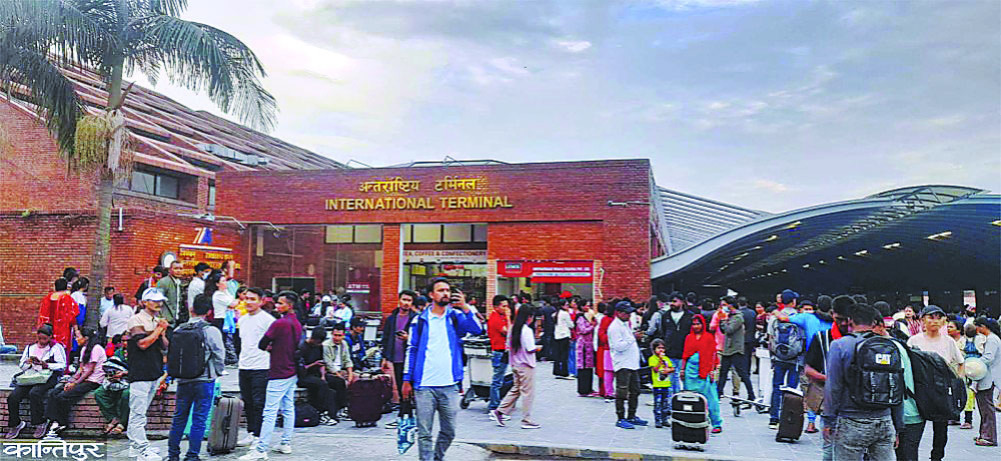
In recent times, the situation of going to the Russian army looked terrible. Young people are putting their hands in such a risky 'lottery'. For those who want to go abroad, it is necessary to identify a good opportunity and open a legal and safe way. Otherwise, the situation of choosing an illegal path, becoming a victim of loans at high interest rates, and going to jobs that do not match the qualifications and abilities will continue to increase.
We use Google Cloud Translation Services. Google requires we provide the following disclaimer relating to use of this service:
This service may contain translations powered by Google. Google disclaims all warranties related to the translations, expressed or implied, including any warranties of accuracy, reliability, and any implied warranties of merchantability, fitness for a particular purpose, and noninfringement.
I met Anil Pariyar from Belpata-2, Achham in the industrial city of Mumbai. He works there in the textile industry. He earns 12,500 Indian rupees a month. This amount has been used for daily living of Pariyar, but there is no savings.
There is not much work in the village. Willing to go to Gulf or Malaysia. But there is no money to go there. It takes two to four lakhs. No one will give loans to people like us," he was saying in a Mumbai dera, "There is no progress here. No savings. Even though Mumbai didn't give us much money, it helped us to pay off the debt we incurred in the household business.
Anil was not alone in this situation, he was accompanied by a dozen young people who came to Mumbai in search of work from Achham and Doti. They could not even go for employment in countries other than India. This includes high fees, lack of access, lack of information, contractual work and service facilities and uncertainty of loan repayment. An open border with India, a traditional sign of the Indian labor market, as the village acquaintances continue to move in and out. Due to the low cost and the low risk, young people from the western part of Nepal are forced to depend on Indian employment, even if it is for a low salary. Although many Nepalis are established in the Indian labor market, India is becoming the only option for poor families to get jobs at low cost.
Every year, the number of Nepalis who go to foreign jobs outside of India from Nepal is huge. In the last fiscal year alone, 775,000 young people entered the European labor market from the Gulf, Malaysia. The data of a large number of people going to foreign employment has attracted our attention. Its binding aspect continues to be a matter of public debate. However, we have not paid attention to the issue of the backward classes who are unable to go for foreign employment despite their desire. Which class really needs profitable foreign employment.
According to the latest National Living Standards Survey, 76.8 percent of families in Nepal have received remittances. In the absence of good permanent employment in the country, the remittances received in this way are becoming nourishment for every section of the society. The fact that remittances play an important role in poverty alleviation has been stated in the study reports of various organizations such as the World Bank, Nepal Rastra Bank and others. Despite this, all sections of the society have not been able to benefit equally from remittances.
According to national level statistics, most of the job seekers in India are from very low income families. Middle and high income families tend to look for work in major destination countries other than India. Information, cost and accessibility play an important role in workers' choice of destination. The lower family members, who are most in need of foreign employment, have to hold back from getting profitable foreign employment because they cannot afford the cost. Some invest to go abroad for high risk of loans at a high interest rate of 36 percent. Not all of them succeed. Contractual work, salary, service facilities vary. The situation of having to sweat throughout the year even to cover your costs when there are high costs for low salaries is shining like the sun in front of everyone. It is also ironic that those who went to earn in more risky situations have to return home with heavy debts.
Talent, hard work, desire for progress are everywhere. However, opportunities do not exist. Where and under what circumstances a person is born is a kind of lottery. Which is called 'birthplace lot'. Accordingly, his access to quality education, employment and proper healthcare opportunities is determined. Inequality of opportunity is not only reduced by labor migration, but also brought closer to opportunity. However, because the management of foreign employment is not transparent, the result of foreign employment is uncertain for every worker, so it is like a lottery. Nepalis are attracted to foreign employment for local benefits. If the same person does the same work in Nepal at the same time abroad, the return will be qualitatively much higher than in Nepal. This is what economists call the place premium. Foreign employment is not only a high salary, but also an opportunity to learn new technology, see new places and develop new social relationships.
Despite these benefits, many people who have gone to the airport carrying bags and debt burdens are worried about the consequences of foreign employment developed as a lottery. Not every worker can leave safely. Because the entire cycle of our labor migration is not transparent. Such uncertainty can only be addressed by a proper foreign employment policy. It should be made transparent, safe and profitable to ensure the results of foreign employment. It is not enough to do this, the young people who are geographically, socially and economically backward should be visibly involved in the cycle of foreign employment.
Migration Lab and some of the exercises done by International Manpower Recruitment Company (IMR) can be taken as an example. In collaboration with two organizations, a campaign was carried out to send earthquake victims from Musahar community in Mahottari's Balwa Municipality and Jajarkot to Malaysia at zero cost in a transparent manner. The Musahar community was chosen based on the recognition of the potential for beneficial migration to lift families out of intergenerational poverty and discrimination. Some of them had their passports in the possession of brokers for months or years. Some could not make a passport. IMR returned the passport from the broker, made a new passport. Similarly, 8 months ago, the organization reached the village itself to send the earthquake victims of Jajarkot to Malaysia at zero cost.
Some of them were planning to go abroad (those who couldn't get loans to India) by taking huge loans at high interest rates. In this context, going to a Malaysian job with a monthly salary of 60,000 to 100,000 rupees at zero cost in the village itself has brought great economic benefits. If this community had to take a loan and go for foreign employment, the reconstruction would be affected. If they were stuck without a job as they had taken a loan, they would be in an even bigger hole. These two exercises can be a lesson of how much foreign employment is important for the backward communities to get access to decent jobs in the villages, without investment and returns when thousands of youths come to the door of manpower as zero cost employment. In both these cases, the youth and their families did not believe that it was possible to go abroad for zero-cost employment. Some suspected that it might be a trap later. The chosen ones finally believed fully when they reached Malaysia and received the salary according to the contract.
In Nepal, zero cost, even if not zero, low cost and transparent admission process are also in practice. Due to the lack of access to workers in this practice, the illusion that foreign employment cannot be obtained without paying money has taken root. After the earthquake victims of Musahar and Jajarkot reached Malaysia told their community, it was difficult for the community to believe. All these are the result of lack of correct information. Thus, after the efforts of Migration Lab and IMR set the path to zero cost, it can be expected that other young people from the community will get this kind of opportunity and the related information and network will be developed and expanded.
When transparent, safe, profitable opportunities are not prioritized, job seekers are trapped in risky jobs. For example, let's look at the 'EPS' model of taking workers to South Korea and the 'SSW' model of taking skilled workers to Japan. The government officially sends it to Korea. Korea costs, income and working hours are fixed. Japan has an agreement to ship to SSW. Japan's employment has not been institutionally opened since it has not been decided whether to send it through the government or private (manpower) process. Just as many people were able to benefit from EPS when the government made easy roads, but they could not benefit from Japan's SSW when roads were not built. In 2019, Japan signed a labor agreement with Nepal, second only to the Philippines, in accordance with the policy of bringing in skilled manpower. According to this policy, the Philippines was able to send thousands of workers to Japan. It transformed the lives of those workers and their families. However, even after 5 years, the labor agreement between Nepal and Japan remains the same.
Not being able to pick the fruit from the tree with our hands is our policy failure. Many young people are being forced to go to Japan in search of work through the back door through student visas. Last year, 34,000 students took NOCs just to learn Japanese. They had to go through unnecessary expenses and complicated procedures just to get a job in Japan. Japan really needs workers. Visa is also available. There is also a contract. There is not just one transparent procedure. The number of people who go to domestic labor through the third way is increasing due to the ban on domestic labor for decades. Recently, the situation of going to the Russian army is even more alarming. Young people are putting their hands in such a risky lot. Majority of the youth have great aspirations for foreign employment. Accepting this, it is necessary to identify good opportunities and open a legal and safe way for the youth who want to go abroad. Otherwise, the situation of choosing an illegal path, becoming a victim of high-interest loans, and going to a job that does not match one's qualifications and abilities will continue to worsen.
A good opportunity paves the way for other good opportunities, be it abroad or after returning to Nepal for yourself or your family. In any case, the deep mentality of going abroad is ingrained in the youth. It needs to be corrected or changed. This is only possible by reforming the existing legal framework. The policy related to the management of foreign employment should not be just for show, it is necessary to make it in a way that gives results.
Prioritizing profitable foreign employment does not mean turning a blind eye to malpractices. Social values are not forgotten. Policies should be adopted to promote gainful labor migration by properly curbing malpractices. More and more prestigious establishments in the destination country should create an environment that will attract Nepalis. Priority should be given to countries where the interests and safety of workers are prioritized. If this is practiced, the incidents of being stranded abroad will automatically be reduced. In such a situation, the path of advancement will open up along with getting proper opportunities for foreign employment. Prioritizing profitable foreign employment does not mean neglecting domestic job creation. Rather, the internal labor market of Nepal can be further strengthened through profitable foreign employment. Both of these can be taken together.
– Khadka is the founding executive director of Migration Lab.