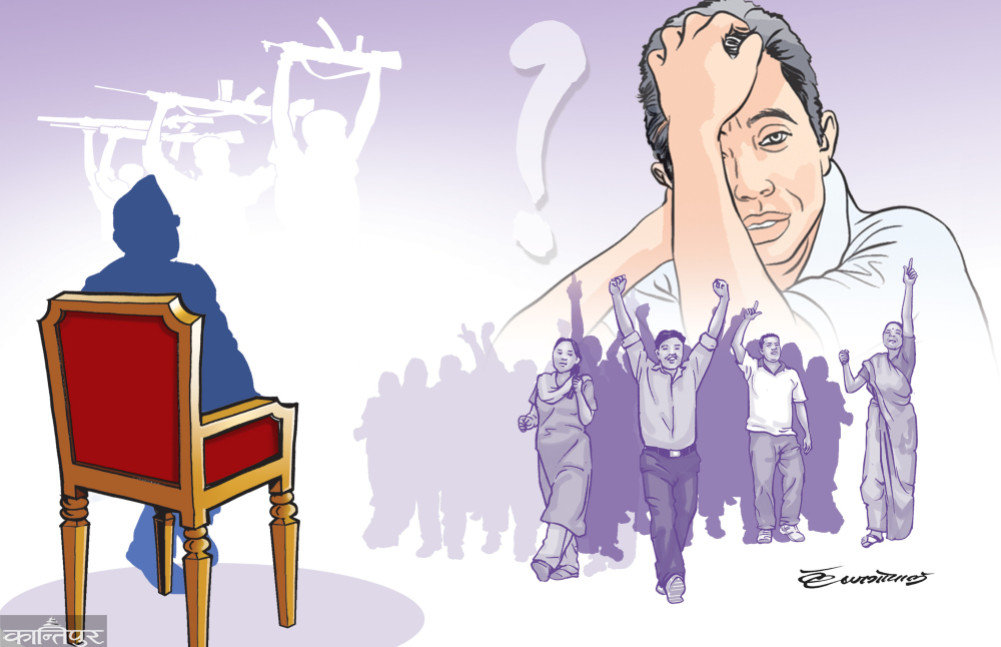
After the success of the people's movement, after the mixed election system was adopted, the power brokering became more distorted. The people are at the stage of rebellion due to extreme frustration due to unstable government resulting from nearly two decades of distorted political games.
We use Google Cloud Translation Services. Google requires we provide the following disclaimer relating to use of this service:
This service may contain translations powered by Google. Google disclaims all warranties related to the translations, expressed or implied, including any warranties of accuracy, reliability, and any implied warranties of merchantability, fitness for a particular purpose, and noninfringement.
Parliamentary arithmetic is the main basis of government formation and dissolution in a multi-party system. The electoral system of some parliamentary systems in the world is based on a mixed system (direct and proportional). In a mixed electoral system, it does not seem possible for any one party to get a majority, i.e. fifty percent plus one seat, with few exceptions. This binding situation creates the character of political brokering in the parties.
In this article, in Nepal, especially in the Interim Constitution 2063, the constitution of the Constituent Assembly, along with the provision of the mixed election system, has been analyzed, and the institutionalized brokering character has caused challenges to the federal republican system.
In politics, brokering is generally accepted as a practical weapon of power. Power brokering is used more in mixed electoral systems than in direct ones. Some mixed system countries, notably Italy and Finland, have had coalition governments since World War II, both of which have frequently changed governments. Italy has had 68 governments in the 77 years from 1945 to 2022, all from multi-party coalitions. After Finland became independent on December 6, 1917, until 2023, there have been 78 majority coalition governments in this country.
But due to the effectiveness of the system and laws, Finland is among the top 10 countries in the world with high development and happiness. Scholars of political science have studied the trend of formation and dissolution of multi-party coalition governments between competing parties in Western European countries, especially Scandinavian countries, which adopted mixed electoral systems after the Second World War. Political parties have also been conducting theoretical debates from various angles on how they compromise on power brokering when forming a coalition government, what reasons and circumstances determine the coalition. Some coalition government theories have also analyzed whether the parties' first choice is their theory or ministerial posts and ministries. Similarly, some theories have also studied the mutual strategic behavior of parties using mathematical tools (game theory) and especially how some gain more and others lose.
Power brokering politics is the behavior of parties and their leaders to enhance their interests and secure their position above others. When maximum power and options are used to make more demands and fulfill interests, assuming the inevitability of one's participation in the coalition government, that situation is considered as a distortion of brokering. American psychological novelist and philosopher Robert Anton Wilson has said that "conspiracy is another name for conspiracy". Political cronyism is therefore perverse, when the leader exhibits undemocratic behavior in the frenzy of power, putting himself, family, wealth, dignity and reputation before the country and the people. Until the point where the government survives, the participating ministers or parties continue to use power by calculating the advantages and disadvantages according to their share. When the state of power brokering becomes distorted, the constitutional and legal foundations are weakened and political values, ethics and public shame are all abandoned. Making the most of arithmetic constraints
The goal of power brokering is to get power on one's own terms and use wealth, dignity, honor, and government resources to promote one's interests. Similarly, the brokering character displayed to recruit their families and cadres for constitutional (even in the courts) and government posts is its perverted form.
Niccolo Machiavelli, a famous diplomat and political philosopher of the 16th century, said in his book 'The Prince' that authoritarians should be more realistic than idealists, not only for monarchy but also in republics, where there is no place for education in morality, religious beliefs, virtues and ideals to gain and maintain power. are Power requires the politics of deception, treachery, deception, dishonesty and terror.
According to Machiavelli, the use of these weapons of power must win the support and trust of the people. Because when there is a problem, the biggest base is the people. However, in some countries that have adopted multi-party democracy, including Nepal, the power brokering has become so distorted that the feeling of extreme frustration and rebellion has started to rise due to the inability to use power for the benefit of the people. The Democracy Study 2024 from Gothenburg, Sweden, noted a gradual decline in elected democracy (42 countries' democracies declined in 2023), increasing authoritarianism and military rule.
The distorted form and character of power brokering in Nepal has not been seen since the restoration of constitutional monarchy and parliamentary system in 2048. Our society is semi-feudal in character. As in other sectors, political parties are dominated by the middle and upper middle classes, where power is used to maintain political dominance. The leadership of the Maoist party is held by the same semi-feudal class, which is also seen in the Congress, RPP and Madhesh parties.
In the 12 years from 2047 to 2059, 11 governments were formed, in which if we look only at the non-repeated ones, 6 prime ministers became prime ministers and more than 250 ministers became ministers. If we look at the nature of the coalition, between 2051 and 2055, the government changed six times and no-confidence motions were submitted ten times. On August 26, 2052, the then UML Prime Minister kept the opposition MPs in a hotel before voting on the motion of no confidence advanced by the Congress, RPP and Sadbhavana, or the incident where the leader of the same party absented two MPs from his own party in the no confidence motion submitted against the Congress Prime Minister and brought down the government. Can be taken in a distorted form.
MPs being held in hotels until voting did not happen in the Indian Parliament in April 1999 when Prime Minister Atal Bihari Vajpayee faced a motion of no confidence. His government collapsed with a deficit of 1 vote in the June polls. However, the perverse activities played for power in Nepal are no less than those of other poor, emerging democratic countries in Africa and the world.
After the success of Jan Andolan 2062/63, the power brokering has become more distorted after adopting mixed electoral system. A total of 14 governments were formed from May 2063 to October 2072 (the time when the constitution was made) and six from October 2072 to January 2079. 16 governments were formed till February 21, 2080, if the current prime minister is changing the government coalition party and staying on as the head of the government.
Taking advantage of the mutual competition between Congress and Communist big parties of different theoretical lines in the Parliament, the practice of power grabbing by the third party sometimes opening one door and sometimes the other to become the prime minister has promoted distorted brokering. It has also caused extreme disgust among the people. The main reason for this is to continue the provisions of 2063 in the constitutional provisions regarding the formation of the legislative parliament in the 2072 constitution.
One of the products of the multi-party system adopted in Nepal is that during this period, except for five prime ministers or presidents, the same persons have been repeated most of the time. Most of the Prime Ministers are from the Communist Party. The data on the formation, dissolution and reorganization of state governments is even more disappointing. With more than two dozen chief ministers in the last seven years, the number of cabinet reshuffles is even more dismal. Since last February, the government has been changed more than 21 times in 15 months and this distortion has been seen the most in Koshi province. After the current Prime Minister Pushpa Kamal Dahal broke the cooperation with the Congress and created another equation, among the participating parties in the province, the ministry's small group of people petitioned the court, left the government by brokering and then participated again after the demand was fulfilled. An example of this is the distorted character of the government formed in Koshi and Gandaki by breaking the constitutional and legal norms.
Among the two major parties, by mathematical necessity, those in the government and those in the opposition have gained enormous brokering power. This has also increased the power of brokers in other parties after the two largest numerically, which has created an opportunity for extreme abuse. For example, the home minister of the current government, who is accused of co-operative fraud, is the leader of the third largest party in the government. He has formed a parliamentary inquiry committee on the fraud and has warned that his party will leave the government if he resigns. Due to satlipsa, the current prime minister is forced to endure such perverse brokering and has to come to the defense of the minister. Other mathematically important parties also have the same politics of brokering.
The more uncertain the ruling party's life expectancy, the more likely it is to abuse power. News of corruption at all levels of government/organizations make headlines in digital and print. The current prime minister told this columnist before the formation of the current coalition that there will be extreme politicization in the state's constitutional bodies (courts, authorities, election commission), administrative and police structures, and it will be difficult to maintain good governance due to the influence of special parties.
Due to the unstable government, the administrative structure is stuck. Due to the perverted power brokering politics, the government is under the siege of conflicting relationship between personnel administration and authority. The Prime Minister himself is innocent. The functioning of the government is driven only by the interests of the bureaucracy. From a constitutional point of view, the separation of state power, especially the sovereign parliament and the judiciary, has been blurred. State organs have become ineffective due to political influence and unstable government. If necessary, they are being used to fulfill the wishes of the leadership of the political party (such as one of the party leaders tried to fulfill the ambition of democratic authoritarianism by dissolving the parliament).
The people are now at the stage of rebellion due to extreme frustration due to this distorted political brokering game of nearly two decades and the resulting unstable government. If the federal democratic republic is to be protected, the party that has at least a large mandate should form a government as soon as possible and make some bold decisions for basic reforms such as reviewing the electoral system, the number of provinces and localities, the formation of service commissions in constitutional bodies, and the end of politicization in personnel administration and the police. More than that, one should dare to take necessary bold steps against the corrupt. However, if the current government formation system is to continue, it is certain that we will have to bear the brunt of the end of this system.