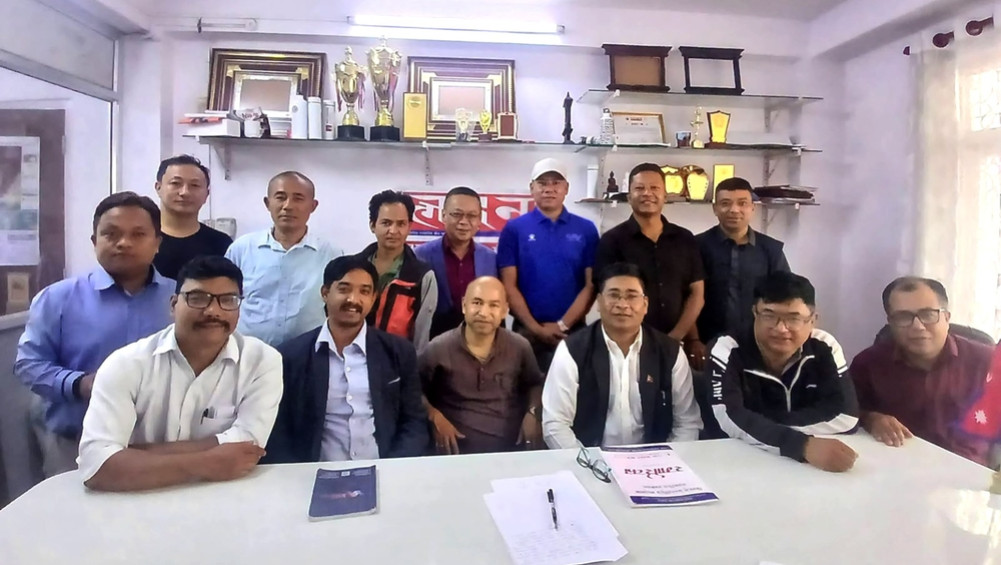
According to Phonies, the conference will provide an important opportunity for experience exchange, international collaboration, knowledge sharing, and building common campaigns among indigenous mother tongue journalists from around the world, including Nepal.
We use Google Cloud Translation Services. Google requires we provide the following disclaimer relating to use of this service:
This service may contain translations powered by Google. Google disclaims all warranties related to the translations, expressed or implied, including any warranties of accuracy, reliability, and any implied warranties of merchantability, fitness for a particular purpose, and noninfringement.
The third International Indigenous Mother Tongue Journalism Conference is being organized in Kathmandu by the Federation of Nepal Indigenous Journalists (FONIJ) and coordinated by the Newa Journalists National Dabu.
The conference to be held from August 24 to 27 will be co-organized by ethnic journalist organizations affiliated with FONJ, namely Tamang Journalists Association, Kirat Rai Journalists Association, Tamu (Gurung) Journalists Association, Tharu Journalists Association Nepal, Magar Journalists Association, Limbu Journalists Association and Sherpa Media Group, it was informed on Thursday.
In the context of the United Nations declaring 2022-2032 as the International Decade of Indigenous Languages and conducting a campaign for the protection, promotion and revival of indigenous languages worldwide, FONJ President Lucky Chaudhary informed that the conference is being organized on the occasion of World Indigenous Peoples' Day and the 27th founding anniversary of FONJ. According to him, at the end of the conference, a 'Kathmandu Declaration' will be issued, encompassing the necessary policy reforms for the protection, promotion and institutional development of mother tongue journalism, ensuring linguistic rights, strengthening indigenous media and a common commitment to the professional safety of journalists.
According to Phonies, the conference will provide an important opportunity for exchange of experiences, international cooperation, knowledge sharing and building a common campaign among indigenous mother tongue journalists from all over the world, including Nepal. The conference is expected to make a significant contribution to the sustainable development of mother tongue journalism, capacity building of journalists and expansion of international networks.
The conference will have serious discussions on the current situation, opportunities and challenges of indigenous mother tongue journalism around the world, professional, commercial and physical safety of journalists, the future of mother tongue communication in the digital age, inclusiveness in communication policy and linguistic rights.
In addition, various sessions will be conducted on the relationship of indigenous communities with water, land, forests, biodiversity, herbs and natural resources, the impact of climate change on indigenous communities and the role of media in climate justice. The conference will be attended by more than 500 native-language journalists and media personnel, including experts, 60 international native-language journalists from 27 countries, 300 representatives from FONIS branches across the country, 40 representatives from the National Press Club of Newa, and 100 from ethnic journalist organizations, according to the organizers.
Although Nepal is a multilingual, multicultural, and multi-ethnic country, many native languages are on the verge of extinction. The organizers say that in the current situation, where the use of native languages is limited in the mainstream of information and communication and the voices of indigenous communities are not adequately represented, a common national and international debate is needed for the protection, strengthening, and professional development of native-language journalism. FONIS will also conduct fellowship programs in Madhes and Lumbini provinces to expand membership and encourage journalists.