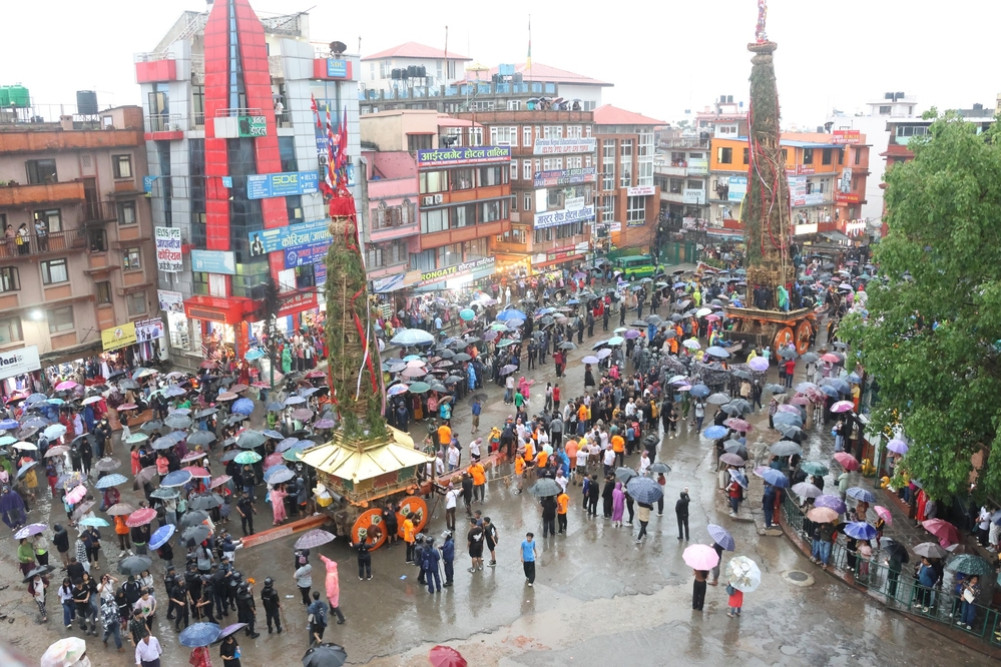
The chariot, which was taken to Gabahal on the first day of the festival, was then taken to Lagankhel on Sunday via Mangalbazar, Sundhara, and Chabahal.
We use Google Cloud Translation Services. Google requires we provide the following disclaimer relating to use of this service:
This service may contain translations powered by Google. Google disclaims all warranties related to the translations, expressed or implied, including any warranties of accuracy, reliability, and any implied warranties of merchantability, fitness for a particular purpose, and noninfringement.
As part of the ongoing Rato Machhindranath Jatra in Lalitpur, a chariot was pulled to Lagankhel Bus Park on Sunday.
The chariot, which was taken to Gaahbahal on the first day of the jatra, was then taken to Lagankhel via Mangalbazar, Sundhara and Chaahbahal on Sunday.
Rato Machhindranath, who is worshipped as the god of rain and seasons, was placed on a 32-hand high chariot on Baisakh 5 with prayers, and the jatra was formally started on Baisakh 8 by pulling the chariot. According to Janak Pokhrel, spokesperson of the Guthi Sansthan, the Guthi Sansthan plays an important role from the construction of the chariot until the completion of the jatra. The institution is also actively involved in pulling the chariot and other management work.
According to him, after the chariot is taken to Lagankhel, Mahabali Puja is performed and coconuts are dropped from the top of the chariot after observing the site. The day after the coconut is thrown, it is customary for only women to pull the chariot.
The chariot is then taken west from Etitol via Kumaripati to Lalit Mandap in Jawalakhel, where a program is held to show the bhoto. This year's Rato Machhindranath Jatra concludes after the bhoto is shown by the Head of State.