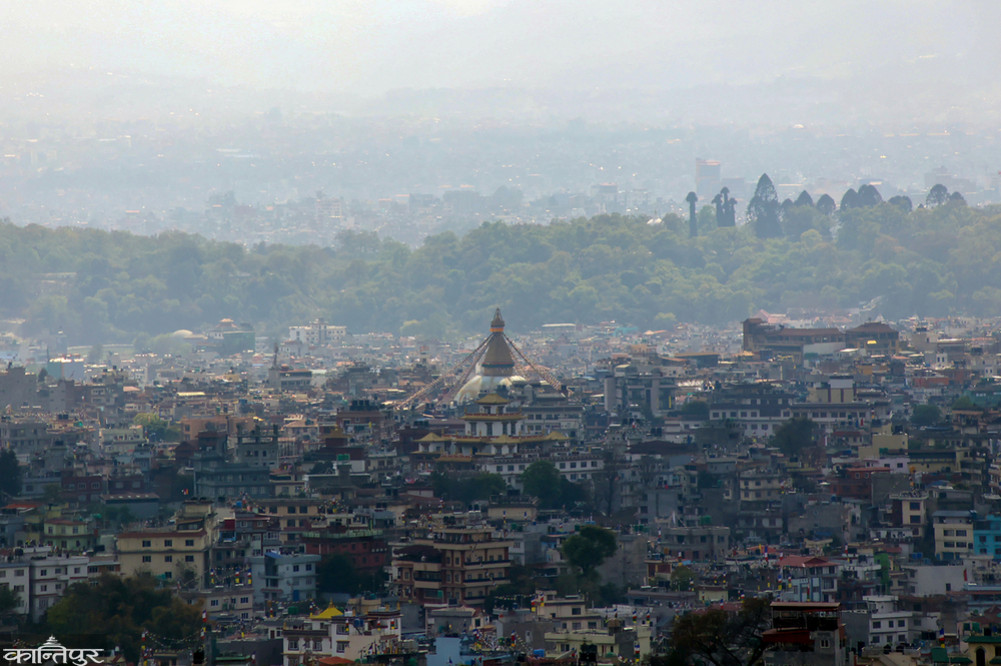
When analyzing Air Quality Index (AQI) data, just seven days ago, Kathmandu was ranked the second most polluted city in the world, with air pollution reaching 178 AQI.
We use Google Cloud Translation Services. Google requires we provide the following disclaimer relating to use of this service:
This service may contain translations powered by Google. Google disclaims all warranties related to the translations, expressed or implied, including any warranties of accuracy, reliability, and any implied warranties of merchantability, fitness for a particular purpose, and noninfringement.
Air pollution has significantly decreased with the rains that have been falling in most parts of the country since Friday.
Analyzing the Air Quality Index (AQI) data, Kathmandu was ranked the second most polluted city in the world just seven days ago when air pollution reached 178 AQI. Today, air pollution has come down to 60 AQI. With this, Kathmandu is ranked 67th in the list of most polluted cities in the world.
According to the AQI standard, 0 to 50 is considered 'good', while 51 to 100 is in the 'be alert' category. 101 to 150 is considered 'unhealthy', which can especially affect respiratory and heart patients. Similarly, 151 to 200 is considered 'unhealthy for everyone', 201 to 300 is 'very unhealthy', and above 300 is considered 'extremely dangerous'.
Gyanraj Subedi, Director General of the Department of Environment, said that air pollution has decreased due to the rains and storms that fell on Friday and Saturday. According to him, rain helps to bring dust and pollution particles in the air to the ground, while wind blows those particles away, reducing pollution.