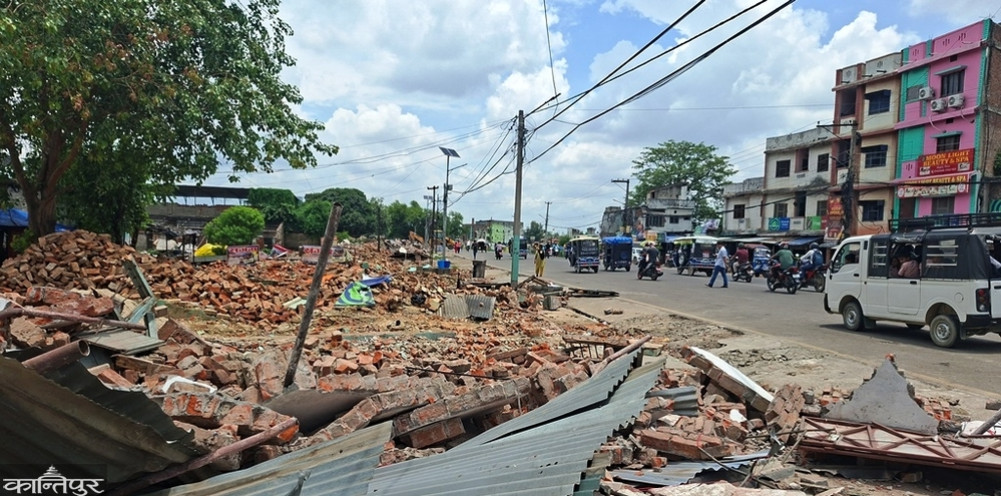
They have urged the government to find alternatives while preserving the old settlement of Birgunj, which holds historical, cultural, and economic importance, during the road expansion.
We use Google Cloud Translation Services. Google requires we provide the following disclaimer relating to use of this service:
This service may contain translations powered by Google. Google disclaims all warranties related to the translations, expressed or implied, including any warranties of accuracy, reliability, and any implied warranties of merchantability, fitness for a particular purpose, and noninfringement.
Expressing dissatisfaction with the preparations underway for the expansion of Birgunj's main road, local businessmen, homeowners and various stakeholder groups have demanded that Prime Minister Balendra Shah implement the 'urban road' criteria.
They have urged the government to find an alternative while preserving the old settlements of Birgunj, which have historical, cultural and economic importance.
The memorandum jointly submitted to the Prime Minister by Birgunj Youth and Businessmen Road Victims Struggle Committee and Birgunj Bachaun Sangh Committee through MP Buddhi Prasad Panta on Saturday states that the road expansion will seriously affect old settlements, religious heritage, commercial structures and livelihood of locals.
The committee states that Birgunj is a historical city of about 200 years old and states that a special policy is needed to preserve its original form. The memorandum claims that the historical identity of the city will be in danger if the old structures of Birgunj, known as a trading center on the Nepal-India border, are demolished and the road expanded.
According to the memorandum, about 1,500 households are living in the main road area stretching from Gandak to Ghantaghar. About 3,000 retail and wholesale businesses are operating in this area, and about 10,000 youth have been directly or indirectly employed. They say that if a large number of houses and businesses are affected during the road expansion, the livelihood of thousands of families will be in danger.
The committee has mentioned that homeowners have taken loans from banks and financial institutions to build houses and traders are operating businesses on the basis of loans and investments. It is claimed that if these structures are destroyed due to the road expansion, many families will be unable to repay the loans, pushing them into financial crisis.
Locals have recalled that an alternative route connecting the Pathlaiya-Parwanipur-Bahuari-Sirsia Integrated Customs Check Post was built in the past as per the decision of the Nepal government. Similarly, they argue that there is no need to demolish the old settlement to widen the road when the load of goods vehicles operating through the old customs area has been shifted to the new ICP and alternative road.
As mentioned in the memorandum, the integrated customs check post in Birgunj has come into operation in a four-kilometer area as per the notice published in the Nepal Gazette. Stating that most of the import-export activities have been shifted from the old customs checkpoint to the new structure, a demand has been made to reconsider the justification for the road expansion.
The committee has mentioned that the government can determine the boundaries of the road based on the need and justification, basing it on the provision in Section 3 of the Public Roads Act, 2031. Under the same provision, they suggest that the main road of Birgunj can be classified as an 'urban road' instead of a highway and managed in a way that causes less damage.
The memorandum claims that the principle of giving priority to the protection of public interest and heritage based on need and justification has been established in various judgments of the Supreme Court. Therefore, they demand that the 'doctrine of necessity' should be adopted and the option that causes the least damage should be chosen.
Locals have said that the government should be serious about preserving monasteries, mosques, dharamshalas, schools, hospitals and other historical and cultural heritage in the old area of Birgunj. They say that historical heritage and old settlements should not be destroyed in the name of development.
In a memorandum addressed to the Prime Minister, it has been urged to reduce the ‘right of way’ and implement ‘urban road’ standards while expanding the main road of Birgunj. They have appealed to the government to find a solution that will maintain a balance between development and people’s livelihood.