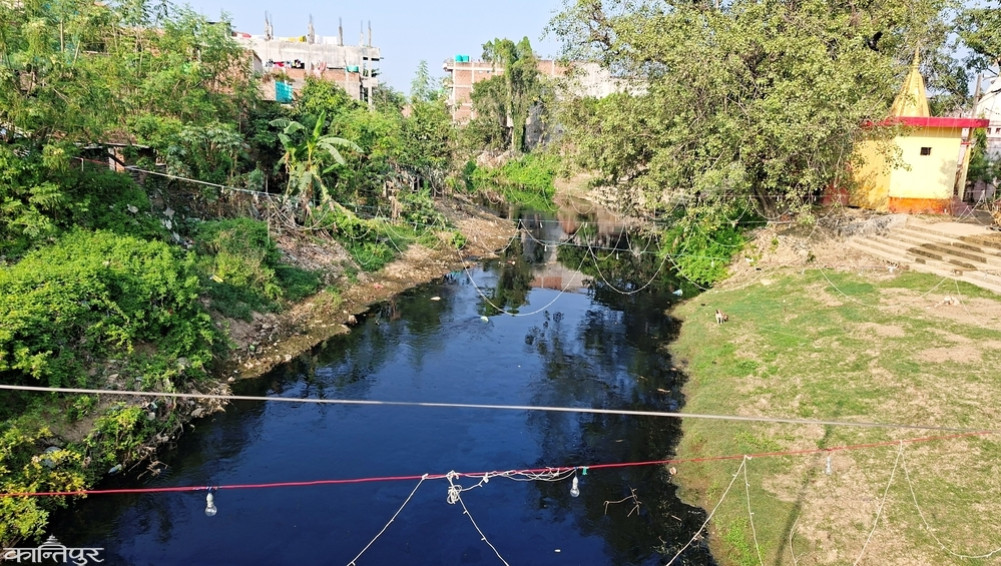
The river, which originates from Ramban in Simara, Bara, starts to become polluted after flowing for about 3 kilometers. By the time it reaches Birgunj, the water of the river turns completely black.
We use Google Cloud Translation Services. Google requires we provide the following disclaimer relating to use of this service:
This service may contain translations powered by Google. Google disclaims all warranties related to the translations, expressed or implied, including any warranties of accuracy, reliability, and any implied warranties of merchantability, fitness for a particular purpose, and noninfringement.
Locals are angry after the pollution of the Sirsia River in Birgunj did not decrease during the Chhath festival. The anger among the locals has increased as the industries of the Parsa-Bara Industrial Corridor are polluting the river in a way that plays with the religious beliefs of the people.
Brijeshwor Prasad Chaudhary, secretary of the Sirsia River and Birgunj Pollution-Free Campaign, accused the industries of the Parsa-Bara Industrial Corridor of being negligent in attacking the religious beliefs of the locals. ‘In previous years, when Chhath was approaching, the industries of the corridor used to stop dumping waste from their industries in the river a week in advance,’ he said, ‘but this year, it has gone too far.’
Social activist Prakash Tharu Chhath ghats are constructed in more than a dozen places in Parsa and Bara on the Sirsia River. He said that a large number of devotees and devotees arrive at those ghats. In this way, there is a tradition of devotees standing in the river themselves and offering arghya to the setting and rising sun. He said that allowing the river to be polluted in a way that even devotees suffer is an unforgivable crime.
The Sirsia River, which has been highly polluted for three decades, now has black water flowing in it. The water in the river is not fit for human and livestock use. Irrigation cannot even be done with the water in the river. It has become difficult to perform pujas and cremations in the river. The river, which originates from Ramban in Simara, Bara, starts becoming polluted after flowing for about 3 kilometers. By the time it reaches Birgunj, the water in the river turns completely black.
Ranjan Kumar Singh, chairman of the Ranighat Chhath Puja Management Committee in Birgunj, says that it is sad that the religious faith of millions of locals is being played with. He said that due to the pollution of the river, two artificial ponds have been constructed on the banks of the river this year for the devotees to perform religious rituals.
Instead of raising the issue of Sirsia pollution during Chhath every year, he believes that if the administration and local government dare to take strict action against the industrialists responsible for river pollution, this problem will end forever. A decade and a half ago, the Sirsia River Monitoring Committee, formed to find the source of pollution of the Sirsia River, had submitted its report to the then Chief District Officer Nagendra Jha and identified 48 sources. Of these sources, 46 industries in the Parsa-Bara Industrial Corridor, the remaining two were the waste dumped into the river by the Birgunj Metropolitan City Office, and an illegal brewery operating in the Birgunj Metropolitan Area were identified.
A large number of people celebrate Chhath festival in Sirsia River not only in Nepal but also in India. Pollution in this river, which enters India through Nepal, has also been causing problems for the residents of Raxaul and its surroundings in India.