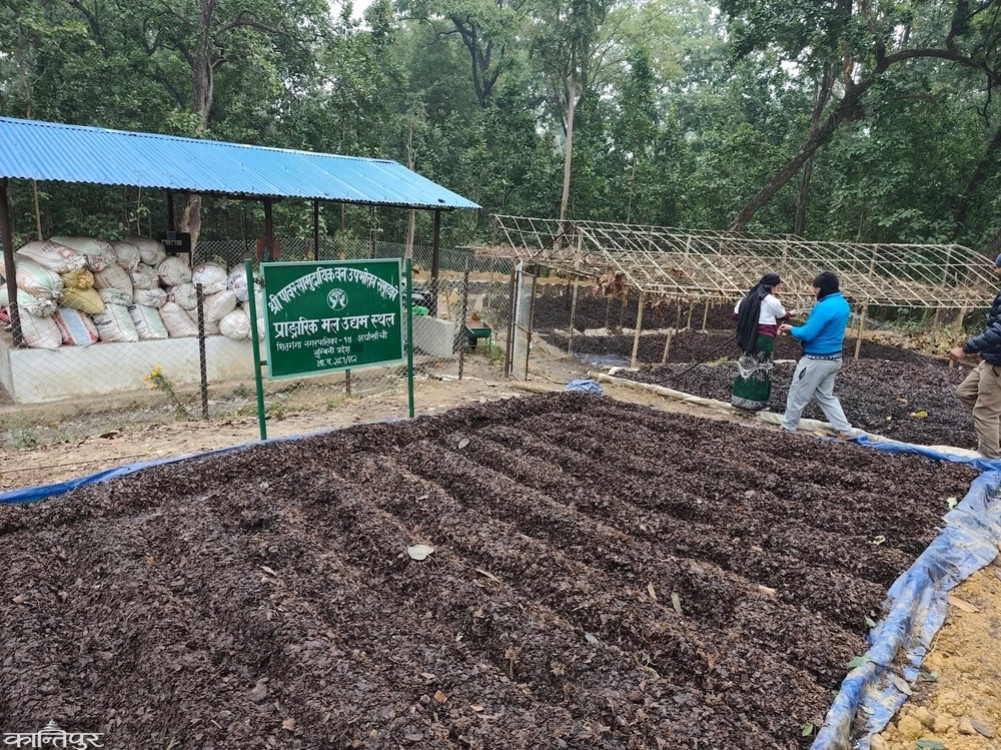
The use of chemical fertilizers has decreased after farmers in Shitaganga Municipality-14 started using organic fertilizer produced by collecting leaves from community forests.
We use Google Cloud Translation Services. Google requires we provide the following disclaimer relating to use of this service:
This service may contain translations powered by Google. Google disclaims all warranties related to the translations, expressed or implied, including any warranties of accuracy, reliability, and any implied warranties of merchantability, fitness for a particular purpose, and noninfringement.
Hari Bahadur Tandon of Shitaganga Municipality-14 Power Village used to use chemical fertilizers every year while producing rice seeds. He had to go to the markets of Kapilpastu and Butwal to find that fertilizer. He no longer buys chemical fertilizers. He uses organic and cow manure produced from leaf litter of the Power Community Forest. He cultivates rice in 15 kattha fields. He has no intention of buying chemical fertilizers in rice farming. ‘We should use organic manure from leaf litter in all fields, including seeds,’ he said. ‘If we used chemical fertilizers, we would have produced 30 bushels of rice. We hope that organic fertilizers will grow even better.’ The reason for this hope is that earlier, when used in vegetables and grain crops, the fruits looked good and the production increased. ‘Instead of the chemical fertilizers that I have been using in my fields for years, I now use fertilizer produced from this leaf litter,’ he said. ‘This fertilizer increases the fertility of the soil and improves the quality of the crops.’
He is also a consumer of the forest. He visits the forest every month to protect the forest. He has been involved in protecting the forest from fires in winter by building firelines, pruning, growing and increasing plants for many years. He loves community forests as much as private land.
Chura Karki of Power village has decided not to buy chemical fertilizers from now on. He is thinking of using manure and fertilizer made from leaf litter in his fields to produce grains and vegetables organically. He has 25 acres of land under his power. He produces 50 quintals of rice. He expects that organic fertilizers will increase rice production. ‘Organic fertilizers make the soil fertile, which improves farming,’ he said, ‘The land here is fertile. Moreover, grains and vegetables grown with organic fertilizers are sold at a high price.’ He said that consumers in the village have been advised not to use chemical fertilizers after using cowsheds and organic fertilizers.’ He said that the forest is also a strong basis for self-employment. He said that the goal is to make the village prosperous through agriculture and forestry enterprises by producing organic farming from fertilizer prepared from waste leaves. Karki, who is also the coordinator of the advisory committee of the Power Community Forest Consumer Group, now every household of the consumers has earned income by planting trees in the forest, cleaning bushes, pruning trees, and collecting leaves. ‘Our aim is to do organic farming, the produce of which can reach big cities,’ he said, ‘The goal is to make the village economically prosperous by organizing one agricultural enterprise and another forestry enterprise.’ We are trying to eliminate the compulsion to go abroad in search of employment.'
Although Power Village is remote from the district headquarters, it is near Kapilvastu's No. 4, Pipra. The produce here is easily exported to Kapilvastu and Butwal by rex, jeep, and truck. Milk, goats, pigs, and other livestock are raised.
Bir Bahadur Khamchaki of Power grows 18 muri paddy in a 7 ropani field. He does not grow much grain by applying chemical fertilizers. Last winter, he paid consumers a daily wage to collect leaves that fell on the ground in the forest. The leaves were collected in an empty space in the forest. The Division Forest Office provided a machine to crush the leaves. The same leaves were decomposed and tested to make organic fertilizer.
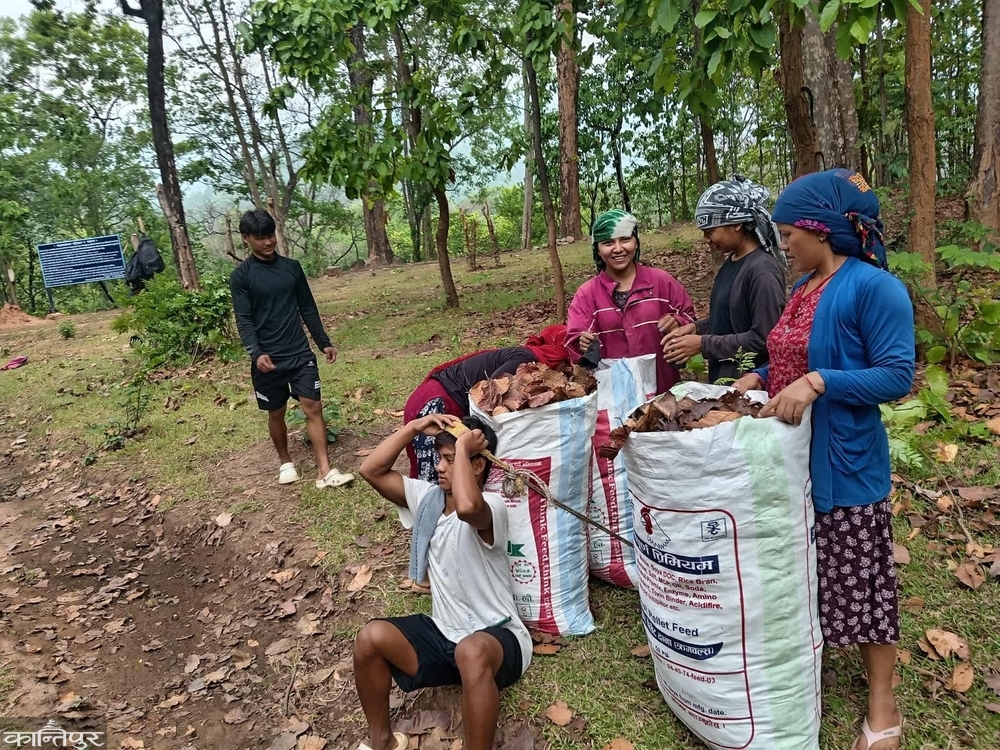
The users of Power, Buddha, Charpokhari, Deurali and Banganga community forests here had collected 33,000 kg of leaf litter throughout the winter. Organic fertilizer was made from the same leaves. Out of the 111 users, 50 of them kept the manure in their fields and produced grains, vegetables and plants. The area of the forest is 1,034 square meters. The forest users' group sold the prepared manure for Rs 25 per kg.
Even in the current winter, the users collected leaf litter that would otherwise be wasted in the forest. They receive Rs 700 daily from the forest group for raking leaves throughout the day. The test of producing fertilizer from leaves has been successful and the yield is good, so the demand for fertilizer is increasing. Khamchaki, who is also the chairman of the Power Community Forest Users' Group, said that the village will be made free from the use of chemical fertilizers. ‘Every year, the leaves that fell in the forest would be swept away by the rain,’ he said, ‘We have used the wasted leaves to make fertilizer. With this fertilizer, there is no need for chemical fertilizers.’
Consumers have cleaned the forest by collecting leaves throughout the winter. Due to which there was no fire. ‘The leaves were swept away and wasted,’ Khamchaki said, ‘Until now, attention had not been paid to it. The crops and vegetables produced from leaf fertilizer are organic.’ He said that Power Village would be made an introduction to the village that produces organic crops and vegetables. He said that all consumers in the village have been asked to put organic fertilizers in their fields. ‘Vegetables and food produced from urea fertilizer are not tasty to eat,’ said Loknath Khanal, a farmer from Power Village. ‘Due to the lack of young manpower, we were forced to buy chemical fertilizers in the market. Now that organic fertilizer is produced from the waste leaves, we will no longer buy urea fertilizer.'
He said that he will keep cow dung and organic fertilizer in the fields. He said that vegetables and food crops produced from leaf fertilizer can fetch a good price in the market. He expects that educated youth will join agricultural enterprises and become self-employed in the village as the demand is high. Khanal said that he has planned to make the village self-employed through agricultural production as there is a high demand for organic food and vegetables in the market.
He said that 5 tons of fertilizer have been produced so far and preparations are underway to produce 6 tons. A leaf shredder plant has been established inside the forest of Power Forest. The Division Forest Office had provided two machines to shred leaves. Keshar Khadka, the Information Officer of the Forest Office, said that one more machine will be provided this year.
Fertilizer is made from leaves under the forest management based on the conservation system. Under this management, consumers are earning income by producing, growing, pruning, and protecting trees by selling them. The leaves that fall on the ground in the forest are collected by shoveling them, putting them in bags and sacks, and then brought to the plant by the consumers. ‘Consumers have found employment by collecting leaves,’ said Khadka, ‘On the other hand, when the forest is clean and tidy, the risk of fire is reduced. Wild animals, insects, birds, herbs, and trees in the forest are all protected.’
This is how organic fertilizer is made from leaves.
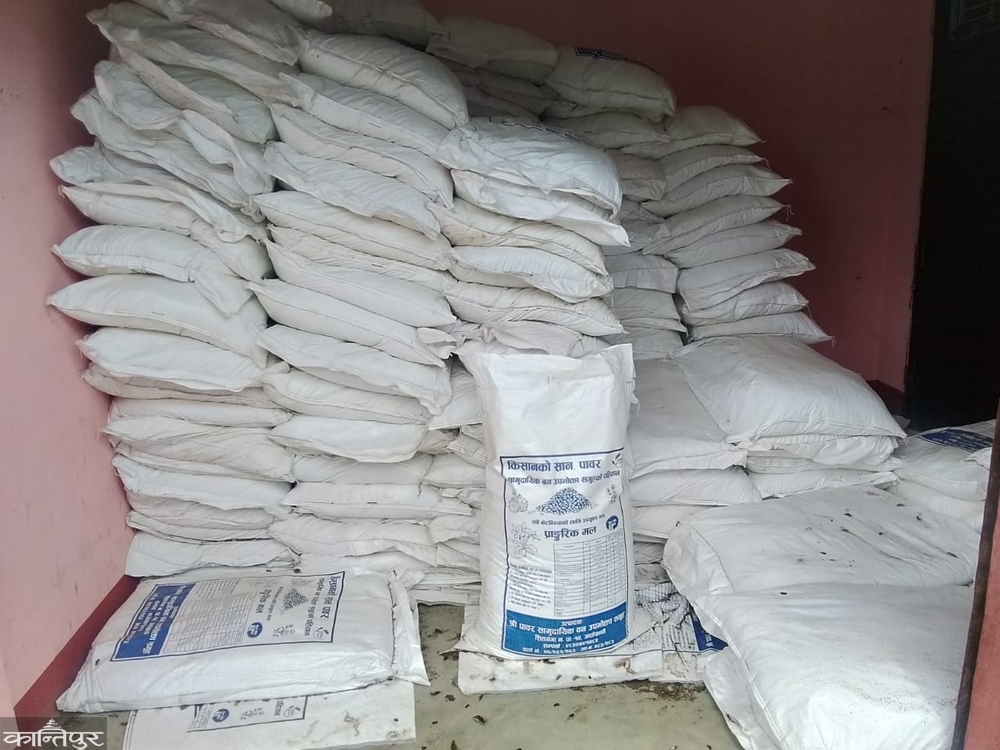
Leaves are collected in the forest and stored in the plant. After the leaves are ground into powder using a machine and decomposed in a pond for two weeks, they are separated by a grading machine, and then the fertilizer is ready to be used in the fields. That is what is called a fertilizer. Packaging or sacks are kept . Information Officer Khadka said that this fertilizer will double the production of vegetables and food crops when used in the fields, which will be fruitful for income generation .
After increasing the forest floor in this way, the risk of fire incidents during the summer season has decreased . Khadka said that by mobilizing a large number of manpower for environmental cleaning and collecting leaves, it is expected to provide economic benefits to consumers and open the door to self-discovery through organic vegetable and food crop production .
Arghakhanchi has a forest area of 63,207 hectares . Of which, the area of community forests is 34,342 hectares . There are 466 forest groups in the district. Among the 6 local levels of the district, Shitganga Municipality has the largest forest area of 47,364 hectares . Shitganga is the largest city in the country in terms of area . The smallest is Malarani Rural Municipality, which has 2,870.31 hectares.