It has resolved to expand the successful practices and creative programs implemented by the Congress-led local government across the province, to place citizens at the center of service delivery, and to reduce expenses by abolishing or adjusting unnecessary structures through structural reforms of the provincial government.
We use Google Cloud Translation Services. Google requires we provide the following disclaimer relating to use of this service:
This service may contain translations powered by Google. Google disclaims all warranties related to the translations, expressed or implied, including any warranties of accuracy, reliability, and any implied warranties of merchantability, fitness for a particular purpose, and noninfringement.
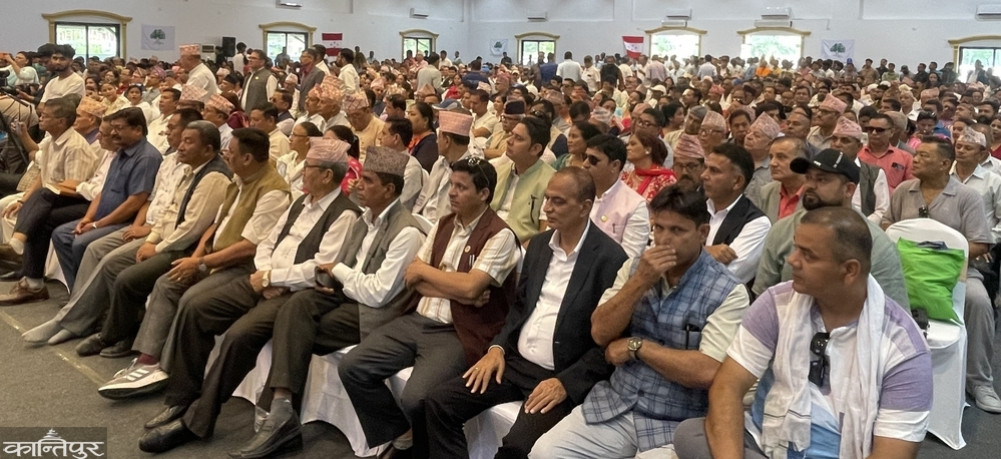
The Nepali Congress's two-day grassroots campaign in Butwal ended on Tuesday. The gathering passed the 28-point 'Lumbini Resolution'.
The Lumbini provincial-level consultation workshop organized by the Central Policy, Research and Training Institute of the Nepali Congress has also expressed objection to Prime Minister Balendra Sah's statement that Nepal has also encroached on Indian territory. The resolution passed through thematic discussions and interactions between the party's central, provincial, district and local level leadership has deemed Prime Minister Sah's statement made in the House of Representatives meeting on Jestha 17 as irresponsible, objectionable and against the national interest. The campaign has also concluded that the Prime Minister, the government and the ruling party should correct their statements and apologize through parliament.
The gathering has demanded that work be done to strengthen the citizen-oriented and accountable governance system, protect the civil rights, freedoms and fundamental rights guaranteed by the constitution, and create a sense of a responsible government. The resolution states that coordination between all three levels of government is necessary to complete the remaining work of the Lumbini Master Plan on time to develop Lumbini, the source of world peace and the birthplace of Buddha, as a major destination for Buddhists around the world. The federal government has been urged to make decisions only by keeping the spirit, methods, procedures and self-respect of the constitution in mind to strengthen the rule of law. The
gathering has decided to launch a campaign to build a squatter-free local level by giving priority to permanent solutions to the problems of unorganized settlements, landless Dalits and squatters. A commitment has also been expressed to immediately proceed with the process of distributing documents in areas where data collection and verification have been completed and to coordinate between the federal, provincial and local levels to relocate families living in risky areas to safe places.
A resolution has also been passed to expand the successful practices and creative programs of the Congress-led local government throughout the province, to keep the self-respect of citizens and procedural purity at the center of service delivery, and to reduce expenses by abolishing or adjusting unnecessary structures through structural reforms of the provincial government. It has been decided to implement the slogan 'Online, not online, service at home and in the courtyard' and provide services such as birth and death registration, health insurance registration and renewal through online means, and to effectively operate 'Ghar Dalan Service' for senior citizens, pregnant women, people with disabilities and chronic patients.
The governments at all three levels have been urged to implement the concept of a plan bank and prevent opaque and impulsive decisions made beyond the allocated resources and to adopt a policy of not investing in unproductive sectors. It has been stated that all local levels will present the budget by Asad 10, to mandatorily follow all seven stages of plan formulation, and to start the zero-waste local government building campaign.
Similarly, under agricultural modernization, the commitment has been made to implement the 'one local level, one specialized agricultural product' policy, ensure easy access to fertilizers, seeds and irrigation, operate agricultural ambulances and facilitate market access for farmers, emphasize pocket zone upgrading and branding of major products of the province such as rice, wheat, maize, oilseeds, fruits, vegetables and coffee, and provide tax concessions to industries based on indigenous crops, operate the 'Entrepreneur Mother Program' to connect women's traditional skills with entrepreneurship, develop the Rupandehi-Nawalparasi Industrial Corridor as a special economic zone, and make the Nepalgunj-Kohalpur and Bhairahawa-Butwal Industrial Corridors fully equipped with facilities.
With the aim of promoting the tourism sector as the main basis for the economic development of the province, the resolution also mentions developing a 'Buddha Circuit' connecting Lumbini, Ramgram, Devdaha, Tilaurakot and Ruru areas, promoting religious sites like Bageshwori, Thakurbaba and Swargadwari, and branding Tharu culture, Maghi festival, Lumbini festival and Ridi Mela as tourism.
A resolution has also been passed to develop adventure tourism, sports infrastructure, hiking, cycling and long-distance trekking routes in the hilly areas of the province, expand the tourism network from Marchwar to Putha Himal and develop the Chure area as a 'hill station tourism hub'. In terms of health, it has been decided to include all citizens in health insurance, run an integrated social security program 'from womb to grief', and organize school nurses, community nurses, digital health profiles, non-communicable disease testing, mental health counseling and public health fairs.
A commitment has been expressed to control the growing drug addiction among the youth and to take initiatives to extend free treatment of sickle cell anemia to all local levels in the affected areas. A resolution has also been passed to increase domestic investment in education, create curricula based on local language, art, culture and civilization, and develop a quality technical education system linked to skills, research and production.
According to Nepali Congress Province President Amar Singh Pun, the gathering has decided to intensify the campaign to connect the industrial areas of the province with road networks, upgrade the north-south corridor and directly connect the provincial capital with all districts of the province. He said that a commitment has been made to protect the language, culture and traditional professions of endangered and marginalized communities, to run special programs to end caste discrimination, child labor and gender violence, and to implement programs targeting conflict victims and martyrs.
‘A resolution has also been passed to launch the ‘Janmbhoomi Samunnati Special Campaign’ to connect the skills and experience of those who have returned from abroad with self-employment and entrepreneurship, to launch the Green City-Healthy City Campaign, to prioritize environment-friendly infrastructure development, to link waste management with energy and organic fertilizer production, and to make revenue growth, job creation, and forest conservation effective through scientific forest management,’ he said. ‘It has also been urged to strengthen coordination, cooperation, and coexistence between the federal, provincial, and local governments and to make the budget distribution system proportional and needs-based.’
He said that it has also been decided to form a regular coordination mechanism between the party and the government and hold monthly dialogues and to intensify the ‘Roots Campaign’ to strengthen the party organization. The two-day Roots Campaign gathering was attended by members of the federal parliament and provincial assemblies of Lumbini Province, the district coordination committee and local level chiefs and deputy chiefs, chairmen and vice-chairmen, as well as party officials from the center, province, district, region, and local levels.