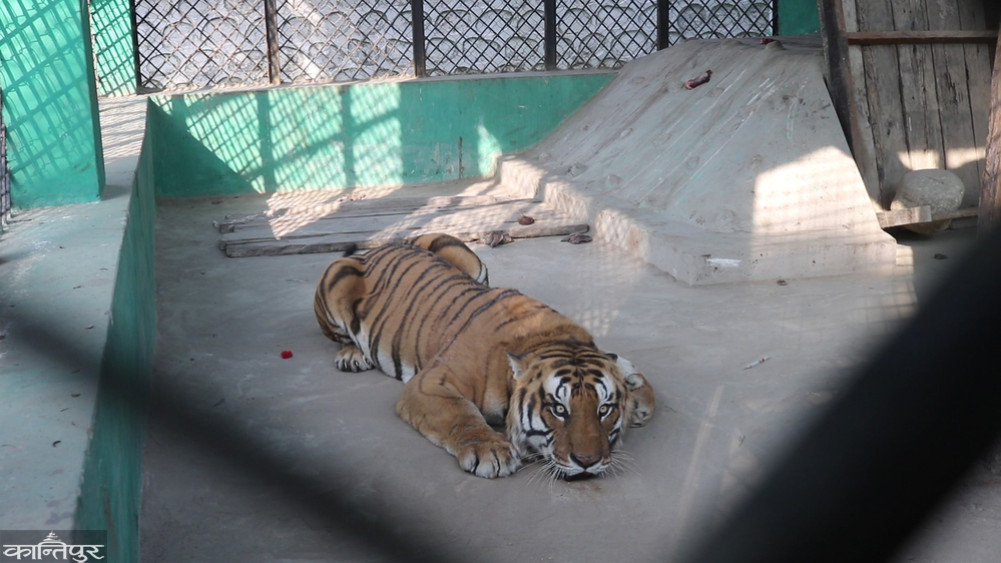
The park administration has said that a problematic tiger in captivity has been sentenced to life imprisonment. The public has been prohibited from entering the area because the adult tiger in captivity is very aggressive.
We use Google Cloud Translation Services. Google requires we provide the following disclaimer relating to use of this service:
This service may contain translations powered by Google. Google disclaims all warranties related to the translations, expressed or implied, including any warranties of accuracy, reliability, and any implied warranties of merchantability, fitness for a particular purpose, and noninfringement.
Five problematic tigers that have killed people at different times are living in captivity in a cage. The tigers, which were captured at different times over the past ten years, have been kept in a strong iron cage. The park administration has stated that the problematic tiger in captivity has been sentenced to life imprisonment. The adult tiger in captivity is very aggressive, and the public has been prohibited from entering the area around it.
The tiger in captivity screams, panics and becomes angry when it sees people. About 6 years ago, a 68-year-old Lahanu Tharu died when a tiger attacked a farmer from Geruwa Rural Municipality-4, Rajipur, who had gone to the bush in the buffer zone to graze cows and bulls.
The tiger was captured by a technical team of the Bardiya National Park and the National Trust for Nature Conservation. Trapping cameras were installed in Rajipur and surrounding areas to identify the tiger. The Division Forest Office, Bardiya, has a record of Ramdin Tharu, who went to graze buffaloes in the Kushmaniya Community Forest on Bhadra 26, 2079, being killed by a tiger.
The tiger has been identified and kept in a cage under control. Bardiya National Park has stated that 35 people have died in tiger attacks in the community forests under the Bardiya National Park, the buffer zone and the Division Forest Office since 2056.
The tiger was identified after being captured on camera, taken into control and kept in the wildlife detention center at the park's headquarters, Thakurdwara. 'The captive tiger is given 7 kg of cow meat as food for a day,' said Sarojmani Poudel, the park's information officer. 'A problematic tiger cannot be released into its natural habitat,' he said, 'it has to live in a cage for life.' Five problematic tigers, including two males, are being kept in the Bardiya National Park headquarters and two males and one female at the Rammapur post.’
As the park’s cages are full, the problematic tigers have to be sent to empty cages in other parks. Animal health workers are monitoring the tigers from afar to get regular information about their health. Ajit Tumpha Hamphe, head of the National Trust for Nature Conservation, said that if a tiger is suffering from a serious disease, it is tested by dot. He said that since dot cannot be done all the time, treatment is done only if it is a serious illness.
In the census conducted in 2018, 87 tigers were found in the Bardiya National Park. Currently, its number has increased to 125, according to the park. The results of the latest tiger census are expected to be released in the month of Shrawan. A troubled rhinoceros in Bardiya National Park has been kept in a cage for 16 years, while a leopard has been in captivity for a year.