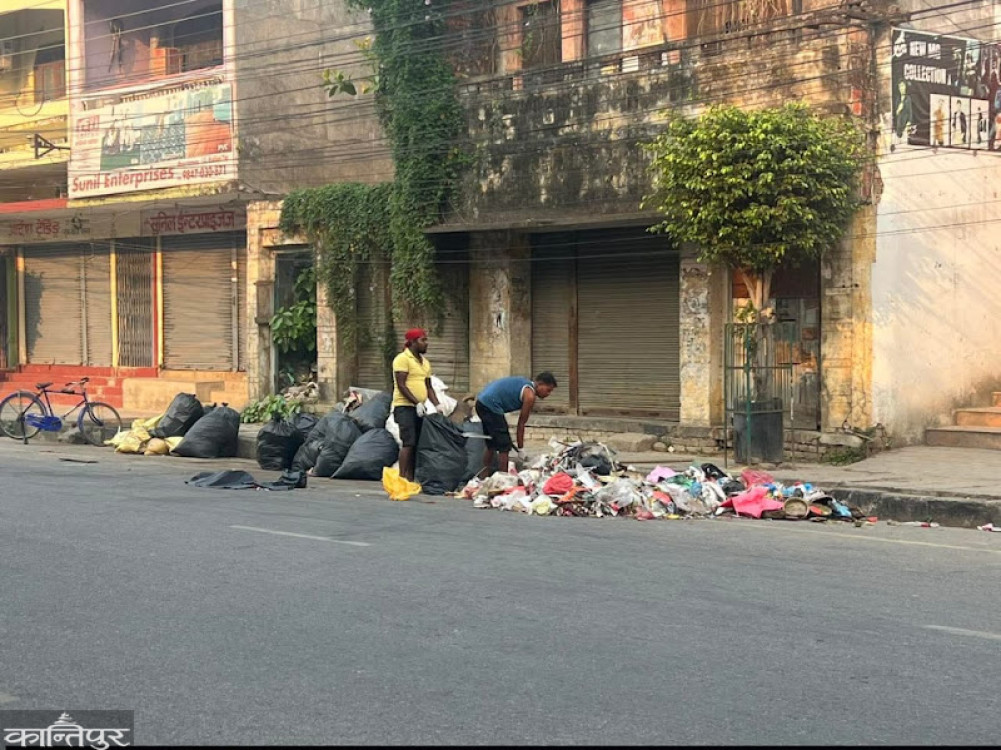
Chief Administrative Officer of Siddharthanagar Municipality, Janak Thapa, said that waste management in the city has become easier and more effective after the rules for waste classification were strictly implemented for two weeks.
We use Google Cloud Translation Services. Google requires we provide the following disclaimer relating to use of this service:
This service may contain translations powered by Google. Google disclaims all warranties related to the translations, expressed or implied, including any warranties of accuracy, reliability, and any implied warranties of merchantability, fitness for a particular purpose, and noninfringement.
After the rule to separate biodegradable and non-biodegradable waste has been imposed, waste management in Siddharthanagar has become effective. A month ago, Siddharthanagar Municipality made it mandatory to classify waste generated by every house, shop, commercial establishment and government agency at the relevant place. The municipality has implemented a provision that only classified waste will be collected by the municipality, unclassified waste will have to be managed by the relevant agency itself, and those who throw waste in public places will be punished with fines.
After the rule to classify waste has been strictly implemented for two weeks, waste management in the city has become easier and more effective, said Chief Administrative Officer of Siddharthanagar Municipality Janak Thapa.
He informed that 20 individuals and commercial firms who threw waste in public places in violation of the rule have been brought under the ambit of action. They have been fined between Rs. 5,000 and Rs. 50,000. The city had become ugly and smelly due to ineffective waste management in Siddharthanagar, which is the gateway to Lumbini and an important border with India. The city residents and travelers were suffering from the waste that was thrown indiscriminately in the city's main squares, roadsides, and public places. The city's residents and travelers were suffering from the waste that was thrown indiscriminately in Siddharthanagar, an important border directly connected to the international world. The rule to classify the waste in a critical condition at the source of the waste for immediate management has been made mandatory, Thapa said. The construction process of a waste processing center has been taken forward for a long-term solution to the problem. The municipality's objective is to inspire the city residents to grow vegetables and fruits by preparing compost at home using rotting waste. Biogas companies and commercial farmers are ready to take the non-rotting waste collected in the municipality.
According to the municipality, the collection of biodegradable waste from households in Siddharthanagar has decreased by 70 percent. The municipality has made a plan to collect biodegradable waste daily in all 13 wards of Siddharthanagar and at least once a week for non-biodegradable waste.
The municipality plans to collect non-biodegradable waste in a systematic manner at appropriate places and increase its income by selling it. In Siddharthanagar, which has about 16,000 households, 125 people are being deployed daily for waste management. The municipality claims that more than 30 million rupees are being spent on waste management annually.