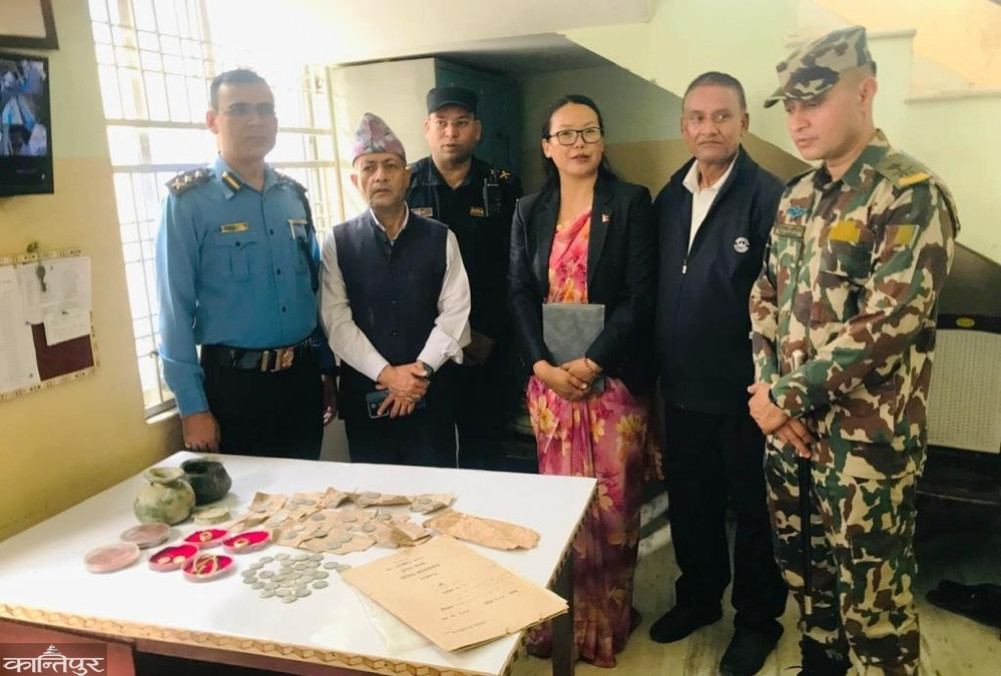
The safe contained 2 Asrafis, 1 royal ring, 1 beruwa ring, and 2 kadhas, all in a copper vessel. All of these are worth about 23 tolas of gold.
We use Google Cloud Translation Services. Google requires we provide the following disclaimer relating to use of this service:
This service may contain translations powered by Google. Google disclaims all warranties related to the translations, expressed or implied, including any warranties of accuracy, reliability, and any implied warranties of merchantability, fitness for a particular purpose, and noninfringement.
Historical and archaeologically important gold ornaments, Asrfi, kept at the police office for security during the armed conflict, have been returned to the Kapilvastu Museum. After 24 years, the police have handed over the jewellery of archaeological importance to the museum. The material, which was kept locked in an iron safe, was opened in the presence of Chief District Officer Janardan Gautam, Shamsher Dal Gana Chief Senan Bidurdhwaj Adhikari, District Branch President of the Nepali Journalists Federation Dilaram Bhusal, and museum employee Shankar Dhital.
After opening the safe and inspecting the collected materials, District Superintendent of Police Santosh Acharya handed it over to the head of the Kapilvastu Museum, Shanti Sherma. The safe contained 2 Asrfis, 1 Raj Authi, 1 Beruwa Authi, and 2 Kadhas kept in copper vessels. All these are worth about 23 tolas of gold.
Similarly, 34 silver coins dated from 1862 to 1920, inscribed with the names of British Queen Victoria, Edward VII and George V, were also in the safe. Similarly, 28 silver coins from the reign of Sultan Mohammad Mumtaz, which are about 500 years old, were in the safe.
The materials were found by farmers while digging fields in Suryawalia and Sohsa of Suddhodana Rural Municipality-1 Pataria (formerly Pataria Village Panchayat Ward 5) of the district before 2042. The local administration then took control of them and kept them in the Kapilvastu Museum.
The museum handed them over to the police on Chaitra 18, 2058. During the conflict, the safe remained safe even when the Maoists attacked the District Police Office on Chaitra 21, 2061. Due to security concerns, he said he was happy to be able to re-transfer gold and silver items of historical and archaeological importance by keeping them safe for 24 years.
These items that have come to the museum will be preserved according to archaeological values and kept in the museum for public viewing, said Shanti Sherma, head of the Kapilvastu Museum.