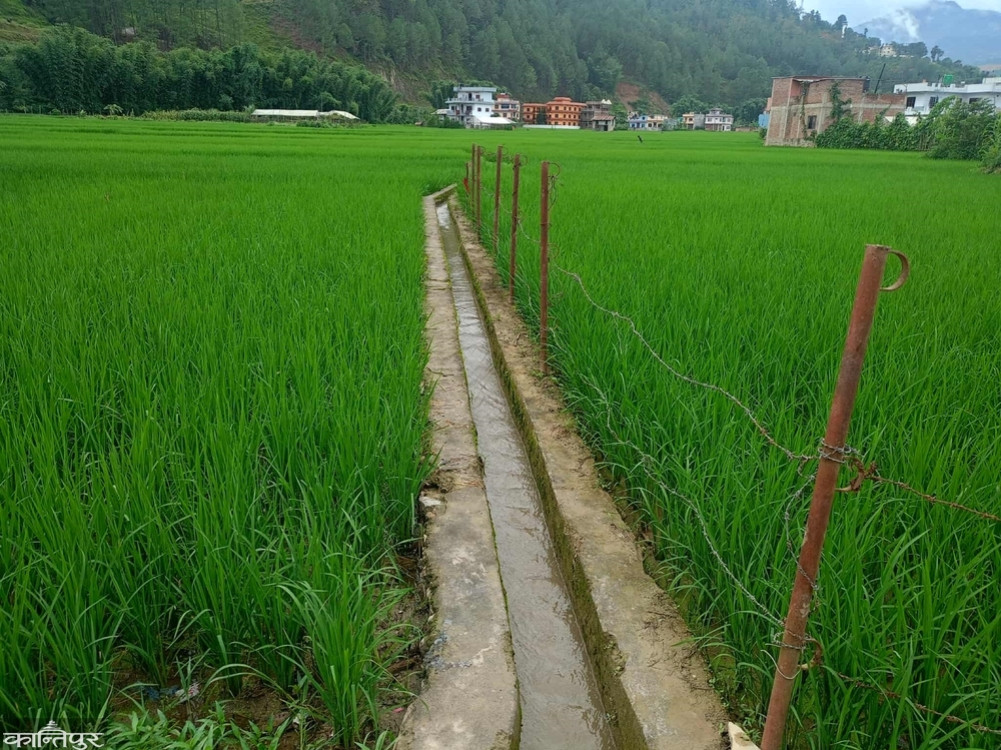
According to the Water Resources and Irrigation Development Division Office, 36.49% of the 8,544 hectares of irrigable land have been provided with irrigation facilities.
We use Google Cloud Translation Services. Google requires we provide the following disclaimer relating to use of this service:
This service may contain translations powered by Google. Google disclaims all warranties related to the translations, expressed or implied, including any warranties of accuracy, reliability, and any implied warranties of merchantability, fitness for a particular purpose, and noninfringement.
According to the objective of increasing the production of agriculture, fruits and vegetables by providing irrigation facilities in the fields, irrigation facilities have been provided in an area of 3 thousand 118 hectares in Arghakhanchi.
According to the Water Resources and Irrigation Development Division Office, 36.49 percent of the irrigable land in the district has 8,544 hectares of land.
Out of 26 thousand 130 hectares of arable land in the district, 21 thousand 247 hectares are being cultivated, said Engineer Bhesraj Bhusal, head of the office. He said that 3 thousand 180 hectares have been provided with irrigation facilities for twelve months and 5 thousand 426 hectares have seasonal irrigation facilities.
'During the rains, paddy crops have been irrigated,' he said, 'Winter crops, vegetables, fruits and spices have been irrigated throughout the winter. Lately, irrigation is reaching the agricultural farm.' According to Bhusal, there is no leakage of water even in the places where the fields are irrigated by removing the raw water from the water sources and fields.
'Our work is to deliver water to the fields through irrigation channels and pipes according to the demand of the farmers,' he said, 'The agriculture office looks at the increase in agricultural production. Where irrigation has reached, there is ease for the farmers, water consumption and production have also increased.
He also said that it takes years to complete large irrigation schemes started due to lack of budget. It took a decade to complete the Chauwatar Irrigation Project, which was used as a grain storehouse. Here, the number of farmers opening farms for harvesting rice on time, winter crops, seasonal and off-season vegetable production is increasing.
Out of the budget of 178 million 78 thousand rupees received in the financial year 2081/082, 15 crore 34 lakh 6 thousand rupees, i.e. 86.15 percent, have been spent and 97 percent of the material progress has been made by the office.
Out of 133 irrigation schemes started last year, 123 schemes have been completed and 2 schemes are ongoing (multi-year). 8 plans have not been implemented yet. According to the approved budget, Ramji Prasad Bhattarai, information officer of the
office, said that in the financial year 2081/082, the office plans to build 86 dams, construct 15.87 km of paved roads, build 4 ponds, expand irrigation facilities in 19 hectares, strengthen irrigation in 390 hectares, 1.01 km of embankment, 4.35 hectares of land, 37 houses and 61 hectares of land.