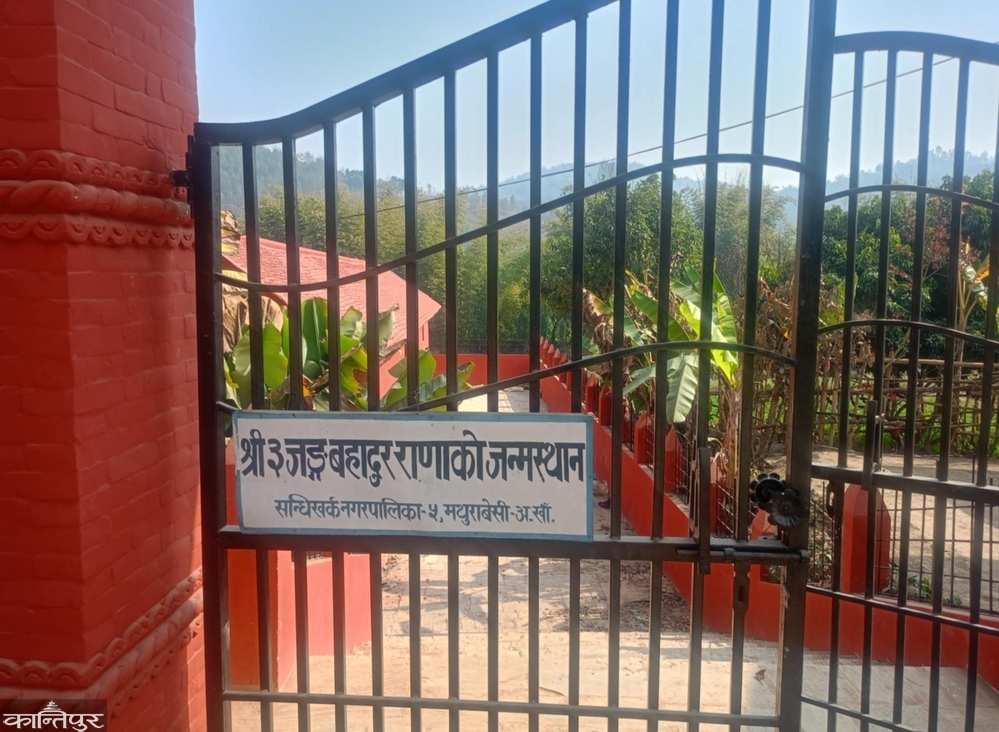
Cracked rooms, buildings that are about to collapse have been abandoned. Stones are laid on the ground. The palace has been made attractive by painting the roof and the building red.
We use Google Cloud Translation Services. Google requires we provide the following disclaimer relating to use of this service:
This service may contain translations powered by Google. Google disclaims all warranties related to the translations, expressed or implied, including any warranties of accuracy, reliability, and any implied warranties of merchantability, fitness for a particular purpose, and noninfringement.
Rana Prime Minister Jung Bahadur Rana's birthplace in Sandhikhark Municipality-5 Mathura, the historic Lampati Palace has been repaired and repainted. Cracked rooms, collapsing buildings have been toppled over and stones have been strewn across the floor.
In the palace, the places where the bricks fell from the mud of the building and the holes were left and the old and decayed structures like dalin, masi, tham, doors, windows have been replaced with new ones. The roofs and buildings are painted red to make them attractive.
Lampati Palace is one of the tourist destinations in Arghakhanchi. "Jang Bahadur's birthplace, Mathura Lampati Palace has been protected," said Krishna Prasad Shrestha, head of Sandhikhark Municipality, "Historical heritage should be made a tourist destination, more extensive publicity is needed." The artistically constructed Beeshkhutte Palace is considered new in Nepal. Even though a person was appointed to oversee the palace till the Rana reign, there was no such arrangement after democracy. Recently, Shrestha informed that the local and Lumbini provincial governments have started protecting the palace.
Rana's history
According to Pitambar Sharma, former head of the Local and District Development Committee (JIVIS) of Wangla, Jung Bahadur's father, Balnar Singh, was an army officer, who was employed in the ammunition depot of Pyuthan. V.No. In the 1860s, he was transferred to Jumla to settle a Guthi land dispute in the Sinja province of Jumla. He went to Jumla with his wife Ganesh Kumari. While staying there, Ganesh Kumari became pregnant.
At that time, pregnant women used to go to Maita. While going to Gorkha, Ganesh Kumari fell ill in the forest of Mathura and Jang Bahadur was born in Mathura on 5th June 1874. The locals of Mathura's Pandey caste took good care of them and made them to the village of Balkot on the other side in Choupari. A Brahmin of the Khanal caste of Balkot was given the name Veerana Singh Kunwar when he was ritually baptized. It is said that he later changed his name to Jung Bahadur as he was of Jungian nature. Sanskrit scholar Rajendra Kumar Acharya said that after the birth of his mother Darili, she took her son through Ridi, Syangja, Pokhara, Lamjung Besishahar and reached Maitighar Gorkha.
Jung Bahadur suddenly became powerful in the politics and governance of Nepal. During the reign of King Rajendra Vikram Shah, he caused an internal rebellion within the palace and made Crown Prince Surendra ascend the throne and made himself extremely powerful by abandoning various policies. He was the eldest of seven children born to his father Balnar Singh and mother Ganesh Kumari.
 vs. From October 2, 1903 to July 17, 1913, he became the eighth Prime Minister of Nepal. Later, he built Balkot Chowpari where his mother lived, Darshandhunga in Pokhara, Ranipokhari Pauwa in Bensisah in Lamjung, and Beeshkhutte Palace in Mathurabensi. Sanskritist Acharya mentioned that all these palaces and palaces are artistic and built in the same design.
Kathmandu, Lalitpur, Panauti and other places he built palaces and palaces. Mathura belongs to Sandhikhark Municipality and Balkot Chhatradeo Rural Municipality-2 with Nawaran. After the first Rana became the Prime Minister, he sent his Jethan Sahansingh Colonel to Mathura and built Beeshkhutte Palace in Lampati. Near the palace is a religious area called Mathuradham, where Lord Krishna is believed to have performed a ballalila during the Dwapara Yuga. Yogi Naraharinath established Kotihome in Mathura and increased the importance of that place. Gopeshwar Peeth is located near the palace. V.No. In 2043, Yogi Narharinath increased the religious importance by establishing the 16th Kotihome.
According to Rishabh Adhikari, Ward President of Sandhikhark Municipality-5, this area has been preserved with the aim of making it a place where future generations can study history. Recently politicians and academic personalities have started visiting there.
Jung Bahadur became famous for wrestling, shooting, playing tunes, riding horses and catching an elephant while hunting with King Rajendra Vikram Shah. V.S. of Jang Bahadur, who played a role in establishing governance in his own dynasty by declaring 'Shri 3 Maharaj' by quelling the power of Bhardar and King Rajendra, who was considered powerful at that time. He died in 1934. In his time V. no. Handwritten censuses were taken in 1910, 1911 and 1913. At that time, the population details of 33 districts including Bhaktapur, Patan, Kathmandu were collected. According to
ward member Krishna Bhusal, since Jung Bahadur has an important historical background, it should be developed as a study and tourist destination for future generations. He also said that the local level and the Lumbini state government have shown interest in recent times.
There is a history of King Mahendra spending the night in that palace during his visit. Although there is a large pond and land around the palace, the locals said that the pond has been buried and the land has been lost.

