We use Google Cloud Translation Services. Google requires we provide the following disclaimer relating to use of this service:
This service may contain translations powered by Google. Google disclaims all warranties related to the translations, expressed or implied, including any warranties of accuracy, reliability, and any implied warranties of merchantability, fitness for a particular purpose, and noninfringement.
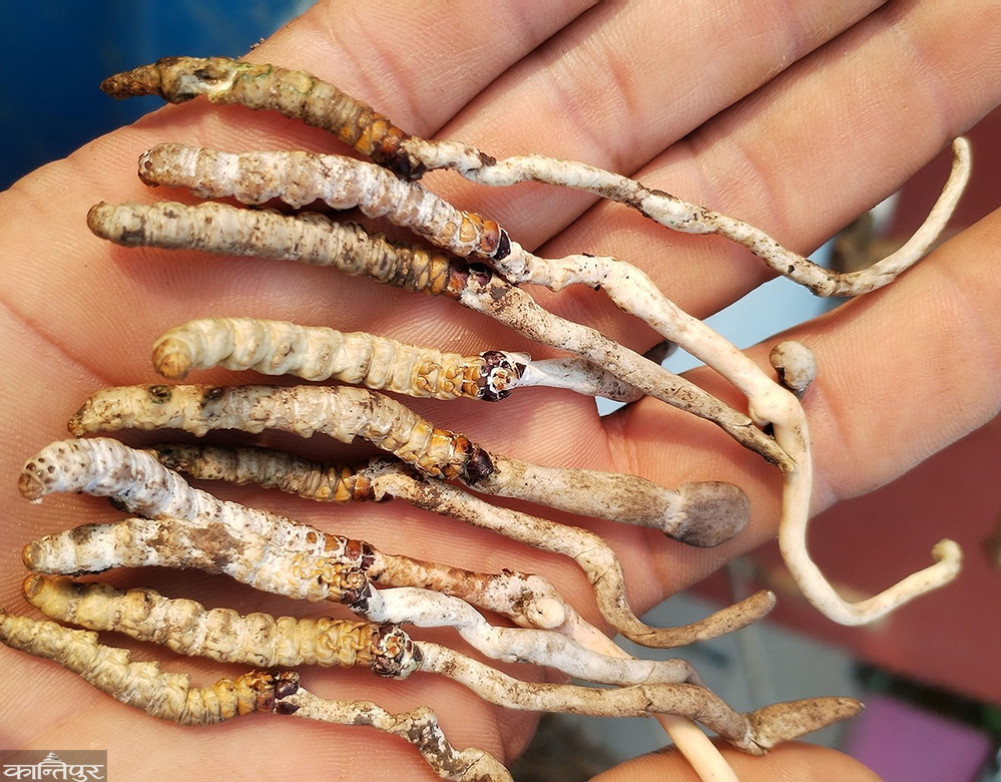
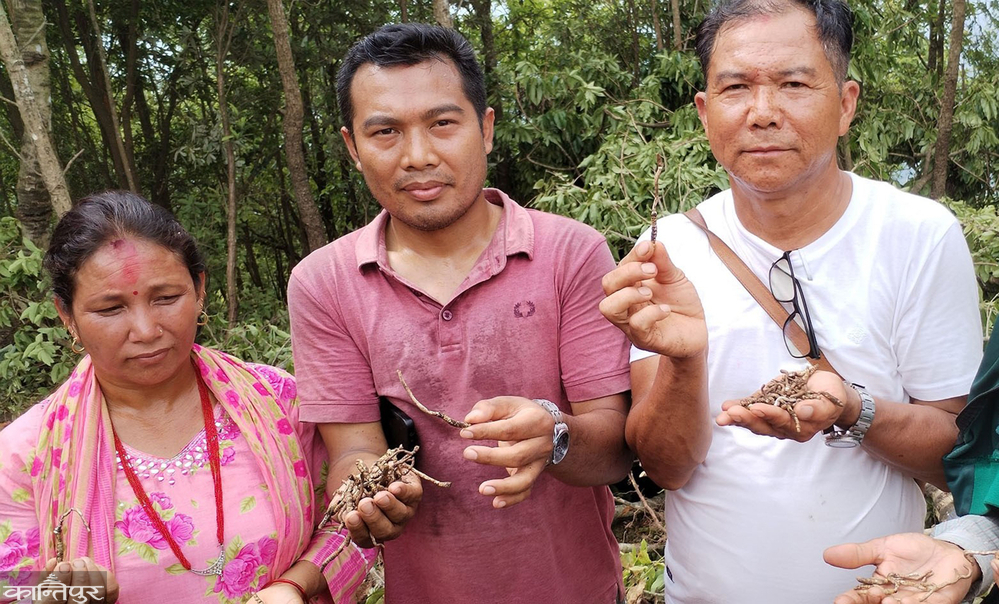
After finding an object that looks like Yarchagumba in Rimigha Danda (Lake) of Palpa, the rural municipality has started the investigation. Rambha Rural Municipality-3, Pipaldanda's Rimigha Pospakha Community Forest Area, Kholsi and Chisyan areas, after finding a plant of a species similar to Yarchagumba, prepared to send it to the laboratory.
According to village chairman Bishnu Prasad Bhandari, they were found while digging a hole while cleaning the bushes in Rimigha Lake and preparing to plant orange seedlings in the community forest area. "Initially there were a couple of species of plants that looked like yarchs and the lower part looked like insects," he said. He said that now the locals will be banned from collecting and even going to the forest.
Division Forest Office will immediately depute forest staff to collect and send the facts to the National Forensic Science Laboratory Khumaltar, Lalitpur, Divisional Forest Chief Narayandev Bhattarai informed. What if he didn't send it to the lab ? said that it cannot be known officially. "It looks the same, I also looked at the photo," he said, "but it is impossible to say what is official without the laboratory report." Rimighia Lake is at an altitude of 1,800 meters.
In the winter, after the insect dies, in three months, the tree grows in the snow. All three are called Yarchagumba . A unique biological species that is formed by the combination of worms (larvae of a fly) and aphids (mushrooms). "It looks the same," Division Forest Officer Bhattarai said, "We will know only after sending it to the laboratory. We cannot say what it is now." He said that it is not possible to say what it is because there are hundreds of species.
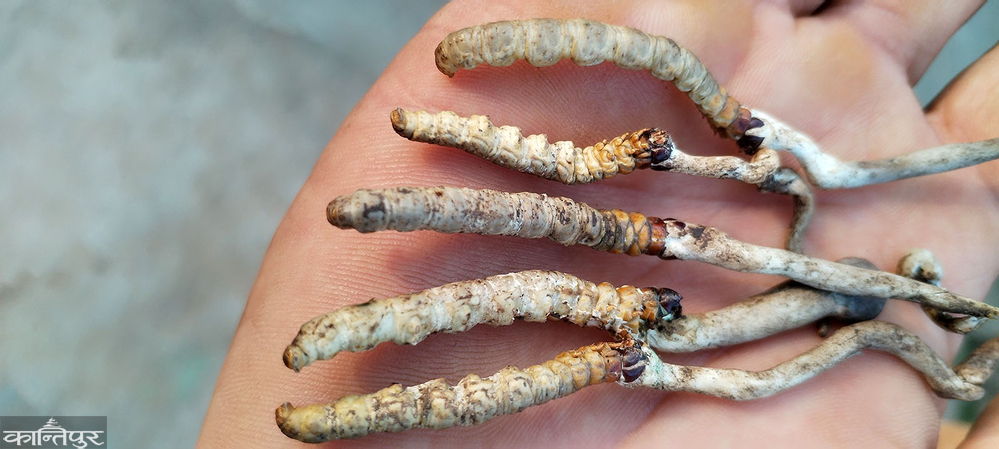
Yarcha is also available from May to June. According to experts, Yarchagumba is found at an altitude of more than 3000 meters. After the end of winter in the Himalayas, the snow melts around April and the plants grow and start blooming. At the same time the butterflies begin to flower . The caterpillar in the larval stage of the same butterfly reaches the ground . Its above-ground part has gray color and below-ground part is yellow.
The underground part of the yarcha is 4 mm thick and 4 cm long. The upper part is thin and about 5-6 cm long . According to Ravin Maharjan, employment coordinator of Rambha Rural Municipality and a student of Forestry and Environment, although the species are similar in height and have the same size and color as Yarcha, preparations are being made to send them for research.