We use Google Cloud Translation Services. Google requires we provide the following disclaimer relating to use of this service:
This service may contain translations powered by Google. Google disclaims all warranties related to the translations, expressed or implied, including any warranties of accuracy, reliability, and any implied warranties of merchantability, fitness for a particular purpose, and noninfringement.
A woman died due to the attack of wild animals in Banke on Wednesday 9th January. 67-year-old Cheti Budhathoki of Raptisonari rural municipality-8 Ovari died. It is not yet clear whether the attack was caused by a tiger or any other wild animal.
Recently, the rate of tiger attacks on people is increasing in various protected areas and settlements near forests. After the increase in the attacks of wild animals, the monitoring of wild animals of the tiger food species in the areas around the forest has been started from Tuesday.
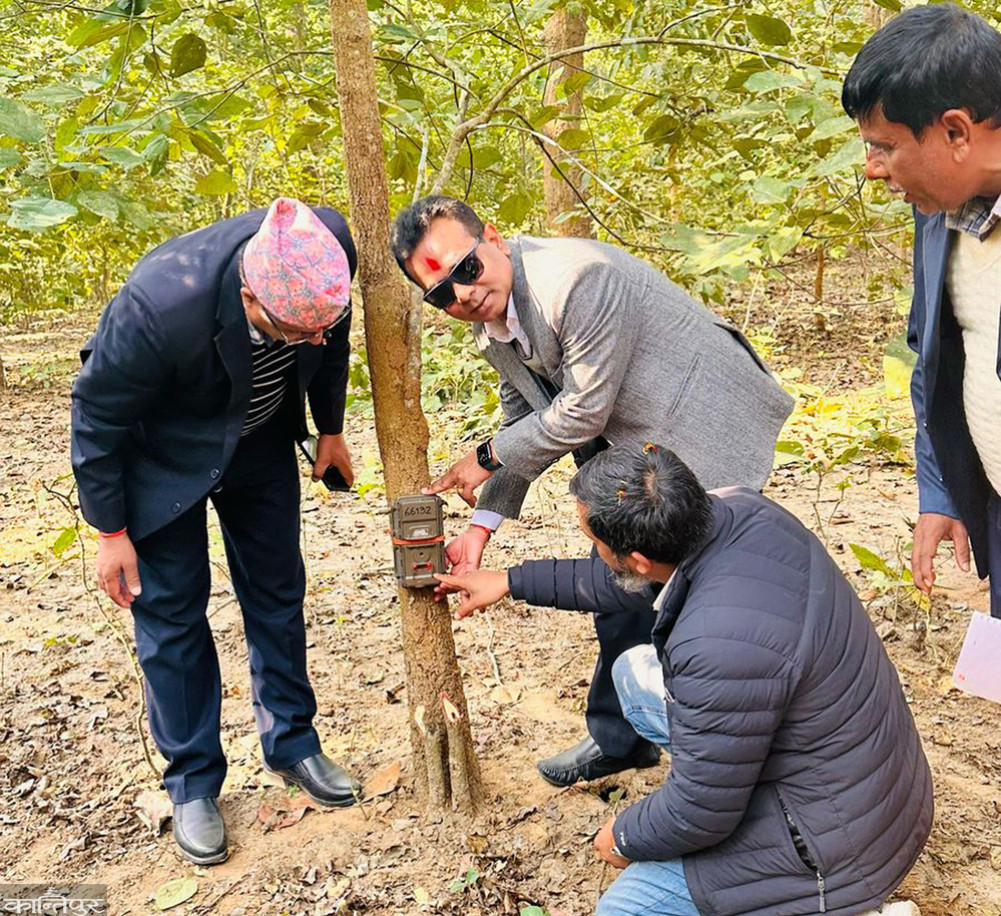
Division Forest Office Banke Project and facilitation of Banke National Park and with the technical support of ZSL reached Kamdi Biologi Marg in Raptisonari Rural Municipality-3 Baisa and inaugurated it on Tuesday by Mohanraj Kaf, Secretary of Ministry of Forest and Environment, Lumbini Province.
According to Senior Forest Divisional Officer Shankar Prasad Gupta, what is the number of tigers especially in that place? What is the density of tigers? This is a study to find out. Not only tigers, but also how many food species are there? The subject is also studied. By
camera trapping method, pictures are collected by placing an automatic camera on the tiger's path. For this, a fixed grid is made and the camera is placed within it by finding a place that has more traffic.
According to Sanjay Kandel, program officer of ZSL, camera trapping helps to find out whether a tiger has roamed in that area or not. In particular, the biological route is more important than keeping the wild animals themselves, so it shows where the tigers and other wild animals have migrated from.
'The study of food species gives information on how many tigers can move in that area in the future,' he said, 'Even when tigers live, they need food. As one of the major factors that determine the number of tigers is food species, food is also included in the monitoring.
Currently, automatic cameras have been installed in 95 grades in the Kamdi corridor and around 35,000 hectares of land to monitor tigers and food species. The camera is kept for 15 days from the date of installation.