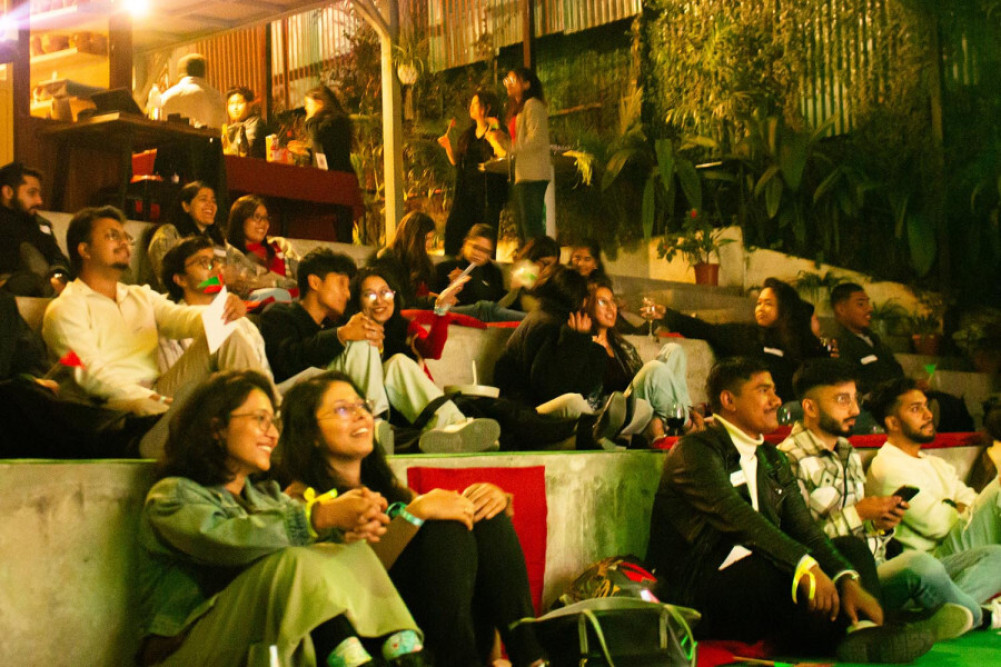
Dating culture in Nepal was often limited to family acquaintances or a circle of friends. Despite the recent increase in the use of dating apps, ‘mixers’ have re-established the importance of physical presence.
We use Google Cloud Translation Services. Google requires we provide the following disclaimer relating to use of this service:
This service may contain translations powered by Google. Google disclaims all warranties related to the translations, expressed or implied, including any warranties of accuracy, reliability, and any implied warranties of merchantability, fitness for a particular purpose, and noninfringement.
In the hustle and bustle of daily life and sometimes loneliness, a new style of socialization has entered the urban life of Kathmandu – ‘dating mixers’.
People are now starting to participate in such gatherings, where they seek direct communication, new relationships and love. This is challenging the traditional understanding of dating culture.
Such ‘mixers’, which are becoming a vehicle for cultural transformation, create an environment for easy and spontaneous conversation between people. Going beyond the traditional idea of finding a friend, such gatherings are breaking the boundaries of class, caste and culture and seeking a new definition of intimacy.
For 29-year-old Biraj Vijay Ojha, this experience was very interesting. He was stunned when his friend recommended his name at a gathering of the ‘queer’ community in Kathmandu. The friend had prepared a detailed PowerPoint presentation about him and introduced him. Ojha says, ‘Initially, I was very nervous, this experience was new to me.’
‘Pitch a Friend- Queer Edition’ was organized on April 3 in partnership with ‘Queer Honky Tonk’ and ‘The Guest List’. It was probably the first such event in Nepal, where participants arrived with their friends and when they returned, they had a new possibility of love in their hands.
Ojha himself was also looking for a partner. However, since the queer community was small, most of the faces there were familiar. He says, ‘I wanted to meet new people, but since the circle was small, most of them were acquaintances.’ Nevertheless, the experience was pleasant because such events have given the queer community a place outside of ‘Pride Month’.’
At a time when human relationships are becoming distant in the urban rush, such community spaces have become important for connecting people. Not only for dating, but also for friendship, communication and peace of mind. According to Ojha, although dating is a priority, its main purpose is for people from the community to come together and have fun.
According to Samiksha Gurung, co-founder of ‘The Guest List’, their aim is not only to match people up. She says, ‘We want to create a safe and intimate place for everyone, where people can talk openly.’ Their organization has been organizing programs like ‘Social Party’, ‘Intentional Dating’ and ‘Speed Dating’.
Safety is the biggest priority in such programs. During the registration process, pairs are decided based on the interests, age group and preferences of the participants. According to Shubhi Bhattarai, founder of ‘Queer Honky Tonk’, planning such events takes a lot of effort. ‘We have to strike a balance between the interests of the participants and the management. We only feel successful when people come and praise us after the event,’ she says.
Dating culture in Nepal was mostly limited to family acquaintances or a circle of friends. Despite the recent increase in the use of dating apps, ‘mixers’ have re-established the importance of physical presence. ‘It is surprising and positive for us that people from different generations are actively coming to such events to find a life partner.’
However, some questions have also been raised about the accessibility of such events. Ojha understands that such gatherings are limited to a certain educated and urban class and their language and style may not be comfortable for everyone. “Sometimes these events feel a bit too ‘urban’,” he says.
‘The Social Club Nepal’, founded in January 2026, is also emphasizing the need for physical socialization. According to the club’s founder, Tulip Shrestha, five couples who connected through their program are still in relationships.
Sumit Man Shrestha, 24, recounted his experience attending a program called ‘Date-Is.’ Describing himself as an extrovert, he says, “I didn’t think people would come to such social events in Nepal, but there was a very good turnout. Even introverts were chatting openly there.”
He recounted his experience on a ‘blind date,’ saying, “I was sitting next to a shy girl.” She said she was very scared at first, but gradually we both exchanged our hearts with each other and the meeting was very fruitful.’
Amid the ‘catfishing’ (false identity) and security risks of dating apps, such face-to-face meetings provide transparency and real human energy. In a busy city like Kathmandu where people are falling prey to loneliness, such ‘mixers’ are working to get people out of their mobile screens and into the real world.
People of different backgrounds, identities and ages, who are ready to meet, get to know and be seen by each other, are starting a new and healthy dimension of dating in Nepali society.